A hummingbird holds its position beside a flower; a swift sweeps through open air. Their contrasting flight styles belong to related birds. Between those familiar silhouettes lies an evolutionary question: what did a wing look like before it acquired either extreme? A small Eocene fossil, Eocypselus rowei, preserves feathers that help answer it.[1]
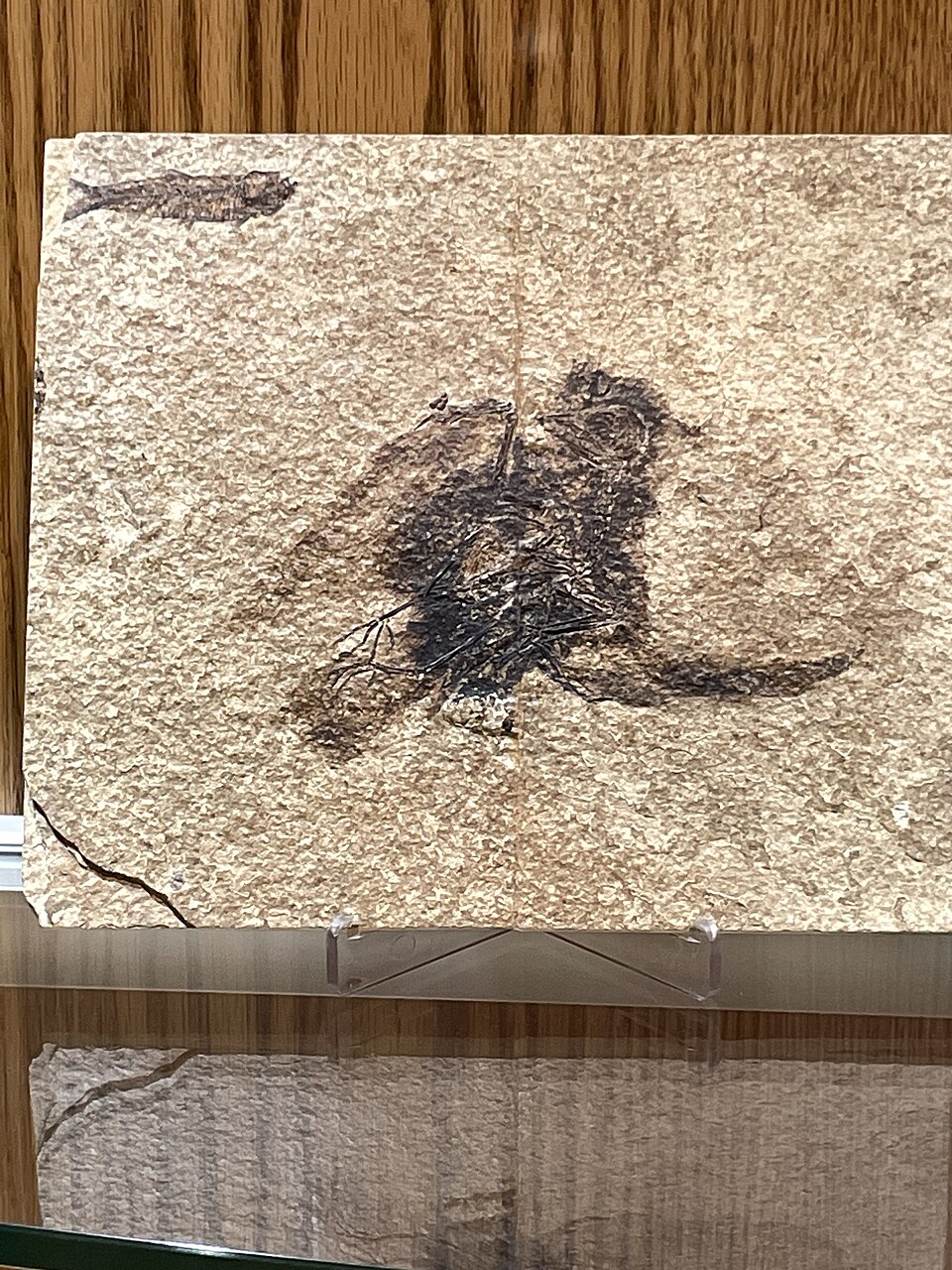
The lake kept more than bones
Around 52 million years ago, a large freshwater lake occupied part of what is now southwestern Wyoming. Its deposits preserve an unusually broad sample of life: fishes dominate, but birds, bats, insects and plants also entered the record. The National Park Service describes a lake bottom where oxygen scarcity and saline water discouraged scavengers, while microbial mats helped hold remains together. That setting matters because an articulated skeleton and its surrounding soft tissues require more protection than scattered bones do.[2]
The E. rowei specimen, WDC-CGR-109, came from the Fossil Butte Member of the Green River Formation. Daniel Ksepka and colleagues described it in 2013. Skeleton and plumage survive across a slab and counterslab, although splitting broke bones and some limb impressions had been retouched with paint. Microscopic feather structures supported the plumage's authenticity.[1]
Those qualifications belong beside the beautiful outline. Preservation gives access to particular features; preparation can complicate others. A fossil's evidential strength depends on which question we ask of it.
Follow the feathers beyond the hand
The preserved wing falls between the short wings of hummingbirds and the greatly elongated wings of living swifts. The researchers found neither group's specialized configuration. This supplies a constraint that arm bones alone cannot: feathers extend the aerodynamic surface beyond the skeleton. The bird was also small, supporting their inference that reduced body size preceded the later flight specializations.[1]
That sequence changes the evolutionary story. Smallness need not arrive as part of a finished hovering apparatus. Traits can appear at different points in a lineage, then acquire new functional relationships as other structures change. A tiny bird in the right part of the family tree becomes informative precisely because it lacks the complete package we recognize today.
A branch whose attachment still matters
The placement of Eocypselus determines how far that argument travels. A “stem” relative branches outside the group defined by living members and their most recent common ancestor. It can preserve clues to earlier anatomy without being the direct ancestor of any living species.
Albert Chen and colleagues exposed a complication in 2019. One analysis used relationships inferred from living birds' DNA to constrain the tree, then placed fossils using anatomy. It recovered Eocypselus beside the group containing swifts and hummingbirds. An alternative analysis combined molecular and anatomical evidence simultaneously and placed it on the owlet-nightjar stem instead. Support for that second placement was substantially weaker; the authors were hesitant to accept it.[3]
This was a disagreement about how to connect the fossil to other birds. Its feathers remained the same. The uncertainty affects which ancestral condition those feathers can help reconstruct, and the researchers cautioned against using the weaker placement to date the owlet-nightjar lineage.[3]
The practical distinction is between observing a structure and assigning it a historical role. We can compare a preserved wing with living wings even while testing where its owner belongs. Calling the specimen a known common ancestor would conceal that second task.
Europe adds neighbors to the tree
In 2024, Gerald Mayr and Andrew Kitchener described additional Eocypselus material from England's London Clay, including three new species. Their account retained the interpretation of eocypselids as stem apodiforms, outside the living swift–treeswift–hummingbird radiation. The genus was becoming a more varied collection of early birds, with more anatomy available for comparison.[4]
The same study offered an ecological contrast. Long legs and other features suggested that Eocypselus could have caught insects by launching from perches along forest edges. Another early bird, Primapus, had arm anatomy consistent with a more aerial, fast-flying existence. These are functional interpretations of skeletons, rather than preserved feeding events.[4]
The English fossils date to roughly 55 million years ago, older than the Wyoming specimen. They place different ways of using the air alongside one another early in this history. The fossil record samples neighboring branches and overlapping experiments, making a single-file procession toward modern flight an inadequate picture.[4]
That is what gives the feathered Wyoming bird its lasting interest. It makes an evolutionary comparison physically possible: a small body, an actual wing outline, and a set of relationships that can be challenged with more specimens. The outline is unusually tangible. The history built around it remains a testable explanation.
Sources
- Ksepka, Clarke, Nesbitt, Kulp and Grande, “Fossil evidence of wing shape in a stem relative of swifts and hummingbirds (Aves, Pan-Apodiformes).” Proceedings of the Royal Society B (2013) — specimen, preservation, wing shape and evolutionary interpretation.
- National Park Service, “Fossils,” Fossil Butte National Monument — the lake ecosystem and conditions associated with exceptional preservation.
- Chen, White, Benson, Braun and Field, “Total-Evidence Framework Reveals Complex Morphological Evolution in Nightbirds (Strisores).” Diversity (2019), University of Bath repository — alternative analyses and uncertainty in Eocypselus placement, especially section 4.2.
- Mayr and Kitchener, “New fossils of Eocypselus and Primapus from the British London Clay reveal a high taxonomic and ecological diversity of early Eocene swift-like apodiform birds.” Ibis (2024) — new species, relationships and inferred ecology.
- CryolophosaurusEllioti, “WDC - Eocypselus rowei holotype,” photographed June 12, 2023. Wikimedia Commons, CC BY 4.0 — original specimen photograph and attribution.