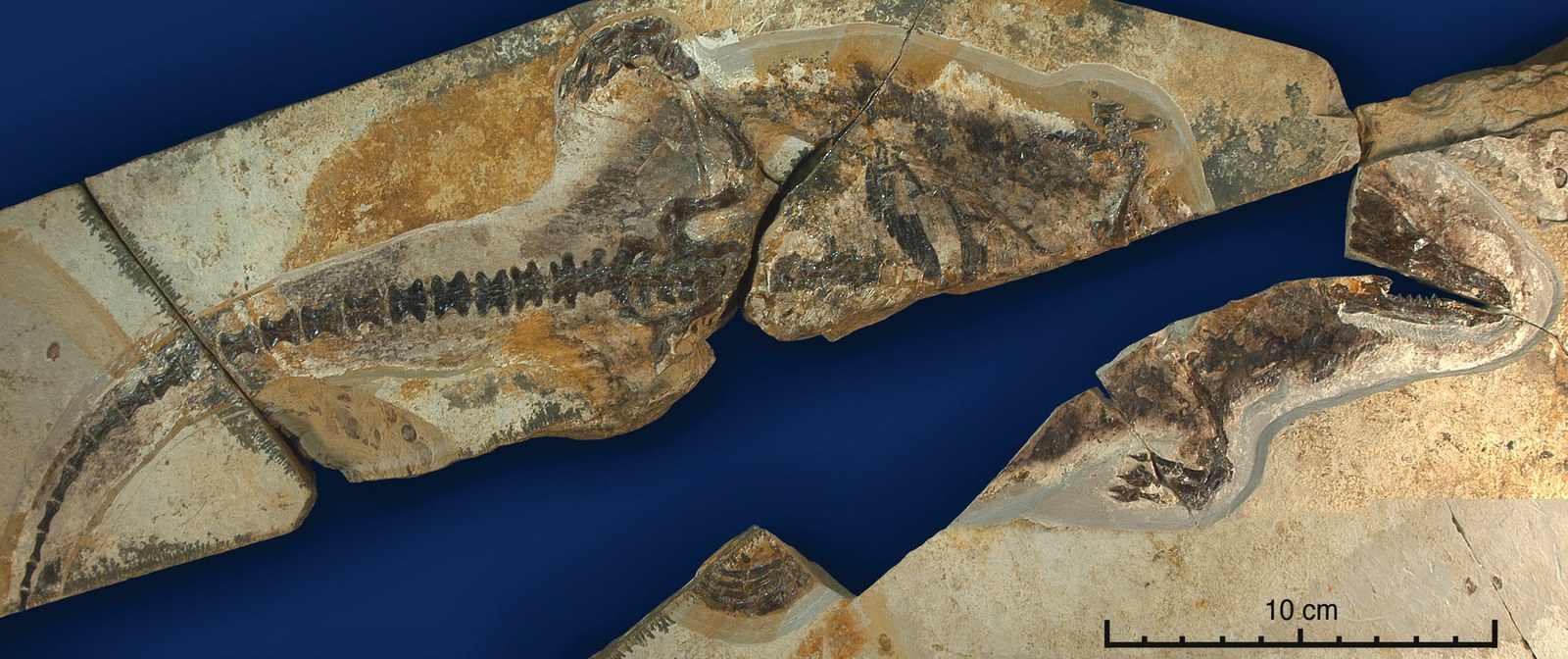
At first glance, JZMP 04-117 is a dark animal-shaped interruption in pale stone. The skull is incomplete. Ribs have shifted. Limbs overlap the body, and a long chain of tail vertebrae runs toward the slab's edge. Yet a shadow still follows the skeleton: impressions of guard hairs, carbonized underfur, scales, and soft tissue extend beyond the bones.[1]
This is the holotype—the specimen on which Castorocauda lutrasimilis was named. Described in 2006 from the approximately 164-million-year-old Jiulongshan Formation of Inner Mongolia, it belongs to Docodonta, an extinct branch of mammaliaforms close to—but outside—the crown group containing all living mammals.[1][2] It was not a beaver, an otter, a seal, or an ancestral halfway point leading toward any of them.
It was, however, built for some of the same work. The fossil joins a wide, reinforced tail to probable webbed feet, robust forelimbs, and teeth suited to seizing slippery prey. It separately preserves dense pelage, an evolutionary signal rather than a uniquely aquatic trait. No single feature proves a life divided between bank and water. Together, the locomotor and feeding features make semiaquatic specialization the most economical reading of the whole body.[1]
Image context: the cover is a real photograph of the holotype, not a life reconstruction. The museum learning page that preserves the image credit identifies the dark halo around the skeleton as fossilized fur; the original description maps the broader soft-tissue evidence in detail.[1][5]
The specimen is an argument made of overlaps
The preserved animal measures at least 425 millimetres from snout to tail, although the missing end of the body means its living length was greater. Its incomplete cranium is paired with well-preserved lower jaws and teeth. Much of the vertebral column, ribs, pelvis, limbs, feet, and tail survives on the same slab.[1]
That degree of association matters. Many early mammaliaforms are known principally from teeth and jaws, excellent structures for taxonomy but narrow windows onto locomotion. Castorocauda keeps feeding anatomy beside the apparatus for moving on land and in water. It also keeps hard tissue beside the soft perimeter that gave the body its living width.[1][3]
The specimen is flattened, not frozen in three dimensions. Compression can shift bones and blur the original thickness of tissue. Soft outlines can be incomplete, and comparison with living animals can tempt a reconstruction past what the rock preserves. A close reading therefore has to separate three levels: structures directly visible on the slab, functions inferred from those structures, and the ecological portrait assembled when several inferences agree.
The first level is unusually rich. The second is strong. The third is persuasive precisely because it does not rest on a silhouette alone.
The tail carries two independent swimming signals
The name Castorocauda means “beaver tail,” but the tail earns that analogy twice. Soft tissue supplies one line of evidence. The preserved outline is at least half again as wide as the pelvis along much of its length. Guard hairs cover the base; farther back, carbonized scales dominate, with sparser hairs continuing among them. This was not merely a furry cord trailing behind the animal. It was a broad surface.[1]
Bone supplies the other line. Several tail vertebrae have flattened centra and enlarged, forked transverse processes. Seen from above, those processes make a butterfly-like planform. Comparable vertebrae occur in modern beavers and otters, where expanded tails contribute to propulsion and control in water.[1]
The two signals strengthen each other without becoming identical. A broad soft outline shows the tail's external area; reinforced and flattened vertebrae show the internal framework that supported it. Neither records an actual swimming stroke. Nor does resemblance establish kinship. Beavers evolved within placental mammals more than a hundred million years later. The comparison is functional convergence: unrelated bodies meeting a similar mechanical demand with some of the same geometry.[1][3]
That distinction rescues the fossil from its nickname. “Jurassic beaver” is an efficient mental image but a poor family tree. The slab says that a docodont had a paddle-like tail. It does not say that beavers began here.
The feet suggest water while the forelimbs keep the bank
Near the hind toes, remnants of soft tissue appear between the digits. The original authors interpreted them as probable webbing. That phrasing is appropriately narrow: a remnant between toes is not a complete membrane, and a membrane is not a measured swimming performance. In combination with the tail, however, it adds a second potential propulsive surface to the body.[1]
The forelimbs tell a more mixed story. A broad lower humerus, enlarged muscle attachments, a massive elbow process, robust radius, blocky wrist bones, and broad hand bones resemble the construction of digging mammals. The authors compared this package with the platypus, whose powerful forelimbs excavate burrows and also row during swimming.[1]
Here the behavioral boundary matters. No burrow was preserved with JZMP 04-117, and the fossil cannot show whether this individual dug a den, rooted through sediment for prey, or used the forelimbs mainly in locomotion. The bones establish leverage and strength; burrowing and rowing remain comparative functional inferences.
Even the plated ribs resist an easy aquatic story. Their thin expansions may have stiffened the trunk and enlarged muscle attachment, but they lack the dense, heavy construction used for buoyancy control in fully aquatic mammals such as sirenians.[1] Castorocauda reads as an animal able to move between media, not a body committed to permanent submergence.
Teeth bring feeding into the same habitat
Docodont molars already combined shearing crests with basins capable of crushing and grinding. At the front of Castorocauda's molar row, however, the crowns are compressed from side to side and carry recurved cusps in a line. The describing team compared that arrangement with teeth used by seals and early whales to grasp fish and aquatic invertebrates.[1]
This is one of the fossil's more tempting leaps. There is no fish lodged in the rib cage and no gut content tying the animal to a last meal. Tooth form constrains what could be seized and processed; it does not preserve a menu. The safest conclusion is that the anterior teeth were compatible with catching small vertebrates and invertebrates in or near water, while the rear molars retained broader processing functions.[1]
The ecological case becomes powerful through agreement. A paddle-like tail alone might describe occasional swimming. Webbing alone might be ambiguous. Digging arms alone could belong to a terrestrial animal. Fish-gripping teeth alone could reflect prey taken at a shoreline. In one articulated body, these features converge on an animal that foraged in water and still worked effectively on land.[1][2]
Fur changes the timing, not just the texture
The dark material surrounding the bones preserves both impressions of longer guard hairs and carbonized traces of shorter underfur. When the fossil was described, it pushed complex pelage deep along the mammalian stem. Insulation and tactile hair did not wait for the origin of crown Mammalia, and a layered coat was already available to a docodont experimenting with water.[1][5]
It is reasonable to infer that dense fur helped retain heat and manage the skin-water boundary. It is harder to reconstruct exact color, grooming behavior, oil production, or the degree of waterproofing. Those properties are not preserved. The fossil demonstrates pelage architecture; the performance of that coat remains comparative biology.
This is also where the specimen outgrows the old story of Mesozoic mammals as uniformly tiny, terrestrial insect eaters living in the dinosaurs' shadow. Castorocauda was not enormous—the original estimate placed it broadly in the mass range of a small platypus—but its body was specialized, not generic.[1] Later docodont discoveries strengthened that point: Agilodocodon carried climbing adaptations, while Docofossor carried a subterranean package. Swimming, climbing, and digging appear within extinct mammaliaform branches well before the modern mammal orders that independently evolved similar lifestyles.[4]
Broad reviews now treat those bodies as ecological radiations rather than a rehearsal for living mammals. Phylogenetic position is essential: a stem lineage can display impressive ecological variety without being the direct source of later placental or marsupial specialists.[3][6] Evolution repeatedly found workable answers, and most of the branches carrying them ended.
What one slab can carry
JZMP 04-117 directly preserves a partial skeleton, specialized teeth, strengthened limbs, modified tail vertebrae, fur, scales, and probable tissue between the toes. Comparative anatomy turns those observations into swimming, digging, insulation, and aquatic-feeding hypotheses. The agreement among systems makes the semiaquatic interpretation unusually strong.[1]
The slab does not preserve daily routine. It cannot tell us how far the animal swam, how often it entered water, whether it nested in a bank, or which prey dominated its diet. It does not make Castorocauda an ancestor of any living aquatic mammal. Those absences are not defects. They define the clean edge of the discovery.
What survives is more consequential than a Jurassic version of a familiar animal. A single docodont body shows that ecological invention preceded the modern groups we associate with it. Tail bones widened under a soft paddle. Fur enclosed a swimmer. Feet met water without surrendering the land, and teeth shifted toward prey caught there.
The fossil does not say that early mammaliaforms were secretly modern. It says they were already various.
Sources
- Qiang Ji, Zhe-Xi Luo, Chong-Xi Yuan, and Alan R. Tabrum, “A Swimming Mammaliaform from the Middle Jurassic and Ecomorphological Diversification of Early Mammals,” Science 311 (2006) — U.S. National Library of Medicine record for the primary description of specimen JZMP 04-117, its anatomy, soft tissue, age, and functional comparisons.
- Michael Hopkin, “Jurassic beaver swims into view,” Nature News (23 February 2006) — contemporary report on the specimen, its discovery context, and the original ecological interpretation.
- Zhe-Xi Luo, “Transformation and diversification in early mammal evolution,” Nature 450 (2007) — review placing docodont specialization and convergence within the branching evolution of Mesozoic mammaliaforms.
- Laura Demanski, “Mammal diversity,” University of Chicago Magazine (2015) — institutional account connecting the swimming Castorocauda with the climbing Agilodocodon and digging Docofossor.
- Naturalis Natuurwijzer, “Het ontstaan van haren” (2019) — museum learning page on the fossilized pelage and source page crediting the real holotype photograph to Zhe-Xi Luo and Carnegie Museum of Natural History.
- Neil P. Kelley and Jonathan A. Marcot, “Untangling the Multiple Ecological Radiations of Early Mammals,” Trends in Ecology & Evolution 35 (2020) — review of ecological diversity, convergence, and the need to keep stem-lineage ecology in phylogenetic context.