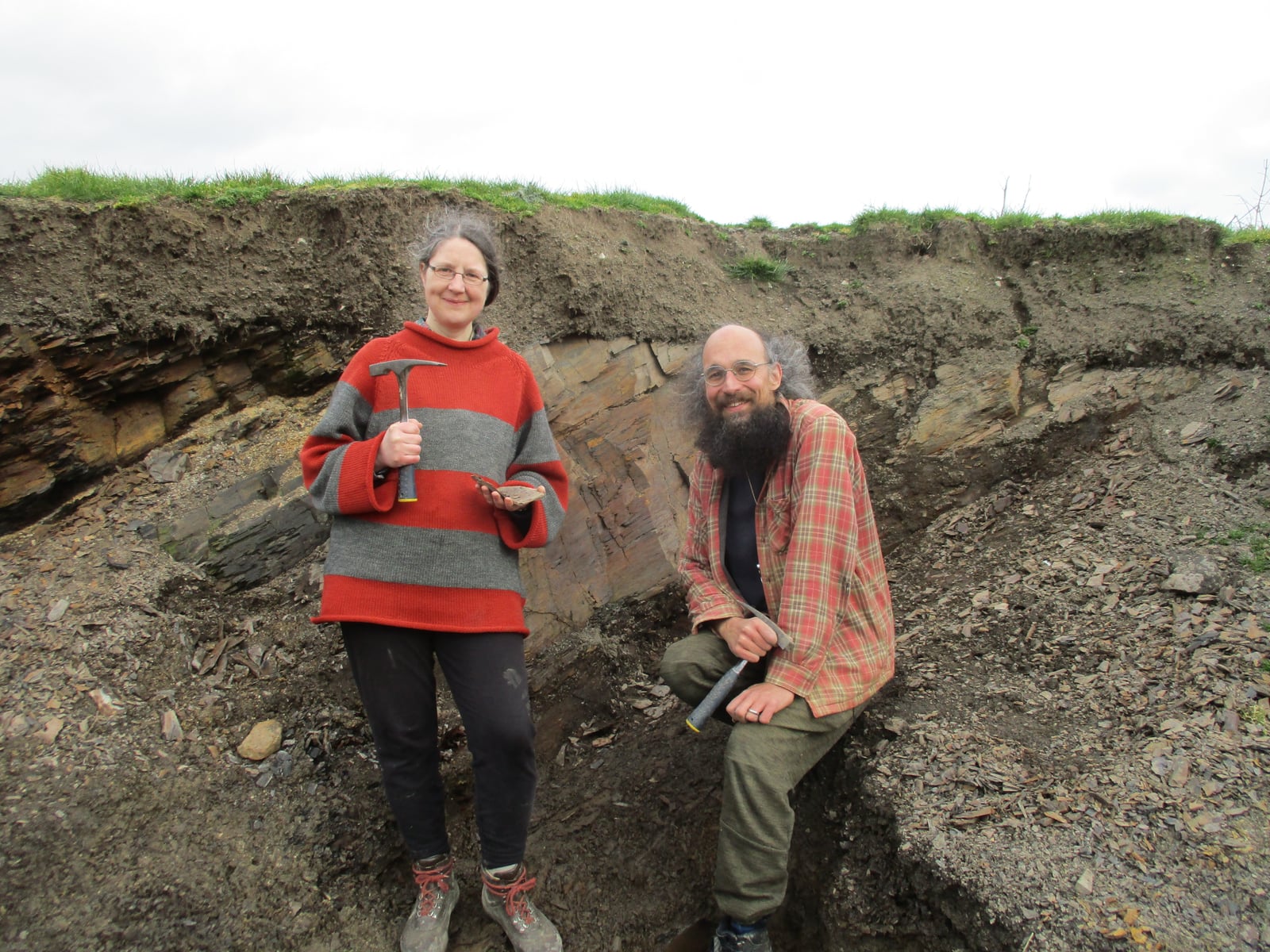
The trail to Castle Bank began with stone laid out for feeding sheep. Joseph Botting and Lucy Muir noticed fossils in it, asked where it came from, and obtained permission to investigate the quarry. That was in 2013. For years, their finds were chiefly sponges. Then, in 2020, a creature with two delicate tentacles extending from a tiny tube revealed that this unassuming Welsh exposure preserved much more.[1]
The practical discovery was a change in how to look. Botting’s account describes splitting suitable rock into fine layers and inspecting each surface for minute carbon flecks. Some specimens became intelligible only under a microscope. Equipment bought through crowdfunding helped turn those specks into publishable anatomy.[1]
Castle Bank lies near Llandrindod Wells in mid Wales, where rocks record a sea more than 460 million years old. Museum Wales reported over 170 species in its 2023 account, many just one to five millimeters long.[2] The quarry’s importance lies partly in how easily such a community could escape attention.
A seabed preserved unevenly
The setting matters as much as the magnification. In their 2023 study of Castle Bank sponges, Botting, Muir and Junye Ma placed the locality in the Gilwern Volcanic Formation. Graptolites—colonial animals whose fossils help correlate rocks—constrain its age to the Middle Ordovician. The exposed succession includes siltstone and volcanic ash.[3]
Slowly accumulated, finely layered sediment alternates with beds deposited rapidly. From this combination and the associated animals, the researchers inferred a seabed near the depth reached by storm waves, perhaps 50–100 meters below the surface. That is an environmental estimate, rather than a depth read directly from a fossil.[3]
Preservation changes vertically through the quarry. Within a particularly productive interval, sponges retain connected skeletons and traces of soft tissue; elsewhere, their remains are mostly disassembled. A sponge missing from one layer may therefore be unrecognizable rather than absent.[3]
Position matters: similar-looking stones need not offer the same chance of recovering an animal.
Small bodies, different lives
Many Castle Bank fossils survive as carbon films, including features usually lost from the record: trilobite guts, worm jaws and fine tentacles. Such details allow researchers to investigate animals that would contribute little to an ordinary collection of hard shells.[2]
Smallness itself needs interpretation. Museum Wales describes numerous juvenile Ogyginus trilobites but no adults, suggesting a possible nursery. Other animals appear to be adults of small species. The museum proposes that shelter among structures on the seabed might have favored small inhabitants; this remains an ecological interpretation, not something demonstrated merely by their dimensions.[2]
A millimeter-long fossil therefore presents two separate questions: what kind of animal was it, and how far had that individual grown? Answering the first does not automatically settle the second.
A worm acquires a history
One striking result came from a spoonworm described by Botting and Muir in 2023. Named Llwygarua suzannae, it preserves a broad, two-lobed proboscis, anterior bristles and structures interpreted as bands of muscle. The combination supports placement among echiurans, a group within the annelid worms. Its specimens are held at Amgueddfa Cymru–Museum Wales in Cardiff.[4]
The identification extends the known body-fossil record of spoonworms roughly 150 million years earlier than the previously recognized Carboniferous examples. It also suggests that substantial diversification within the group had already occurred by the Middle Ordovician. An apparent late arrival in the fossil record had concealed a much longer history.[4]
Yet a smaller, somewhat different worm remained unnamed. It might represent another species, or a juvenile with different proportions. Even exceptional preservation did not supply enough evidence to decide.[4] Leaving that specimen unresolved preserves a useful distinction: an expanded history can be secure while the membership of a particular species remains uncertain.
The shells still waiting for their owners
A study published on 28 September 2026 by Stephen Pates and colleagues carries that caution into Castle Bank’s bivalved arthropods: joint-legged animals enclosed partly by a two-sided carapace. The term describes their covering; these are not molluscan clams.[5]
The team recognized 18 taxa, including formally named species and provisional forms. Most are known only from isolated carapaces. Some preserve more: Ffabach peryglus has anterior grasping appendages that the authors interpret as adaptations for predation or scavenging.[5]
The assemblage raises a larger question. Were such diverse, tiny arthropods especially characteristic of this place and time, or have delicate carapaces escaped preservation elsewhere? The authors retain both possibilities. A richer sample does not establish that other seas lacked comparable animals.[5]
Castle Bank makes a previously obscure community available for comparison. Before a missing animal becomes evidence of ecological change, researchers must ask whether another rock could have preserved it—and whether anyone has looked closely enough.
Sources
- Joseph Botting, “Exploring a Middle Ordovician Burgess Shale-type fauna,” Springer Nature Research Communities (2 May 2023)—discovery narrative and quarry photograph.
- Lucy McCobb, “A new Welsh treasure trove of very special fossils,” Museum Wales (1 May 2023)—fauna, preservation and ecological interpretations.
- Joseph P. Botting, Lucy A. Muir and Junye Ma, “Teganium (Porifera, Hexactinellida) from the Middle Ordovician Castle Bank fauna of Avalonia (Wales, UK),” Palaeontologia Electronica (2023)—geological setting.
- Joseph P. Botting and Lucy A. Muir, “A new thalassematid echiuran worm from the Middle Ordovician Castle Bank Biota of Wales, UK,” Acta Palaeontologica Polonica (2023).
- Stephen Pates and colleagues, “The diverse bivalved arthropods of Castle Bank (Darriwilian, Ordovician), Wales,” Papers in Palaeontology (28 September 2026)—taxonomy, feeding interpretations and preservation bias.