Aegirocassis benmoulae is easy to misread if you begin with size. A roughly two-metre radiodont from the Early Ordovician of Morocco sounds like one more entry in the prehistoric-giant cabinet, a last oversized cousin of Anomalocaris lingering after the Cambrian.[1] The fossils say something more specific. Aegirocassis matters because it shows an animal built on the old radiodont body plan being redirected toward a different ecological job: not seizing large prey, but filtering small planktonic food from the water column.[1][2]
That shift changes the whole profile. The animal still belongs to the charismatic radiodont lineage, with frontal appendages, swimming flaps, and a body architecture older than true arthropod limbs in the familiar sense.[1][2] But the best way to read Aegirocassis is not as a failed apex predator or a giant leftover. It is a proof that the Ordovician sea had already become rich enough, and structurally different enough, to reward large-bodied suspension feeding near the beginning of the period.[2][3][4][5]
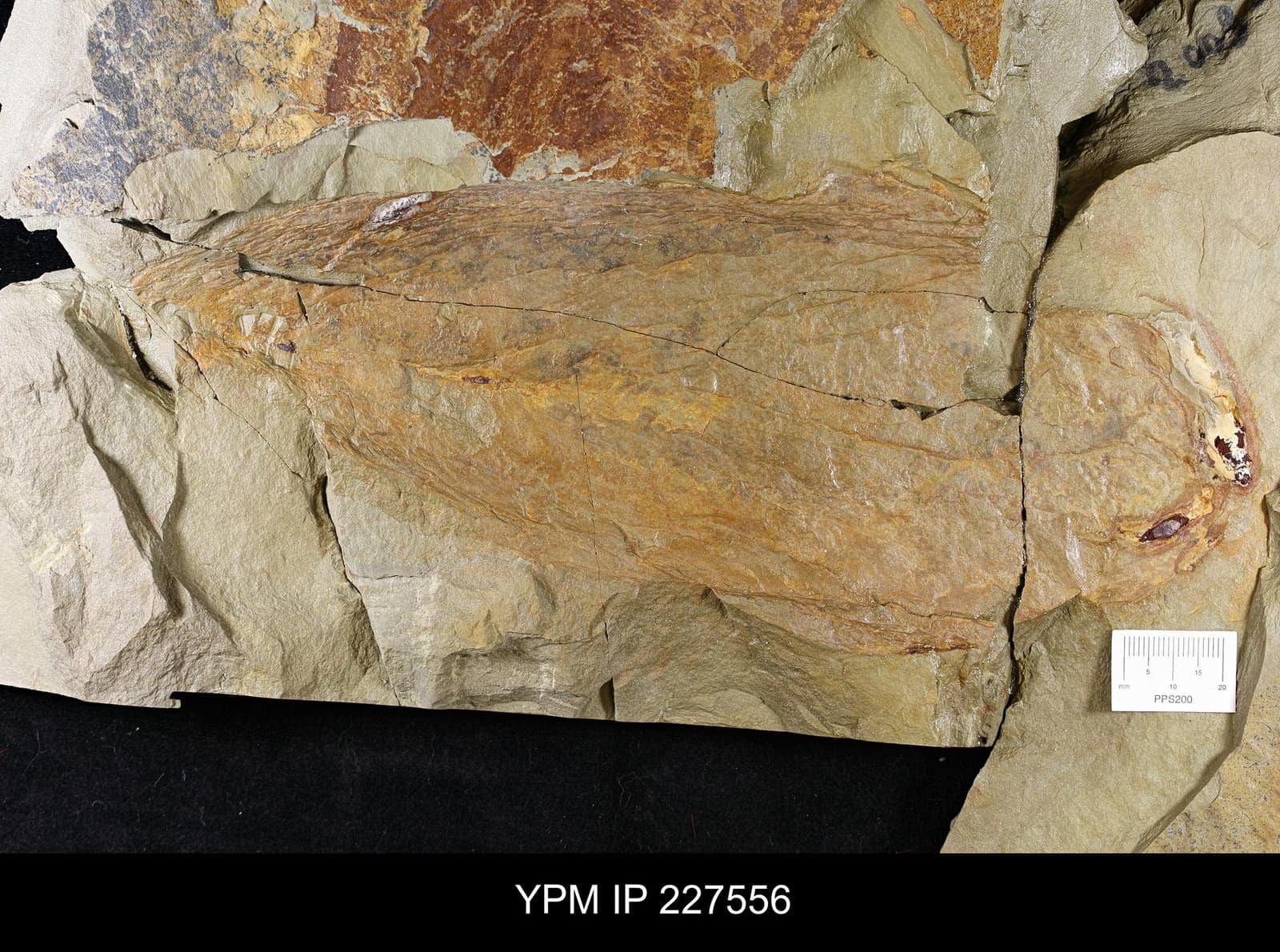
Image context: the lead image uses Yale Peabody specimen YPM IP 227556 from Wikimedia Commons. It belongs here because the article turns on preserved structure. A real slab photograph keeps attention on the fossil evidence itself: a long body with repeated lateral elements, not an illustrated "sea monster" silhouette that would blur the anatomical argument.[6]
Size is the least surprising thing about it
When Van Roy and Briggs described Aegirocassis in 2011, the headline was giant scale.[1] That emphasis made sense. A two-metre animal in the Early Ordovician is not trivial, and the Fezouata fossils immediately widened the known temporal range and ecological reach of radiodont-grade predators and swimmers beyond the Cambrian showcases most readers already knew.[1]
But size by itself is not why the species stayed important. Paleontology is full of large animals that amount to little more than an inflation of an existing design. Aegirocassis did not merely scale up a familiar predatory form. It occupied a marine world already moving toward the more diversified plankton-rich conditions associated with the Ordovician radiation, and its anatomy shows that radiodonts were participating in that change rather than merely surviving through it.[1][4][5]
That is the first useful correction to the species profile. The question is not "How big did this thing get?" The sharper question is "What kind of food web makes a giant filter-feeding radiodont worth building?" Once that becomes the organizing problem, Aegirocassis stops looking like an anomaly and starts looking like a response.
The head appendages stopped grabbing and started combing
The strongest turn in the story came with the 2015 Nature paper that redescribed the animal as a giant filter-feeder with paired flaps.[2] The frontal appendages that in other radiodonts read as prey-capture devices had here become something closer to a rake or sieve. Their long endites carried fine auxiliary spines suited to collecting much smaller particles from the water column than the dramatic mouthparts of a classic hunter would suggest.[2]
This is where Aegirocassis stops being a generic giant arthropod and becomes a genuinely modern-feeling ecological experiment. Large suspension feeders do not succeed simply because they are large. They succeed because the surrounding water contains enough edible matter, at the right size range and in the right concentration, to make filtering worthwhile. Aegirocassis is therefore evidence about Ordovician oceans as much as it is evidence about one taxon.[2][4][5]
The broader radiodont record sharpens the point. Vinther and colleagues described Tamisiocaris from the Early Cambrian as a suspension-feeding anomalocarid, which already showed that radiodonts could move into plankton feeding well before the Ordovician.[3] Lerosey-Aubril and Pates then added another suspension-feeding radiodont in 2018, arguing for the evolution of microplanktivory in Cambrian macronekton.[4] Read alongside those species, Aegirocassis no longer looks like an isolated freak. It looks like one large Ordovician expression of a feeding strategy radiodonts had begun exploring earlier, now scaled up inside a changed marine ecosystem.[2][3][4]
The trunk turned a species profile into an arthropod argument
If the head appendages explain what Aegirocassis was doing, the trunk explains why the fossil mattered to arthropod evolution more broadly. The 2015 paper did not only describe filter feeding. It argued that Aegirocassis preserved paired dorsal and ventral flap structures in a way that clarified trunk limb homology across early arthropods.[2]
That is a technical phrase, but the consequence is simple enough. Radiodont bodies had long seemed awkwardly separate from the limb organization seen in later arthropods. Aegirocassis narrowed that gap. Its preserved flaps suggested that the radiodont trunk was not an evolutionary dead end built on bizarre one-off paddles. It preserved a body organization that helped explain how the components of later arthropod biramous limbs could have emerged from earlier structures.[2]
This part of the profile matters because it prevents the species from being reduced to ecology alone. Aegirocassis is not only the answer to "How did a giant Ordovician suspension feeder live?" It is also part of the answer to "How should we map radiodont anatomy onto the deeper history of euarthropod limbs?" That is why the species remains cited beyond niche discussions of Moroccan fossils. It carries both ecological and structural leverage.[2]
Fezouata made the old body plan newly useful
The Fezouata Biota has become crucial because it preserves Cambrian-looking body plans in an Ordovician setting where marine ecosystems were already reorganizing.[1][5] For Aegirocassis, that setting is not background scenery. It is the reason the animal reads so clearly. In a different deposit, you might have a giant radiodont and little else. In Fezouata, the surrounding faunal context makes it easier to see that this lineage was still innovating.
Potin, Gueriau, Daley, and colleagues showed in 2023 that Fezouata radiodont frontal appendages record both high diversity and ecological adaptations to suspension feeding during the Early Ordovician.[5] That result matters because it shifts Aegirocassis away from the "lonely wonder" frame. The animal is still exceptional, but it belongs to a local and temporal pattern in which radiodonts were partitioning feeding strategies rather than repeating the same predatory script.[5]
This is the right closing lens for the species. Aegirocassis benmoulae matters because it makes three arguments at once. It says giant body size could already pay off in Ordovician suspension feeding.[1][2] It says radiodont appendages were evolutionarily flexible enough to turn a grasping front end into a filtering apparatus.[2][3][4] And it says the Fezouata world preserved not a museum of leftovers, but a marine ecosystem where old body plans were still discovering new work to do.[5]
Sources
- Peter Van Roy and Derek E. G. Briggs, "A giant Ordovician anomalocaridid," Nature 473 (2011).
- Peter Van Roy, Allison C. Daley, and Derek E. G. Briggs, "Anomalocaridid trunk limb homology revealed by a giant filter-feeder with paired flaps," Nature 522 (2015).
- Jakob Vinther, Martin Stein, Nicholas R. Longrich, and David A. T. Harper, "A suspension-feeding anomalocarid from the Early Cambrian," Nature 507 (2014).
- Rudy Lerosey-Aubril and Stephen Pates, "New suspension-feeding radiodont suggests evolution of microplanktivory in Cambrian macronekton," Nature Communications 9 (2018).
- Gaetan J.-M. Potin, Pierre Gueriau, Allison C. Daley, et al., "Radiodont frontal appendages from the Fezouata Biota (Morocco) reveal high diversity and ecological adaptations to suspension-feeding during the Early Ordovician," Frontiers in Ecology and Evolution 11 (2023).
- Wikimedia Commons, "File:Aegirocassis benmoulae (YPM IP 227556) 1.jpg" — photographed Yale Peabody specimen used for the lead image.