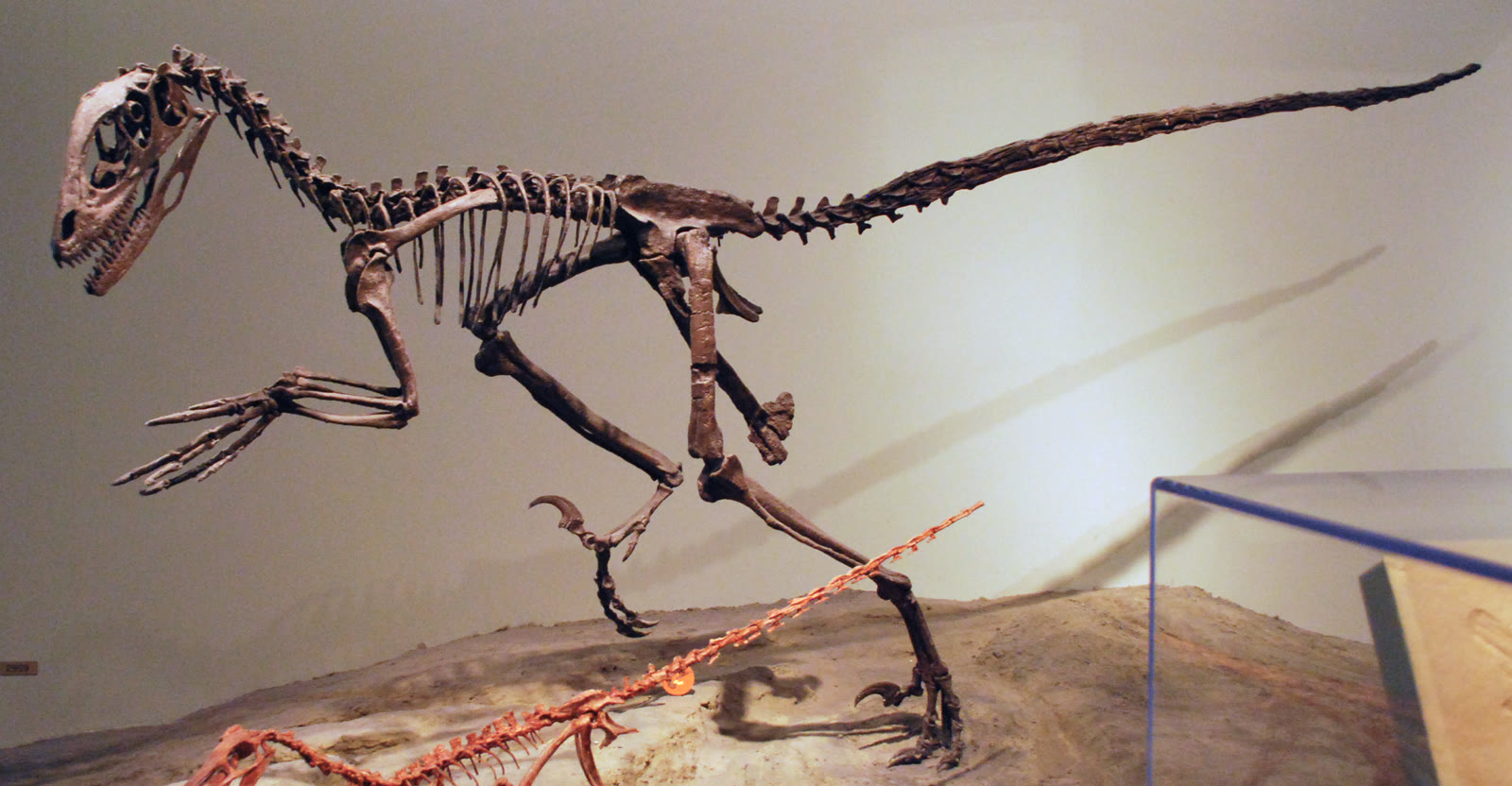
Deinonychus antirrhopus still arrives in popular culture as a shorthand for "smart killer dinosaur," usually flattened into one oversized claw and a movie-ready face. The fossil evidence supports a narrower and better picture. Deinonychus matters because several anatomical systems pull in the same direction at once: the tail behaves like a counterbalancing lever, the forelimb is built to grasp, and the famous second toe works best when interpreted inside that full body plan rather than as an isolated slashing gadget.[1][2][3][4][5]
That order matters. John Ostrom's early descriptions did not make Deinonychus scientifically important by discovering one dramatic weapon.[1][2] They made it important by showing a coordinated predatory package from the Cloverly Formation of Montana. The new theropod combined a very large trenchant claw on pedal digit II, a highly raptorial manus with a mobile wrist, and a caudal series with elongated rods that would have limited tail flexibility.[1][2] Once those features are read together, the animal stops looking like a generic small theropod with one exaggerated toe and starts reading as a tightly organized mechanics problem.
Image context: the cover uses a real Field Museum photograph from Wikimedia Commons. It fits this article because the mounted skeleton shows the three linked structures under discussion in one glance: the body is pitched over a long balancing tail, the arms are not vestigial, and digit II is held apart from the rest of the foot.[6]
1) The tail was not decoration. It was part of the animal's balance system.
Ostrom's 1969 naming paper already emphasized the specialized tail, and the fuller osteological treatment made the point unavoidable.[1][2] The caudal vertebrae carried extremely long prezygapophyses and elongated chevron rods. In practical terms, that meant much of the tail was stiffened and could not flex freely like a rope behind the body.[1][2] The species name antirrhopus was chosen precisely to highlight counterbalancing.
This is the first reason Deinonychus changed how theropod anatomy had to be read. A long, partly rigid tail shifts the logic of the whole animal. It helps stabilize the torso during fast directional changes and keeps the center of mass tied to a forward-moving hindlimb system.[2] That does not mean the tail turned Deinonychus into a perfect athlete in the modern mammalian sense, or that paleontologists can reconstruct every maneuver it made. It does mean the skeleton was not built around a sluggish reptilian trunk with a decorative tail dragged behind it. Balance had been engineered into the rear half of the body.
That point becomes more valuable once the claw hype is set aside. If readers begin with the tail, they are less tempted to imagine a dinosaur that simply jumped and stabbed. They are pushed instead toward a more disciplined question: what kind of whole-body stability would make the foot and forelimb effective at close range?
2) The shoulder and hand tell the same story: this animal was built to hold on
The forelimb becomes clearer in Ostrom's 1974 correction on the pectoral girdle.[3] A bone first thought to be a pubis turned out to be a very large right coracoid, which forced a revised reconstruction of the shoulder and a revised interpretation of the pectoral musculature.[3] Ostrom argued that the enlarged coracoid was related to enlarged pectoral muscles important in predatory activity.[3]
That correction matters because it moves Deinonychus away from the lazy image of "little tyrannosaur with a foot knife." The forelimb was not an accessory. The manus was already described as highly raptorial in the 1969 paper, and the later shoulder reconstruction strengthened that reading.[1][3] A mobile carpus, grasping hand, and powerful pectoral region make far more sense in an animal expected to seize, stabilize, or pull prey than in one imagined as relying on the hind claw alone.
This is why the predatory package has to be read from front to back. A balancing tail without a functional forelimb would support one set of hypotheses. A grasping forelimb without specialized pedal anatomy would support another. Deinonychus preserves both. The value of the taxon lies in that overlap.
3) The sickle claw is real, but the old switchblade story is too crude
No feature of Deinonychus has had a stranger afterlife than the enlarged claw on pedal digit II.[1][2] Ostrom's original papers correctly treated it as highly specialized and unlike the ordinary walking digits.[1][2] The problem came later, when public imagination turned the claw into an all-purpose disemboweling blade.
Later biomechanical work has pushed the interpretation into a tighter range. Fowler and colleagues' 2011 PLOS ONE paper used Deinonychus as the key model for a "raptor prey restraint" hypothesis, arguing that dromaeosaurids may have used the enlarged second toe to pin or grip prey while body weight and forelimb action helped control the struggle.[4] In that reading, the toe is not a theatrical slash-first weapon. It is part of a restraint system.[4]
Bishop's 2019 musculoskeletal modelling sharpened the same caution from another angle.[5] Using Deinonychus as a case study, the paper tested how claw force changed under different postures and parameter assumptions, finding that the digit's performance depended strongly on crouched limb posture and on how the musculotendon system is reconstructed.[5] That does not collapse the claw into irrelevance. It does something better. It tells us the toe must be interpreted as a load-bearing functional structure with mechanical limits, not as a pop-cultural symbol that can do every job equally well.
This is the point where Deinonychus becomes more interesting than its reputation. The claw remains central, but it becomes central as one part of an integrated predatory geometry: torso pitched forward, tail stabilizing, forelimbs engaged, body weight close to the prey, and digit II contributing force within a bounded posture.[4][5] That is a much stronger scientific picture than the old "jumping knife foot" version precisely because it is more constrained.
4) The best reading is integrated, and it still leaves useful boundaries
Put the evidence together and a clean profile emerges. Deinonychus was an Early Cretaceous dromaeosaurid whose skeleton linked tail stabilization, grasping forelimbs, and specialized pedal anatomy into one predatory system.[1][2][3][4][5] That is the high-confidence layer.
The boundary layer matters just as much. This article does not prove exactly how large a prey animal Deinonychus could subdue, does not prove a universal hunting sequence, and does not use one mounted skeleton to settle every argument about feathering, metabolism, or social behavior. Those are adjacent questions, not the same question. The strongest claim is narrower: the fossil anatomy supports coordinated close-range predation better than it supports the old fantasy of a single magical claw doing the work alone.[2][3][4][5]
That is why Deinonychus still reads as modern paleontology at its best. The taxon became famous because it looked fierce. It stayed important because later work kept tightening how the fierceness actually functioned. Tail balance, forelimb grip, and the sickle claw do not compete for explanatory priority. They lock together. Once they do, Deinonychus stops being a poster predator and becomes something better: a skeleton whose logic can still be tested.
Sources
- John H. Ostrom, "A new theropod dinosaur from the Lower Cretaceous of Montana" (1969), Postilla 128.
- John H. Ostrom, Osteology of Deinonychus antirrhopus, an unusual theropod from the Lower Cretaceous of Montana (1969), Bulletin of the Peabody Museum of Natural History 30.
- John H. Ostrom, "The pectoral girdle and forelimb function of Deinonychus (Reptilia: Saurischia): A correction" (1974), Postilla 165.
- Denver W. Fowler, Elizabeth A. Freedman, John B. Scannella, and Jack L. Horner, "The Predatory Ecology of Deinonychus and the Origin of Flapping in Birds" (2011), PLOS ONE.
- P. J. Bishop, "Testing the function of dromaeosaurid (Dinosauria, Theropoda) 'sickle claws' through musculoskeletal modelling and optimization" (2019), PeerJ.
- Wikimedia Commons file page for the Field Museum Deinonychus mount photograph used as the article image.