
Denisovans are a useful antidote to the museum habit of expecting a new human relative to arrive as a skull, a skeleton, or at least a face. The lineage entered science almost backwards. A small finger-bone fragment from Denisova Cave in southern Siberia yielded DNA that did not fit Neanderthals or living humans, and the 2010 genome paper turned that fragment into evidence for an archaic hominin population that had contributed genetic ancestry to present-day Melanesians.[2] In ordinary fossil storytelling, DNA confirms the animal after the bones have done their work. Here, DNA named the problem before morphology had much to say.
That is why the short SciShow video embedded below is worth curating, even though the written record has moved forward since it was made.[1] It captures the central strangeness of the Denisovan case: the evidence began with a tiny fossil, then widened through genomes, interbreeding signals, cave context, and later jaw evidence. The video is best watched as a starting frame, not as the final state of the field. Since the first wave of coverage, the Xiahe mandible from Baishiya Karst Cave, sediment DNA from Denisova Cave, subsistence evidence from the Tibetan Plateau, and the 2025 Penghu 1 protein result have all made the Denisovan map less abstract.[3][4][5][6]
Watch the evidence order, not just the mystery
The video's most important move is the way it refuses to make Denisovans feel like a normal species profile.[1] There is no neat gallery-body to circle. The story begins with genetic difference, then asks what kind of fossil and geographic record can catch up with it. That order matters because it changes what counts as evidence. A tooth, a finger fragment, a mandible, a protein sequence, a sediment sample, and inherited DNA in living people are not redundant clues. They are different ways of seeing a population that has left very few conventional fossils.
Around the opening portion of the clip, the Denisovan discovery is presented through the surprise of a genome that did not behave as expected.[1] The original Nature paper is still the anchor for that surprise. It used DNA from the Denisova Cave finger bone to describe an archaic hominin group related to, but distinct from, Neanderthals, and it reported Denisovan genetic contribution to present-day Melanesians.[2] That contribution should not be treated as a simple population label for all Asia, or as proof that every robust Asian fossil is Denisovan. It is a directional clue: Denisovans were not a one-cave curiosity, and later fossils have to be tested rather than guessed.
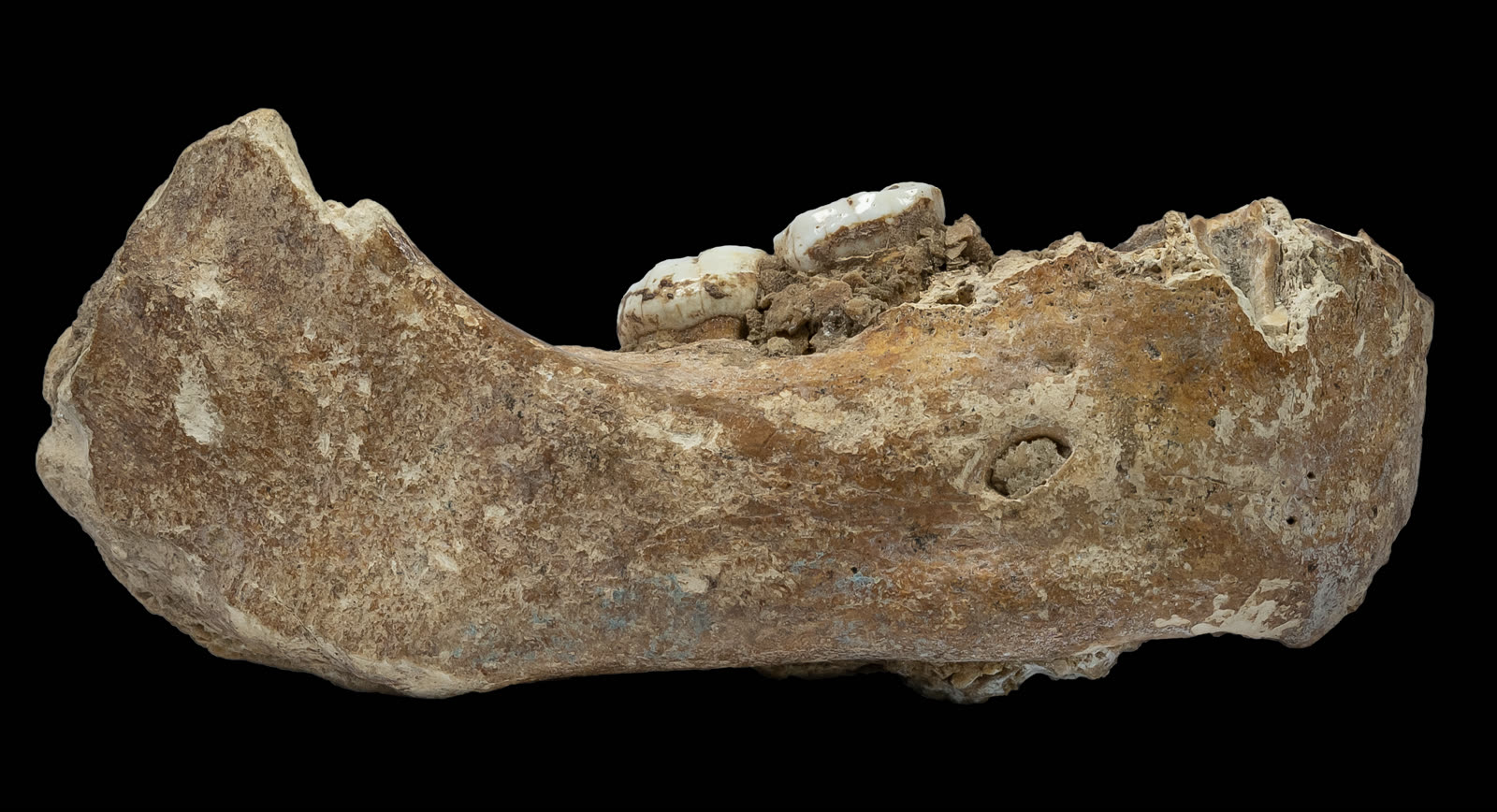
The Xiahe mandible is the cleanest example of the field catching up with the genome.[3] Found at Baishiya Karst Cave on the Tibetan Plateau, the jaw was identified as Denisovan not through recoverable DNA but through ancient protein analysis. That distinction is crucial. It means Denisovan recognition no longer depended only on the cold preservation conditions that made Siberian DNA famous. A large lower jaw with attached molars could enter the same evidence system by another molecular route.[3] The fossil also moved Denisovans into high-altitude Tibet at least 160,000 years ago, giving the group an ecological range that the original cave fragment could only imply.
The video also becomes sharper if you keep cave sediment in mind.[1][4] Denisova Cave is not only a place where several rare hominin bones happened to survive. Sediment DNA later recovered from hundreds of samples recorded turnovers among Denisovans, Neanderthals, modern humans, and animals across the Pleistocene sequence.[4] This is one of the best reasons not to imagine Denisovans as a single fossil body waiting to be completed. In some contexts, the site itself becomes the archive. DNA shed into cave deposits can preserve presence even when diagnostic bones are absent or too fragmentary to name by shape.
The Tibetan Plateau evidence pushes the same lesson from a different direction. The 2024 Baishiya Karst Cave work examined Middle and Late Pleistocene Denisovan subsistence and added the Xiahe 2 fossil evidence, while also showing occupation signals across a long high-altitude record.[5] That matters because it gives Denisovans behavior and setting, not just ancestry. They were not merely a genetic ghost inferred from living genomes. They occupied caves, processed animals, and persisted through cold, high-elevation environments where survival depended on repeated local knowledge.[5]
Penghu 1, reported in 2025, widens the map again.[6] The Taiwan mandible had been known before, but ancient protein analysis identified it as belonging to a male Denisovan. The dating range remains broad, and the find was dredged from a submerged context rather than excavated from a clean cave layer, so it should be handled cautiously. Even with that boundary, the implication is large: Denisovan fossil evidence now stretches across a much wider Asian frame than the name "Denisova" suggests.[6]
The best way to use the video, then, is to let it teach the first rule and let the newer written sources expand the second. First rule: Denisovans are not a mythic missing link waiting for a face. They are a lineage first recognized by molecular evidence. Second rule: molecular evidence does not make fossils irrelevant. It makes fossils more demanding. Every mandible, molar, sediment layer, and protein sequence has to be tied back to context, preservation, and method before it can carry a Denisovan label.
That is why Denisovans remain so interesting in paleontology. They force a mixed discipline. Ancient DNA can name a population from a fragment. Proteomics can rescue identity where DNA fails. Sediment can record presence without a body. Fossils can finally add jaws, teeth, geography, and ecology to a lineage that began as a genome. Read in that order, the mystery is not that Denisovans were invisible for so long. The mystery is how much of them has become visible from such small pieces.
Sources
- SciShow, "Another Species of Human? The Truth About Denisovans," YouTube video.
- David Reich, Richard E. Green, Martin Kircher, Johannes Krause, Svante Paabo, and colleagues, "Genetic history of an archaic hominin group from Denisova Cave in Siberia," Nature 468 (2010).
- Fahu Chen, Frido Welker, Dongju Zhang, Jean-Jacques Hublin, and colleagues, "A late Middle Pleistocene Denisovan mandible from the Tibetan Plateau," Nature 569 (2019).
- Elena I. Zavala, Viviane Slon, Matthias Meyer, and colleagues, "Pleistocene sediment DNA reveals hominin and faunal turnovers at Denisova Cave," Nature 595 (2021).
- Dongju Zhang, Frido Welker, Fahu Chen, and colleagues, "Middle and Late Pleistocene Denisovan subsistence at Baishiya Karst Cave," Nature 631 (2024).
- Takumi Tsutaya, Rena Sawafuji, Enrico Cappellini, Frido Welker, and colleagues, "A male Denisovan mandible from Pleistocene Taiwan," Science 388 (2025), PubMed record.
- Wikimedia Commons, "File:Xiahe mandible.jpg" - photographic source for the article image.