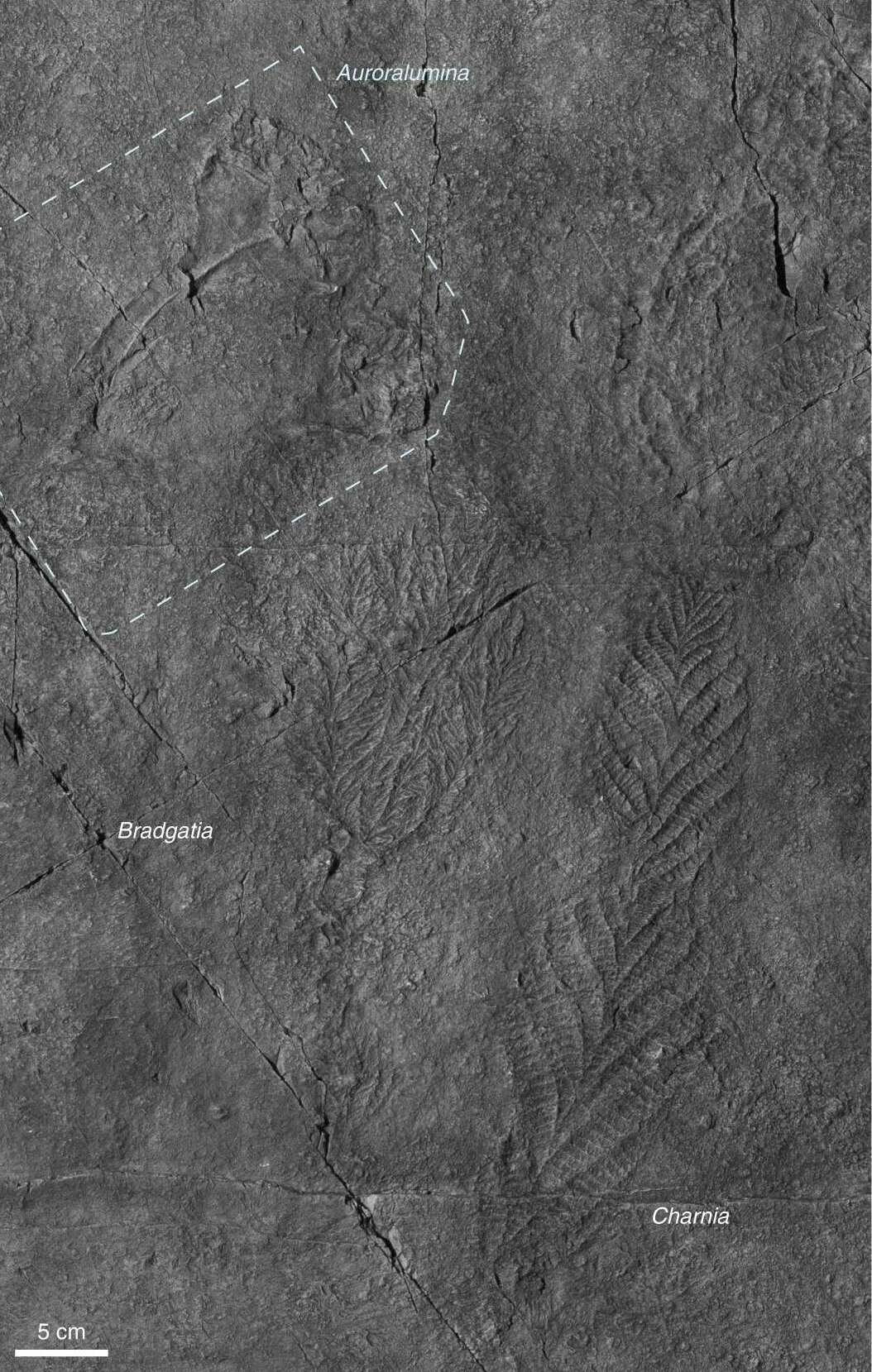
Auroralumina attenboroughii sounds like a creature built for headlines. A roughly 560-million-year-old fossil, named after David Attenborough, interpreted as an early cnidarian and widely described as the oldest known animal predator: every phrase invites a simple origin story.[1][2][3] The fossil itself asks for a slower reading. Its strength does not come from looking like a complete jellyfish, coral, or sea anemone. It comes from a difficult surface: two goblet-shaped impressions on a Charnwood Forest bedding plane, preserved with enough relief, texture, and geometry to make a cnidarian interpretation plausible before the Cambrian begins.[1]
That is why Auroralumina is best treated as a fossil-find close reading rather than as a trophy label. The claim is not just "predators existed earlier than expected." The better claim is narrower and more useful: one late Ediacaran surface preserves a body plan with a rigid organic-walled covering, paired polyp-like cups, and tentacle-like crowns, and that combination pulls a recognizably cnidarian architecture into rocks dated around 557 to 562 million years ago.[1]
The setting matters immediately. The holotype came from Bed B of the Bradgate Formation in Charnwood Forest, Leicestershire, a locality already famous for Ediacaran fossils such as Charnia and Bradgatia.[1] The British Geological Survey account notes that the team cleaned a large rock surface in 2007, made a rubber mould, and captured the impressions of more than a thousand fossils before one form stood out.[2] That workflow is not background color. It explains the kind of evidence this is. Auroralumina was not collected as a detached, three-dimensional object. It was recognized as an unusual pattern inside a crowded fossil surface.
The Natural History Museum describes the fossil as an impression formed in volcanic ash and dust after an eruption.[3] That ash-bed context is central to many Ediacaran localities because it can seal a seafloor quickly enough to preserve low-relief organisms that otherwise would vanish. In Auroralumina, preservation created a paradox: the animal is visually modest, but the relief differences on the rock carry anatomy. The fossil is sharply differentiated from the surrounding mat-textured substrate, and its smooth goblet surfaces, rims, and tentacle-like crowns preserve differently from one another.[1]
Start with the two cups. Dunn and colleagues describe the specimen as two subparallel, goblet-shaped impressions that bifurcate from a partly obscured basal region.[1] Each goblet has a stalk and an expanded cup, with a linear ridge running along the length. Those ridges matter because they are not decorative grooves in a shell. In the interpretation, they record corner sulci in a three-dimensional, polyhedral periderm: the resistant outer covering in which the living polyp sat.[1]
That makes the fossil different from a flat frond or a generic Ediacaran tube. The left-hand goblet preserves two nearly symmetrical faces, while the right-hand goblet preserves a different view, consistent with two cups buried in different orientations.[1] The authors prefer a tetraradial reading, while also acknowledging that more specimens could refine the symmetry interpretation.[1] That caution is important. Auroralumina does not become persuasive because every detail is beyond argument. It becomes persuasive because the preserved geometry narrows the set of reasonable bodies.
The tentacle-like crowns are the second anchor. At the cup margins, the paper identifies dense, overlapping, unbranched projections, especially clear on the better-preserved left cup.[1] These structures are preserved differently from the goblets: the cups look like resistant impressions, while the crowns behave more like softer tissue whose volume was cast by sediment.[1] That tissue contrast is one reason the fossil is so interesting. It preserves a division between a tougher exterior and a softer feeding surface. In a cnidarian reading, the animal was not simply a tube. It was a polyp-like body with a protective organic theca and protruding tentacles.[1]
This is where the "predator" headline begins, but it should begin carefully. Living cnidarians are often predators that use tentacles and specialized stinging cells, or cnidocytes, to handle prey. A fossil with a cnidarian-style polyp and tentacle crown therefore carries obvious ecological implications.[1] But Auroralumina does not preserve a stomach full of prey, visible stinging capsules, or a recorded strike. The predator claim is an inference from body plan, phylogenetic position, and what cnidarian feeding structures normally do.
That inference is still meaningful. The 2022 description recovered Auroralumina as a stem-group medusozoan and called it the oldest crown-group cnidarian in its analysis.[1] If that placement holds, then a major animal phylum had already fixed recognizable parts of its body plan before the Cambrian diversification that makes animal life much easier to see in the fossil record.[1] In plainer terms: the Cambrian did not invent cnidarian architecture from nothing. Auroralumina pushes some of that architecture back into the Ediacaran.
The boundary is just as important. Auroralumina was not a free-swimming jellyfish. It was a polypoid organism with an organic-walled periderm, closer in fossil logic to early medusozoan polyp stages and conulariid-like comparisons than to the bell-shaped medusa image most readers carry.[1] That distinction keeps the fossil from being overmodernized. It is evidence for deep cnidarian history, not a photograph of a modern jellyfish ancestor.
That does not weaken Auroralumina. It gives the predator claim better footing. Early predation may have emerged through a suite of tentacle, attachment, defensive, and prey-handling functions rather than through one instant jellyfish-style sting. Read that way, Auroralumina becomes more interesting than the oldest-predator slogan. It sits at a point where body architecture, ecology, and preservation intersect. The theca suggests a resistant organic outer structure. The tentacles suggest a living feeding surface. The Charnwood ash surface explains why the fossil could be captured at all. The phylogenetic result places it near medusozoan cnidarians, while the uncertainty around symmetry and feeding keeps the interpretation honest.[1][2]
The image matters for exactly this reason. The holotype photograph does not deliver instant drama. It shows a sloping rock surface with low-relief fossils, the kind of object that needs light angle, casts, and patient comparison before it becomes legible.[4] That is the right visual lesson. In the late Ediacaran, some of the most important animal evidence is not a jaw, tooth, limb, or shell. It is a surface difference, a ridge that once was a trough, a smooth patch against a matground, a crown of short projections, and a body plan caught just before animal history becomes louder.
The strongest memory hook is therefore not simply that Auroralumina was the first predator. The stronger hook is that the dawn of predation, if that is what the fossil records, arrived through a small set of disciplined clues on a rock surface: two cups, a bifurcation, a resistant organic wall, tentacles, and a cnidarian family-tree position that reaches back before the Cambrian. The dawn lantern is bright only when the fossil stays attached to the stone.
Sources
- Frances S. Dunn, Charlotte G. Kenchington, Luke A. Parry, James W. Clark, Russell S. Kendall, and Philip R. Wilby, "A crown-group cnidarian from the Ediacaran of Charnwood Forest, UK," Nature Ecology & Evolution 6 (2022).
- British Geological Survey, "560-million-year-old fossil is first animal predator" (2022), discovery and fieldwork context for Auroralumina attenboroughii.
- Natural History Museum, "The oldest known animal predator has been uncovered in Leicestershire" (2022), public-facing summary of the fossil, setting, and preservation.
- Wikimedia Commons, "File:Auroralumina, Bradgatia, Charnia.jpg" - source page for the extracted real holotype-surface photograph used as the article image.