The stone trunks in Chemnitz's Tietz atrium stand beneath a glass roof, surrounded by pale walls and stacked balconies. The display arrived there in 2004, after earlier installations elsewhere in the city. It is a gathering of recovered trees, with a history of collecting and moving them.[1][3] To recover the arrangement of the living forest, researchers had to return underground.
Between 2008 and 2011, an excavation in the Hilbersdorf district exposed trunks still anchored where they had grown. The difference is consequential: a museum can preserve the tree; a carefully recorded excavation can also preserve its neighbors.[2]
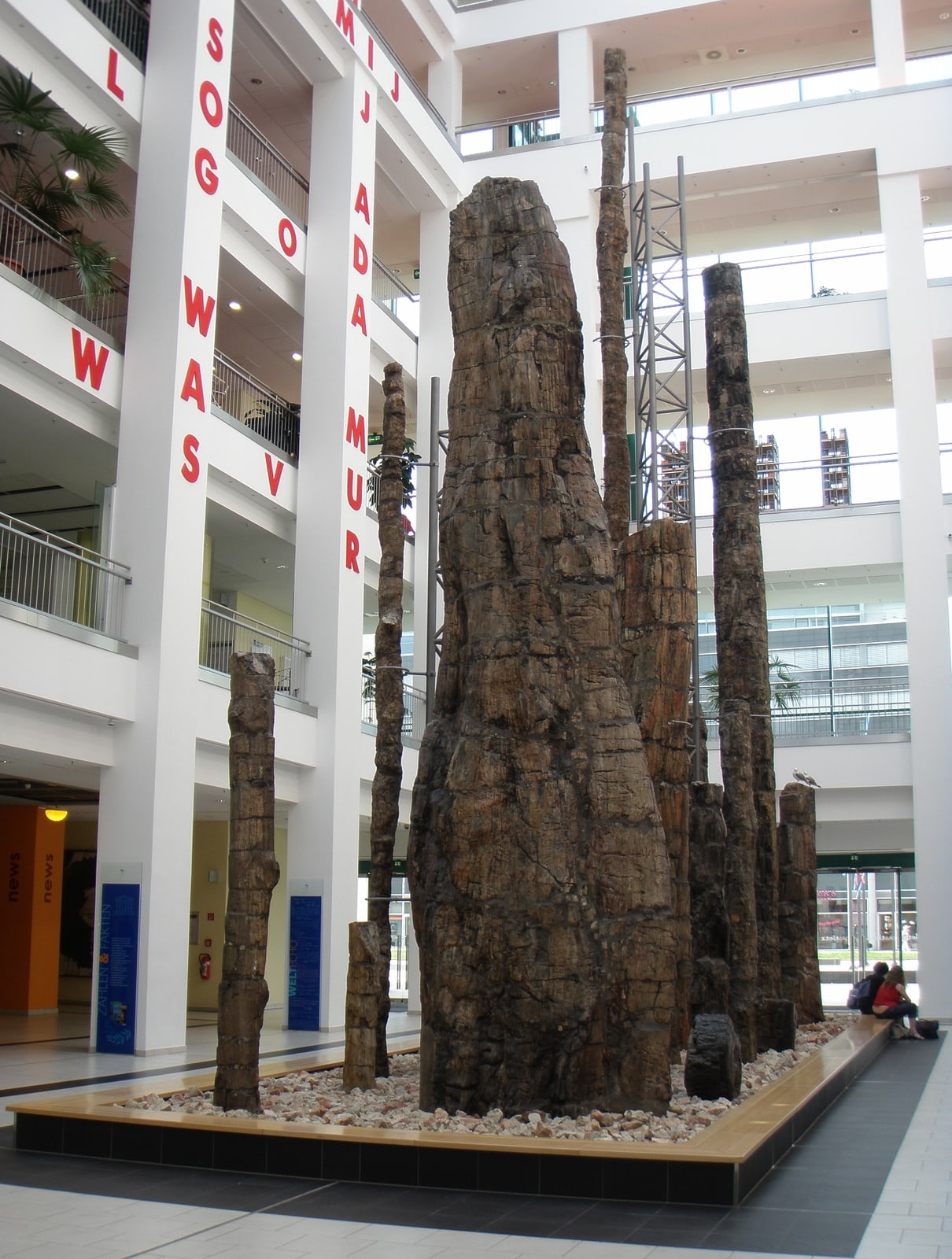
Where the trunks meet the ground
Ronny Rößler and colleagues reported 53 upright trunks in their 2012 excavation study. Many were basal portions rooted in the underlying ancient soil, or paleosol. The team recorded fossils in three dimensions, keeping position and orientation alongside specimen descriptions. Roots and spatial records gave the finds a connection to a particular piece of ground.[2]
This forest belonged to the early Permian landscape of the Chemnitz Basin, preserved in the Leukersdorf Formation beneath deposits of the Zeisigwald volcanic complex. The studies discussed here place its burial around 291 million years ago. The vegetation included seed ferns, tree ferns, tree-sized horsetail relatives and cordaitaleans, an extinct group of seed plants.[4][5]
Imagine two fossil trunks laid side by side in a collection. Their proximity tells us where someone put them. Two trunks still rooted in the same buried soil answer a different question: where plants actually occupied space. That distinction makes the excavation valuable even before a spectacular specimen is lifted out.
The surrounding rock supplies the sequence. Rößler's team distinguished fine, bedded volcanic deposits from an overlying coarse deposit attributed to a concentrated pyroclastic flow. The layers record successive phases of burial, with different capacities to cover, damage and preserve vegetation.[2]
A crown turned upside down
Discovered in 2010 and described by Ludwig Luthardt and colleagues in 2022, a crown of the seed fern Medullosa stellata lay upside down in the volcanic deposits. Ten fronds remained attached, although much foliage was incomplete. The researchers attributed the breakage to accumulating ash.[5]
Attachment is the crucial feature. Fossil leaves and stems often reach collections separately. Here, physical connections joined stem anatomy to fronds. Years of preparation and documentation turned that relationship into a reconstruction.[5]
The crown also qualifies the tempting picture of an entire forest frozen perfectly in place. Some bases remained rooted while an upper part broke, overturned and entered the ash. The site can preserve a local community without preserving every organism's original posture. Reading the forest means following those differences through the deposit.
Moist ground in a seasonal landscape
A dense stand of moisture-loving plants might suggest permanently swampy conditions. In their 2016 study, Luthardt, Rößler and Joerg Schneider found evidence of seasonality instead. Carbonate and iron-rich soil features, together with interruptions in woody growth, supported changes in moisture availability.[4]
Their estimated annual rainfall of 800–1,100 millimeters is a reconstruction with substantial uncertainty. It describes a locally favorable habitat for moisture-demanding vegetation within a seasonally drying landscape.[4]
The forest cannot stand for every surrounding kilometer. Its roots establish a real community, but its favorable conditions were local. A rich excavation can sharpen our view of one habitat while making regional generalizations more demanding.
Life beneath the roots
The soil preserved animals as well. Jason Dunlop and colleagues described two unusually complete scorpions in 2016, provisionally assigning them to Opsieobuthus as the new species tungeri. The question mark attached to the genus in their paper signaled uncertainty about that classification.[6]
For one specimen, the surrounding sediment was as revealing as the animal. It lay beneath a woody root within a narrow zone containing reddish clay. That zone continued behind the body instead of forming an even halo around it. The authors interpreted the geometry and finer sediment as evidence of a burrow into which clay had washed.[6]
This remains an interpretation, supported by the fossil's setting rather than by anatomy alone. It places a scorpion within a possible shelter in the forest floor. The paper also considered whether some remains represented shed skins, a reminder that a buried assemblage can include traces left before the catastrophe.[6]
Preservation continued at a smaller scale inside the trees. Researchers at TU Chemnitz examined fossil plant tissues with electron microscopy and studied the mineral structures that retained cellular detail. Their work described silica crystallization associated with former cell walls.[7] Burial preserved spatial relationships; mineralization helped preserve anatomy. Those are complementary achievements, investigated with different evidence.
The most revealing way to read Chemnitz is consequently to move between scales: from the arrangement of rooted trunks, to an attached frond, to a clay-filled space beneath a root, to the tissue within a petrified stem. Each connection gives a specimen more of its surroundings back. The forest becomes legible through those connections, including the ones the eruption broke.
Sources
- City of Chemnitz, “Petrified forest”—the Tietz display, its relocation in 2004 and the history of collecting.
- Ronny Rößler et al., “A snapshot of an Early Permian ecosystem preserved by explosive volcanism,” PALAIOS 27 (2012)—excavation records, upright trunks and volcanic deposits; author-shared full text.
- Sgeureka, “Versteinerter Wald Chemnitz 2009,” Wikimedia Commons—photograph taken May 25, 2009; provenance and CC BY-SA licensing.
- Ludwig Luthardt, Ronny Rößler and Joerg W. Schneider, “Palaeoclimatic and site-specific conditions in the early Permian fossil forest of Chemnitz,” Palaeogeography, Palaeoclimatology, Palaeoecology 441 (2016)—soil evidence, vegetation and seasonal moisture; university-hosted paper.
- Ludwig Luthardt et al., “Upside-down in volcanic ash: crown reconstruction of the early Permian seed fern Medullosa stellata with attached foliated fronds,” PeerJ 10 (2022)—attached crown, burial interpretation and geological age; PubMed record and abstract.
- Jason A. Dunlop et al., “Permian scorpions from the Petrified Forest of Chemnitz, Germany,” BMC Evolutionary Biology 16 (2016)—provisional taxonomy, burrow interpretation and possible moult remains.
- TU Chemnitz, “291 million years back in time”—electron microscopy and mineralization research on fossil plant tissues.