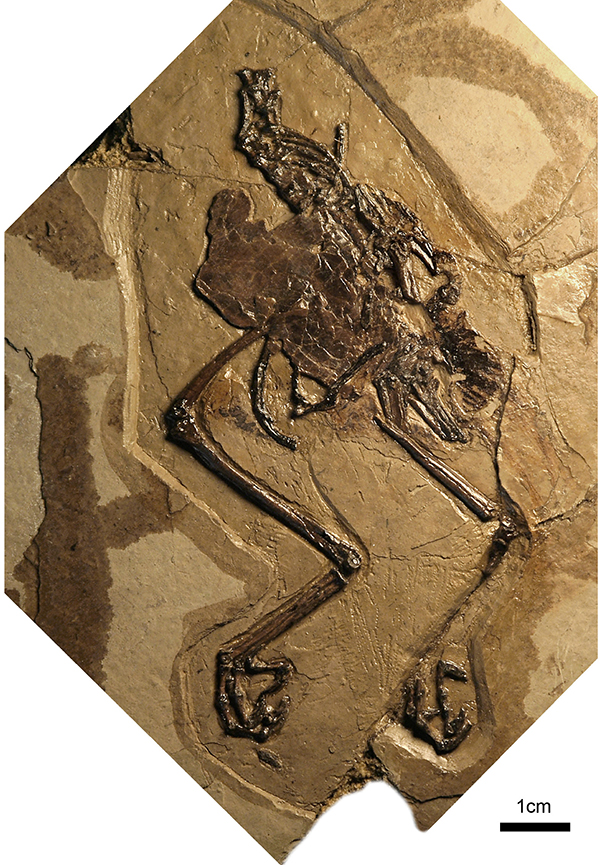
A flat brown sheet lies among the dark bones of a small bird. It has none of the reassuring roundness of an egg. For years, researchers looking at the specimen could not identify it: perhaps displaced bone, perhaps something softer. The answer emerged when a fragment was cut thin enough for light to pass through it. Under the microscope, the sheet became recognizable as eggshell.[1]
The bird was Avimaia schweitzerae, an extinct enantiornithine from the Early Cretaceous Xiagou Formation of Gansu, northwestern China, around 110 million years ago.[6] Her fossil offers an unusually intimate glimpse of reproduction. It also asks us to separate three questions that are easy to merge: what she was carrying, what had gone wrong, and what killed her.
An egg between two bones
Identifying eggshell did not immediately establish where the egg had been. In her firsthand account of the discovery, Alida Bailleul recalls wondering whether the bird had been sitting on it. Jingmai O’Connor pointed out the decisive arrangement: one pubic bone lay above the egg and its counterpart below. The shell was enclosed within the pelvis. That position supported an unlaid egg inside the body, rather than an egg beneath a brooding bird.[1]
Two kinds of evidence had come together. Microscopic structure identified the material; its relationship to the skeleton located it. Either observation alone would have left a larger opening for alternatives. The discovery depended on reading the tiny sampled fragment and the surrounding slab together.
The specimen, catalogued as IVPP V25371, is a partial skeleton with feather traces, including the rear trunk, pelvis and hindlimbs.[2] Missing anatomy limits the portrait of the living animal, but it does not erase the relationship preserved at its center. Here, an incomplete bird supplies evidence that a more spectacular complete skeleton might lack.
What a doubled shell can mean
The 2019 description by Bailleul and colleagues reported four to six compressed sheets of eggshell in thin sections. That count is not a tally of eggs, nor of coatings added during life. Opposite walls of a collapsed egg can lie together. The authors favored an abnormal egg whose walls had each acquired an additional coating after remaining too long in the reproductive tract.[2]
But the paper also describes breakage, sediment between sheets, and displacement during burial. Folding and compression could imitate some apparent duplication. Unusual shell thickness and proportions contributed to the pathological interpretation; the layering alone did not settle it. Death through egg binding was therefore a proposed explanation, not an observed event.[2]
This distinction changes the emotional force of the fossil. We can recognize reproduction interrupted without pretending to have watched the interruption. The shell preserves physical consequences of both life and burial, and those processes have to be untangled before either becomes a diagnosis.
A female bird does not identify every tissue
The institute’s announcement also highlighted possible medullary bone inside the thighbone.[6] Living female birds form this temporary tissue during the laying cycle and draw on its calcium for eggshell production. Finding it in a fossil could connect reproductive anatomy with the physiological work of making an egg.[3]
Yet tissue identification requires more than knowing that the animal was female. In 2020, Aurore Canoville, Mary Schweitzer and Lindsay Zanno directly questioned the Avimaia interpretation. The inner tissue had an orderly, lamellar structure, whereas their criteria called for a predominantly woven organization. They also challenged the suggestion that slower growth readily explained the difference: preliminary observations in slow-growing kiwi did not produce the expected parallel.[3]
The disagreement concerns what the bone tissue is. It does not remove the eggshell from the pelvis. A reproductive female may provide unusually helpful context for identifying a calcium-storage tissue, but context cannot make every layer of internal bone that tissue. Keeping the questions separate prevents uncertainty in one observation from swallowing the whole specimen.
Another slice, an unfinished argument
The bone continued to attract attention. In a 2025 study, Jessie Atterholt, O’Connor and Hailu You described a second thin section from the same femur, slightly farther along its shaft. They again identified an internal layer as medullary bone, describing projections extending into the cavity. They also acknowledged microbial damage that obscured some microscopic detail.[4]
This was additional observation, rather than a direct rebuttal of the 2020 critique. The later paper did not explicitly address that critique. It is therefore misleading either to announce that the identification was overturned or to treat its repetition as the end of the argument.[3][4]
The new section also showed variation in the appearance of a growth mark along the same bone. That offers a practical reason to keep examining the specimen: one polished slice does not necessarily represent every part of a skeleton.[4] A fossil can remain scientifically productive long after its species receives a name.
Protection without a preserved nest
The egg’s outer coating adds another, different kind of clue. The institute reported tiny mineral spheres in this protective cuticle and compared them with structures in living birds associated with humid nesting environments.[6]
There is experimental support for a protective function. A 2017 study by Liliana D’Alba and colleagues compared cuticles in seven ground-nesting bird species. Removing the cuticle showed that these nanostructured surfaces reduced bacterial attachment and penetration. Their effects also included changes in ultraviolet reflectance and, in some species, gas exchange.[5]
That makes the fossil comparison biologically meaningful. It does not locate Avimaia’s nest or show how deeply she buried an egg. A surface capable of helping resist microbes supports a functional interpretation; a particular nesting scene requires further evidence. The slab preserves an egg inside a bird, not the place where she intended to lay it.
Return to the flat patch between the bones. Its identification survives the uncertainty around shell deformation, tissue classification and death. Avimaia remains a reproductive female caught before laying. What makes her valuable is the ability to keep testing the smaller stories gathered around that fact, without requiring them all to be equally certain.
Sources
- Alida Bailleul, “An egg found inside a fossil bird, by accident!”, Springer Nature Research Communities (March 20, 2019)—firsthand account of microscopy and the egg’s position between the pubic bones.
- Alida M. Bailleul et al., “An Early Cretaceous enantiornithine (Aves) preserving an unlaid egg and probable medullary bone,” Nature Communications 10, 1275 (2019)—specimen anatomy, shell layering, burial alternatives and proposed pathology.
- Aurore Canoville, Mary H. Schweitzer and Lindsay Zanno, “Identifying medullary bone in extinct avemetatarsalians: challenges, implications and perspectives,” Philosophical Transactions of the Royal Society B 375, 20190133 (2020)—tissue criteria and the specific challenge to Avimaia; author-hosted full text.
- Jessie Atterholt, Jingmai K. O’Connor and Hailu You, “Osteohistology of enantiornithine birds from the Lower Cretaceous Xiagou Formation,” Geobios 90, 5–16 (2025)—a second femoral section and variation within the Avimaia holotype; author-hosted full text.
- Liliana D’Alba et al., “What Does the Eggshell Cuticle Do? A Functional Comparison of Avian Eggshell Cuticles,” Physiological and Biochemical Zoology 90, 588–599 (2017)—experimental comparisons of protective cuticles in living birds.
- Institute of Vertebrate Paleontology and Paleoanthropology, “Avimaia schweitzerae” (March 22, 2019; institutional account in Chinese)—formation, age, reproductive interpretations and the specimen photograph supplied by Alida Bailleul.