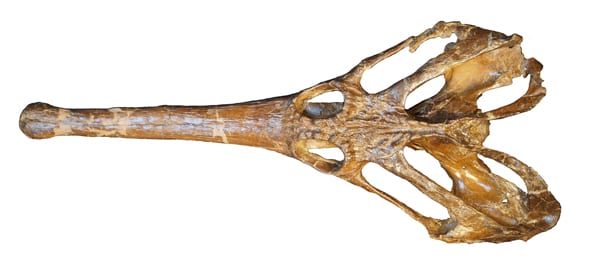
Follow the snout backward. The narrow jaws run into a skull that suddenly opens out, its rear corners held apart by sweeping arches of bone. In the Canadian Museum of Nature's photograph, the head looks almost too delicate for its width. Those arches anchored jaw muscles; the slim bones also help explain why intact skulls are unusually valuable.[1]
This specimen, CMN 8920, belongs to Champsosaurus lindoei. Collected in Alberta in 1953 from the Dinosaur Park Formation, it comes from the Late Cretaceous world of western North America. The formation places that world roughly 75 million years ago. Champsosaurus belonged to Choristodera, an extinct reptile group whose precise position among other reptiles remains debated. Its resemblance to a crocodilian offers a useful starting comparison, but the skull contains a different arrangement of working parts.[2][6]
To understand this freshwater hunter, it helps to follow a meal: capture it, keep hold of it, move it toward the throat. Then consider what the animal could detect before it struck.
A mouth with an inner grip
Behind the familiar teeth along the jaw margins, Champsosaurus carried teeth across the roof of its mouth. These palatal teeth distinguish it from living crocodilians.[3]
Ryoko Matsumoto and Susan Evans examined choristodere palates in a study published in 2016. They found rows of conical teeth whose orientations change across the mouth. That organization supports a role in moving captured food inward, probably with help from a fleshy tongue. A prey animal caught between the jaws would still have to be repositioned and swallowed; the inner teeth could assist that second task.[3]
The tongue's movements are not preserved, and a pointed tooth cannot identify a particular fish species. What the fossils supply is a patterned gripping surface, suggesting how prey could pass through the mouth after the initial bite.[3]
The neck changes the strike
A long snout encourages comparison with the fish-eating gharial, Gavialis gangeticus. Yet a head can move only as its joints allow. In a 2022 study, Matsumoto, Shin-ichi Fujiwara and Evans compared fossil neck vertebrae with modern crocodilian specimens, scanning gharial and caiman necks in different positions to test their anatomical measures.[4]
The comparison supported sideways sweeping in Champsosaurus, but the movement was distributed differently. In the gharial, much lateral bending occurs toward the front of the neck. The fossil reptile's middle and rear neck joints were better suited to that motion. Its broad skull also extended over the beginning of the neck, constraining movement there.[4]
Upward bending was more limited. That makes tossing prey backward through rapid head movements less plausible for Champsosaurus. The palate provides a compatible alternative: food could have been worked inward using the tongue against the tooth rows.[4]
The resulting animal is easier to imagine without making it perform an exact modern routine. A sideways strike is supported by the joints; its speed, timing and success remain outside the evidence.
An underwater sensory world
The skull's underside posed another problem. Paleontologists had proposed that a pair of openings led into the inner ears, an unusual orientation that was difficult to establish in fragile fossils. Thomas Dudgeon and colleagues used CT scanning to trace the internal anatomy of CMN 8920. Their 2020 description confirmed the downward-facing openings, known as the fenestrae ovales.[2]
These are openings in the bony ear region. They should not be imagined as two human-style external ears hanging beneath the head. Establishing where an opening leads is one question; recovering the hearing system that operated around it requires further comparison.
A separate 2020 study examined the sensory anatomy of two skulls, representing C. lindoei and C. natator. Their reconstructed inner-ear cavities suggested sensitivity to low-frequency vibrations in water. The authors also found that the semicircular canals, involved in balance, resembled those of other aquatic reptiles.[5]
Smell was probably significant too. Long olfactory stalks and spacious nasal chambers supported that interpretation, although incomplete bony enclosure prevented a reliable measurement of the olfactory bulbs. The researchers could propose a capable sense of smell without assigning it a precise score.[5]
Together, these comparisons suggest a hunter receiving information through several channels. They do not show which sense initiated a particular strike. A fossil skull can constrain the sensory world an animal inhabited while leaving the sequence of its decisions unrecoverable.
A wider river country
A C. lindoei skeleton from Montana's Two Medicine Formation, described by Dudgeon, Jordan Mallon and David Evans in 2023, extended the species beyond its previously confirmed Alberta occurrences.[6]
Its deposits represent a comparatively dry, seasonal landscape crossed by streams and rivers. The find suggests that Champsosaurus could occupy waterways within drier regions than its usual wetland associations might imply.[6]
The same study's family-tree analysis supported at least three Champsosaurus lineages surviving the extinction at the end of the Cretaceous, about 66 million years ago. That result describes evolutionary persistence; it does not demonstrate that any one feeding adaptation caused survival.[6]
Return to the photographed skull and its long, fragile snout. The outline is now only the entrance to the animal. Behind it are surfaces that held food, joints that directed a strike, and cavities that preserve clues to perception. Each brings the hunter into sharper focus without requiring the stone to remember an entire life.
Sources
- Thomas Dudgeon, “Champsosaurus: CT scanning reveals its ear openings really were on the bottom of its skull,” Canadian Museum of Nature (February 6, 2019)—specimen photographs, skull architecture and research context.
- Dudgeon et al., “Computed tomography analysis of the cranium of Champsosaurus lindoei…” (2020)—CMN 8920, collection history and inner-ear openings.
- Matsumoto and Evans, “Morphology and function of the palatal dentition in Choristodera” (2016)—tooth arrangement and food transport.
- Matsumoto, Fujiwara and Evans, “Feeding behaviour and functional morphology of the neck…” (2022), UCL repository—Champsosaurus and gharial feeding mechanics.
- Dudgeon et al., “The internal cranial anatomy of Champsosaurus…: Implications for neurosensory function” (2020)—olfaction, hearing and balance.
- Dudgeon, Mallon and Evans, “The first report of Champsosaurus lindoei…from the Campanian of the United States…” (2024; online 2023)—age, habitat and lineage survival.