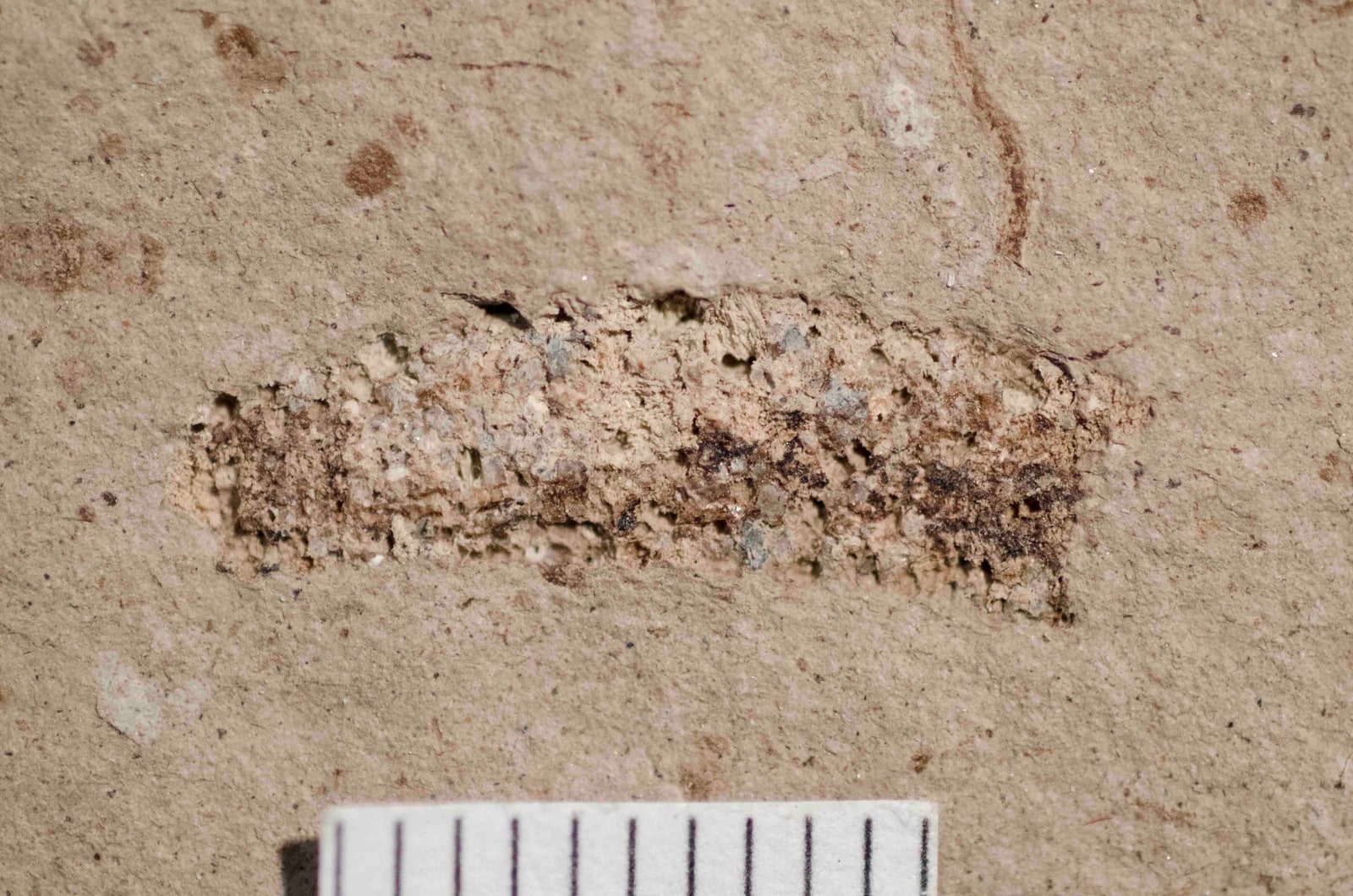
The little structure in the photograph has the rough outline of a rolled sleeve. Fragments interrupt its surface; a ruler supplies scale. The National Park Service labels this Florissant fossil a caddisfly “nest.” What survives is an insect’s construction, a small arrangement of material that once surrounded a living occupant.[1]
Such objects complicate the familiar picture of fossilization. An animal can leave behind a structure it assembled from its surroundings. In some ancient lakes, those structures also helped shape the accumulating carbonate. The insect’s shelter became part of the architecture of the rock.[3][4]
A house made from the neighborhood
Living caddisflies, insects in the order Trichoptera, offer a starting point. Their aquatic larvae use silk in several ways. Some construct nets; others bind sand, small stones or plant fragments into protective cases. The finished cases can resemble tubes, purses or tiny shells. A collection of apparently ordinary debris becomes easier to recognize as animal work when it moves across the streambed.[2]
The distinction between a body and a built object matters here. Each particle in a case has a history before the larva acquires it. The insect then changes the particles’ arrangement. A fossil case therefore invites two questions: what materials were available, and what did the builder do with them? Reading only the outline loses the first question; treating the object as an accidental clump loses the second.
That makes these fossils unusually intimate. A wing records the anatomy an insect grew. A case can preserve the surroundings it gathered.
A submerged log acquires new occupants
A 1999 study by Mark Loewen, V. Leroy Leggitt and H. Paul Buchheim described caddisfly cases from two shoreline sites in Wyoming’s Eocene Fossil Basin. The specimens came from the Green River Formation. One retained bark impressions; another preserved a forked, loglike form. Carbonate coatings and laminated microbial growth covered the wood surfaces, with small tubes above them.[3]
The tubes, roughly 15–20 millimeters long, were interpreted as larval cases. Few construction grains were visible in their walls, leading the researchers to suggest that silk had supplied much of the original structure. They inferred that further carbonate coating developed after the cases were abandoned.[3]
Their reconstruction gives the rock a sequence: submerged wood acquired a mineral and microbial covering; larvae colonized the surface; empty cases received additional coatings. The researchers also proposed that the resulting framework could trap small carbonate particles between its tubes. The shelter’s physical effects could continue after its occupant departed.[3]
In this reading, identifying the fossil also changes the explanation of its enclosing rock. The cases helped organize a surface on which sediment accumulated.
When small constructions add up
Older deposits in Mongolia carry the relationship to the scale of a mound. Tsolmon Adiya and colleagues examined microbial growth associated with caddisfly cases in the Early Cretaceous Shinekhudag Formation, which their 2017 study placed at approximately 140–130 million years old. The mounds measured about 0.5–2 meters across, with cases accounting for as much as 40 percent of an individual mound’s volume.[4]
Microscopic sections revealed case walls containing plant fragments, small crustacean shells and mineral grains. Microbial carbonate structures grew around the concentrations of cases. The deposit combined insect construction with microbial growth and carbonate cementation; its size belonged to that collective history.[4]
The authors interpreted the assemblage, together with the surrounding sedimentary evidence, as a shallow lake-margin setting. The materials inside a case contributed one line of evidence. The mound’s structure and its position among other beds supplied others.[4]
This is the crucial change of scale. A larva arranges a few available pieces around its body. Repeated constructions become surfaces and spaces that other processes can occupy. What began as shelter can eventually become a recognizable component of a rock mass.
The finished house keeps some secrets
A case still cannot replay its builder’s movements. In a 2002 study of living caddisflies, Alison Stuart and Douglas Currie found that similar structures could result from different building behaviors, while similar behaviors could produce different structures. Their comparisons tested a tempting shortcut: assuming that the finished object transparently records the sequence that made it.[5]
For a fossil, the implication is a useful restraint. Arranged grains can support a construction interpretation without recovering every movement of the animal. Resemblance alone cannot supply the missing performance. A careful account can identify a house and still leave much of its construction procedure unresolved.[5]
Evolution adds another complication. Paul Frandsen and colleagues’ 2024 analysis combined genetic data from 207 caddisfly species with fossil calibrations. Their reconstruction inferred three separate origins of portable case making. Carrying a shelter was an evolutionary solution reached in several lineages, so the broad habit cannot by itself place an unidentified fossil builder on one branch of the family tree.[6]
These studies work at different scales: one compares movements and their products; the other reconstructs the history of a behavior across lineages. Together they make an empty case more interesting. Its materials and arrangement remain available for inspection, even when the occupant’s identity and precise actions do not.
Return to the rough sleeve in the photograph. Its edges mark the boundary of a little shelter. The Wyoming and Mongolian examples invite us to look beyond that boundary, toward the surfaces the cases offered and the particles caught around them. An insect could alter the future rock through the ordinary business of making somewhere to live.[3][4]
Sources
- National Park Service, “Caddisfly nest,” Florissant Fossil Beds National Monument — source photograph and institutional attribution, via Wikimedia Commons.
- National Park Service, “Caddisflies,” Rocky Mountain National Park — living larvae, silk use and case materials.
- Mark A. Loewen, V. Leroy Leggitt and H. Paul Buchheim, “Caddisfly (Trichoptera) larval cases from Eocene Fossil Lake, Fossil Butte National Monument” (1999), NPS Paleontological Research, volume 4, pp. 72–77 — specimens, coatings and depositional interpretation; PDF page 80 onward.
- Tsolmon Adiya et al., “Microbial-caddisfly bioherm association from the Lower Cretaceous Shinekhudag Formation, Mongolia: Earliest record of plant armoring in fossil caddisfly cases,” PLOS ONE (2017) — field relationships and petrography.
- Alison E. Stuart and Douglas C. Currie, “Behaviour is not Reliably Inferred from End-Product Structure in Caddisflies,” Ethology (2002) — direct comparisons of construction behavior and finished cases.
- Paul B. Frandsen et al., “Phylogenomics recovers multiple origins of portable case making in caddisflies (Insecta: Trichoptera), nature’s underwater architects,” Proceedings of the Royal Society B (2024) — genetic analysis, fossil calibration and ancestral behavior reconstruction.