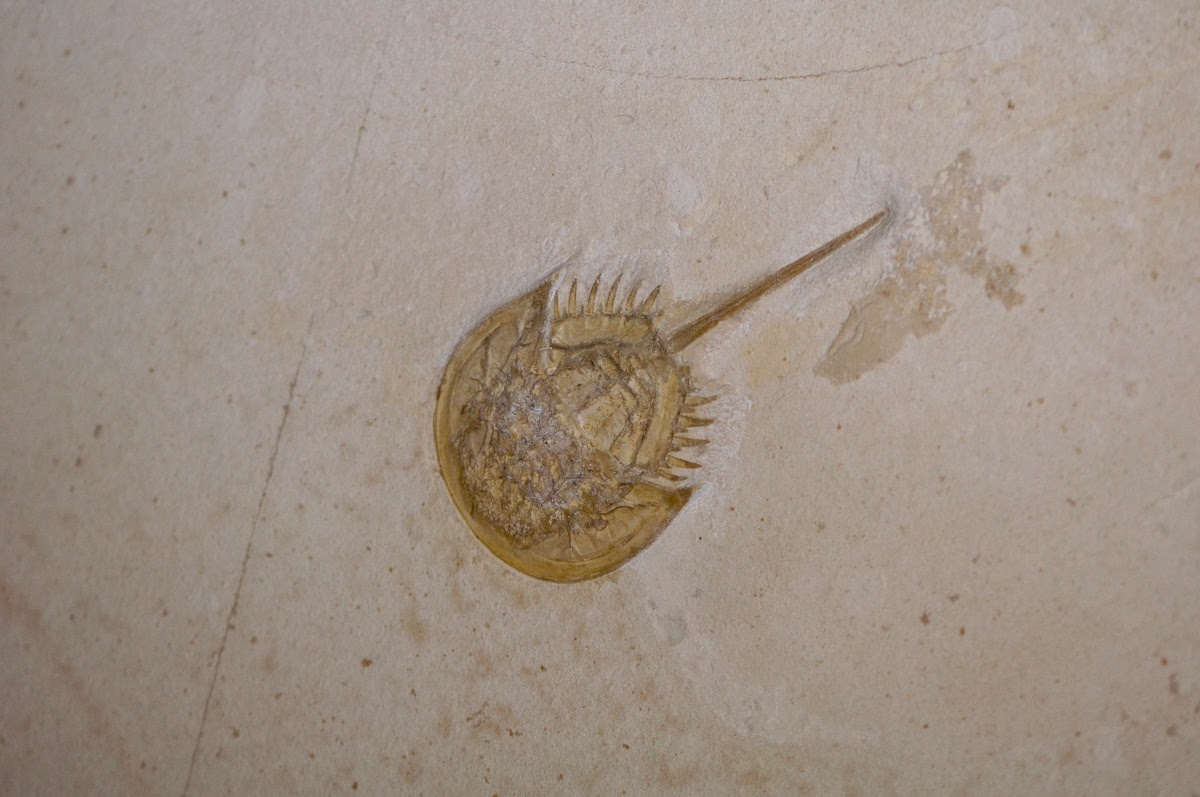
Follow the marks far enough and the animal is still there. A horseshoe crab lies at the end of a 9.7-metre trackway recovered near Wintershof, Bavaria, in 2002. The limestone preserves footprints, tail-spine scratches and front-shield impressions: an unusually intimate connection between an animal and the record of its own movement.[1]
The crab is Mesolimulus walchi. The rock belongs to the Lower Tithonian, late in the Jurassic, roughly 150 million years ago. Dean Lomax and Christopher Racay described the trackway in Ichnos in 2012, identifying the traces as Kouphichnium and interpreting the sequence as a mortichnion: a trail made before death.[1][3]
That interpretation is compelling. It also contains several separate claims. Identifying the walker, reconstructing its movements and explaining why it died require different evidence. This extraordinary fossil lets us follow that distinction across a single surface.
A body gives the footprints an owner
A footprint usually arrives without a foot. Here, the terminal body anchors the attribution. The researchers reported a complete trackway, from its beginning to the preserved crab, rather than a short trail disappearing beyond a broken slab.[2]
Mesolimulus names the animal; Kouphichnium names the trace. The two labels distinguish the walker from the marks it left.[1]
The difference becomes tangible in the Wyoming Dinosaur Center’s photographs. A narrow central mark records contact by the telson, the long tail spine, while leg impressions flank it. Elsewhere, the front shield has pressed into the sediment. The museum suggests a pause or an attempt to burrow. The imprint is visible; the purpose of that contact has to be reconstructed.[3]
Read this way, the slab holds a sequence of changing contacts. A body fossil supplies anatomy. Its trail adds a before and an after, without supplying a stopwatch.
The scratches change before the body stops
Lomax and Racay’s preliminary 2010 conference report identifies the specimen as WDC CSG-233. It describes long, comparatively regular telson impressions early in the trail, followed by shorter, more erratic marks over approximately the final third. They suggested that the animal might have been trying to swim upward and escape the lagoon.[2]
The shortening marks are observations. Attempted escape is an explanation for them. The distinction matters because it prevents a fossil sequence from becoming a screenplay. We can discuss a change in movement without claiming access to the animal’s intentions.
The same report notes that no footprints lead away from the terminal fossil. That supports reading the remains as a carcass rather than an abandoned moult. The authors also found no predatory marks to support a scenario in which a predator dropped the crab. Neither observation establishes a precise cause of death; the report explicitly leaves that cause unknown.[2]
The museum’s account proposes suffocation in oxygen-poor bottom water and interprets disturbed sediment at the beginning as a landing followed by righting of the body. These make the trail legible as a story. They remain reconstructions of the circumstances around the preserved impressions.[3]
A discarded shell can tell a different story
There is a good reason to ask whether a fossil arthropod at the end of some scratches actually died there. Arthropods shed their outer skeletons. A recognisable fossil body outline can therefore represent clothing left behind by a survivor.
In a 2015 study, Lothar Vallon and colleagues re-examined Solnhofen structures previously attributed to dead organisms swaying in currents. They interpreted many as traces of moulting. One specimen of the lobster Mecochirus preserves a sequence of arrival, disturbed sediment, a shed exoskeleton and a departing trail. The animal had walked away. The adjacent slab was not collected, so its subsequent path is unavailable.[4]
That comparison does not reclassify the Wintershof crab. It explains why the connection between marks and remains needs examination. A departure trail can turn an apparent death scene into evidence of successful growth. An irregular patch of sediment can record the effort of escaping an old skeleton.[4]
It also complicates a universal picture of Solnhofen’s bottom waters as instantly fatal. Vallon and colleagues identified evidence of moulting and scavenging in these deposits. Conditions must be reconstructed at the scale supported by the particular fossils, rather than assigned to every slab through one dramatic environmental label.[4]
Even a long trail need not record a living journey
A second comparison comes from an ammonite described by Lomax and colleagues in 2017. Its shell rests at the end of an 8.5-metre mark from the Solnhofen limestones. Here, parallel ridges and furrows match the ribs of a shell that drifted across the sediment after death. The authors classify it as a tool mark, rather than a mortichnion.[5]
The visible association is remarkably similar: a long line, then an identifiable fossil. The mechanism is different. In one case, footprints support active locomotion; in the other, shell ribs scratched the bottom as physical forces moved the remains. The ammonite’s original first contact is also missing, unlike the reported complete Wintershof trackway.[1][5]
The crab’s significance lies in that unusually connected evidence. We can follow an animal through a succession of contacts with the ground and arrive at its preserved body. We can then test explanations against what the surface retains. Its movements are closer to us than its motives, and its final position is clearer than its cause of death. The fossil remains absorbing at exactly that level of resolution.
Sources
- Dean R. Lomax and Christopher A. Racay, “A Long Mortichnial Trackway of Mesolimulus walchi from the Upper Jurassic Solnhofen Lithographic Limestone near Wintershof, Germany,” Ichnos 19 (2012), 175–183 — university record and abstract documenting discovery, age, completeness and trace identification.
- Dean R. Lomax and Christopher A. Racay, Geological Society of America Rocky Mountain meeting abstract (2010) — specimen WDC CSG-233, changing telson marks, absence of departing footprints and uncertainty about death.
- The Wyoming Dinosaur Center, “Final Journey of the Horseshoe Crab,” Google Arts & Culture — institutional photographs, image provenance and the museum’s interpretation of the trackway.
- Lothar H. Vallon and colleagues, “Ecdysichnia — a new ethological category for trace fossils produced by moulting,” Annales Societatis Geologorum Poloniae 85 (2015), 433–444 — moulting sequences and reassessment of Solnhofen traces; full paper on the journal’s website.
- Dean R. Lomax and colleagues, “An 8.5 m long ammonite drag mark from the Upper Jurassic Solnhofen Lithographic Limestones, Germany,” PLOS ONE (2017) — a postmortem tool mark and the limits of inferring behaviour from a body at a trail’s end.