The surprise in Brachytrachelopan mesai comes just ahead of the shoulders. A museum reconstruction supplies the familiar sauropod ingredients: a deep rib cage, four substantial legs and a long tail. Then the neck ends almost before the eye expects it to begin. When Oliver Rauhut and colleagues described this Patagonian dinosaur in 2005, they reported a neck about 40 percent shorter than those of other known dicraeosaurids—a family already on the short-necked side of sauropod diversity.[1]
That comparison matters more than the superlative. The animal was shortening an anatomical feature that other sauropod lineages stretched spectacularly. Its proportions offer a way into a practical question: what could a large plant eater gain by keeping its mouth closer to its body?
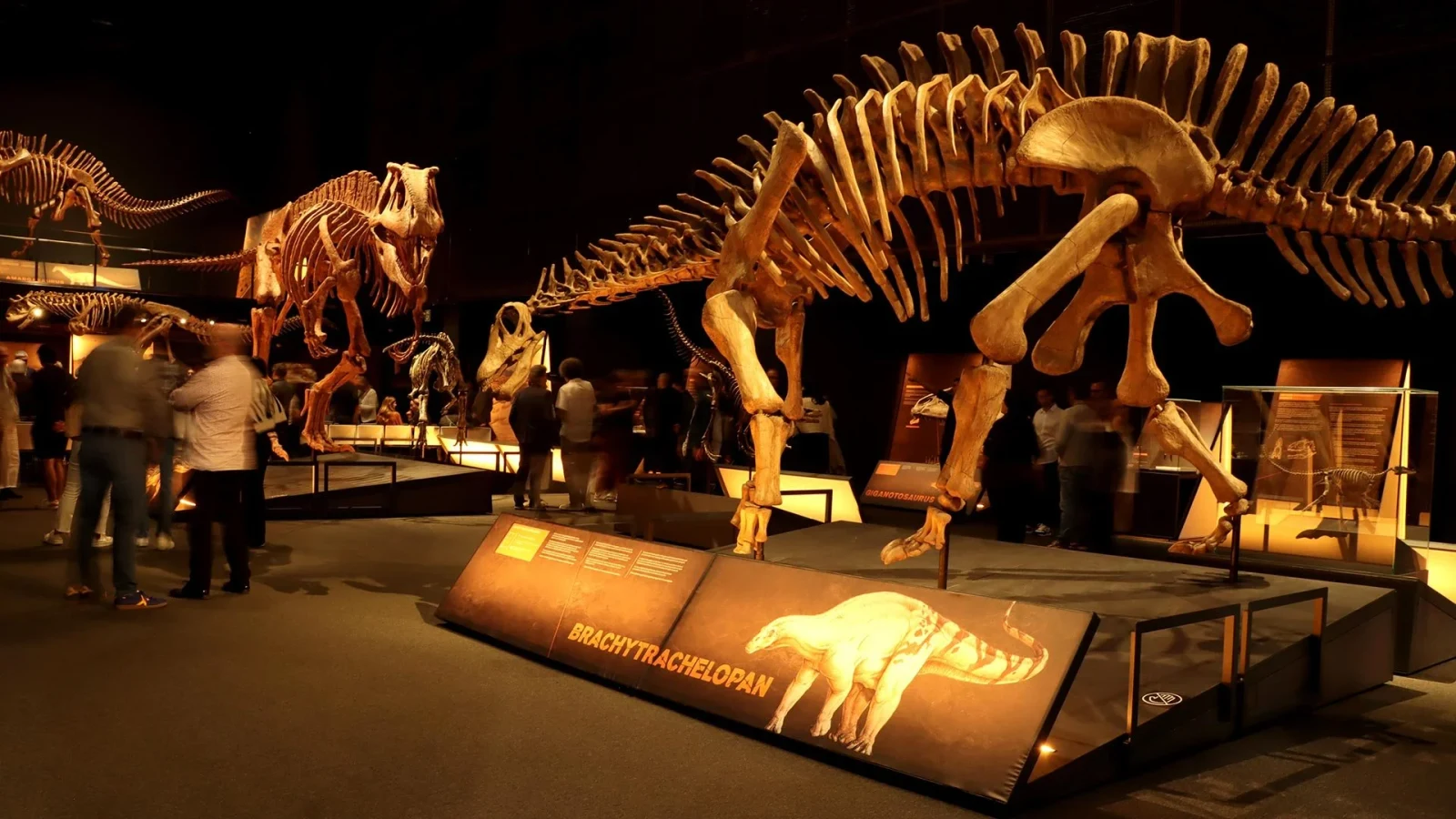
A partial animal from a river landscape
The specimen behind the name is MPEF-PV 1716, held by the Museo Paleontológico Egidio Feruglio in Argentina. Its scientific value lies largely along the backbone. Preserved portions include neck, trunk and sacral vertebrae, ribs, pelvic material and parts of a hind limb. There is no skull in that inventory. The bones establish much of the animal's central framework, while a complete museum silhouette necessarily extends beyond what was recovered.[1][3]
The fossil comes from the Cañadón Calcáreo Formation of Chubut, in central Patagonia. These Late Jurassic deposits record rivers and lakes. A 2026 study of another sauropod from the formation summarizes radiometric evidence placing the unit's base at about 157.4 million years ago, near the Oxfordian–Kimmeridgian boundary.[4] That date anchors the rock succession; it is not an exact birthday for the Brachytrachelopan skeleton.
The same study maps several sauropod localities within the formation, including Brachytrachelopan, Tehuelchesaurus and the newly named Bicharracosaurus.[4] This places the short-necked animal within a broader regional record of sauropod variety. Those occurrences alone do not establish that every species fed together on the same floodplain at the same moment. Geological context gives us a landscape through time before it gives us a single community.
Shortness was built into the vertebrae
Neck length depends partly on how many vertebrae an animal has and partly on how far each vertebra extends. In Brachytrachelopan, the preserved neck vertebrae are conspicuously abbreviated from front to back. A 2025 synthesis describes an animal estimated at less than ten metres long, with exceptionally shortened cervical vertebrae and anatomy interpreted as restricting upward bending. It retains the proposed association with low browsing.[3]
This is a stronger observation than simply looking at a mounted skeleton and deciding that its head sits low. The proportions reside in the bones themselves. The feeding interpretation then asks what movements and positions those proportions would have made practical.
Michael Taylor and Mathew Wedel's 2013 comparison lists an estimated neck length of roughly 1.1 metres for Brachytrachelopan. Their table marks the cervical count as uncertain, a useful reminder that even a memorable measurement may combine preserved anatomy with reconstruction.[5] The exact total remains less secure than the striking compactness of the surviving components.
Their broader explanation of sauropod neck elongation makes this animal especially interesting. Large bodies on four legs provided stable support; relatively small heads reduced the load at the far end; and respiratory air spaces helped lighten neck structures. Together, such features allowed some sauropods to achieve extraordinary reach.[5] They made elongation possible without making it compulsory. Brachytrachelopan shows how far a lineage could depart from the familiar result.
Low food can reward a long neck, too
There is an appealing explanation ready to hand: short neck, low plants. Yet feeding height cannot carry the whole argument.
In 2011, Graeme Ruxton and David Wilkinson modeled the energetic benefits of low browsing in sauropods. A longer neck could let an animal sweep its mouth across a larger patch of vegetation while leaving its heavy body in place. Their calculations predicted substantial savings from the first extensions beyond the minimum length needed to reach the ground, followed by progressively smaller benefits from additional length.[6]
A long neck could therefore be useful close to the ground. It could increase horizontal coverage as well as vertical access. The model was not a simulation of Brachytrachelopan, and it does not explain this species' evolution by itself.[6] It does show why “the food was low” is an incomplete answer.
The more interesting possibility is that Brachytrachelopan exploited vegetation for which a compact, restricted reach worked well. Its anatomy makes that a reasonable hypothesis; identifying the relevant plants, their spacing or the animal's precise cropping behavior would require additional evidence. A short neck narrows the possibilities without preserving a menu.
Reading the animal beyond the mount
Reconstructing movement adds another uncertainty. In a 2022 survey, Taylor documented widespread incompleteness and distortion in sauropod neck fossils, including celebrated museum specimens. Missing pieces can be obscured by restoration, and crushing can alter the shapes of vertebral joints. These problems affect attempts to calculate habitual posture and flexibility from how fossil bones fit together.[7]
That general caution does not erase Brachytrachelopan's distinctive proportions. It changes the confidence we should place in a particular pose. A reconstruction can communicate a compact neck clearly while leaving its exact range of movement unresolved.
Look back at the photograph and the animal becomes more than an abbreviated version of a giant. Its short reach belongs to a real evolutionary branch with its own feeding constraints. The strongest story is already in the backbone: sauropods could retain a substantial body while taking neck proportions in a different direction. Explaining the daily life that made those proportions effective remains the next question.
Sources
- Oliver W. M. Rauhut and colleagues, “Discovery of a short-necked sauropod dinosaur from the Late Jurassic period of Patagonia,” Nature 435 (2005), 670–672—original description, holotype and proportional neck comparison.
- Ámbito Cero, “Dinosaurios de la Patagonia” (2023)—exhibition designer's project page and source of the museum photograph.
- Tom T. P. van der Linden and colleagues, “Introduction to Diplodocoidea,” Palaeontologia Electronica 28 (2025)—preserved Brachytrachelopan material, classification and feeding interpretation; institutional PDF.
- Alexandra Reutter and colleagues, “Bicharracosaurus dionidei, gen. et sp. nov., a new macronarian (Dinosauria, Sauropoda) from the Late Jurassic Cañadón Calcáreo Formation of Argentina and the problematic early evolution of macronarians,” PeerJ (2026)—formation age, depositional setting and mapped sauropod localities.
- Michael P. Taylor and Mathew J. Wedel, “Why sauropods had long necks; and why giraffes have short necks,” PeerJ 1 (2013), e36—comparative measurements and anatomical prerequisites for elongation.
- Graeme D. Ruxton and David M. Wilkinson, “The energetics of low browsing in sauropods,” Biology Letters 7 (2011), 779–781—modeled benefits of horizontal feeding reach.
- Michael P. Taylor, “Almost all known sauropod necks are incomplete and distorted,” PeerJ 10 (2022), e12810—preservation limits on reconstructing neck posture and movement.