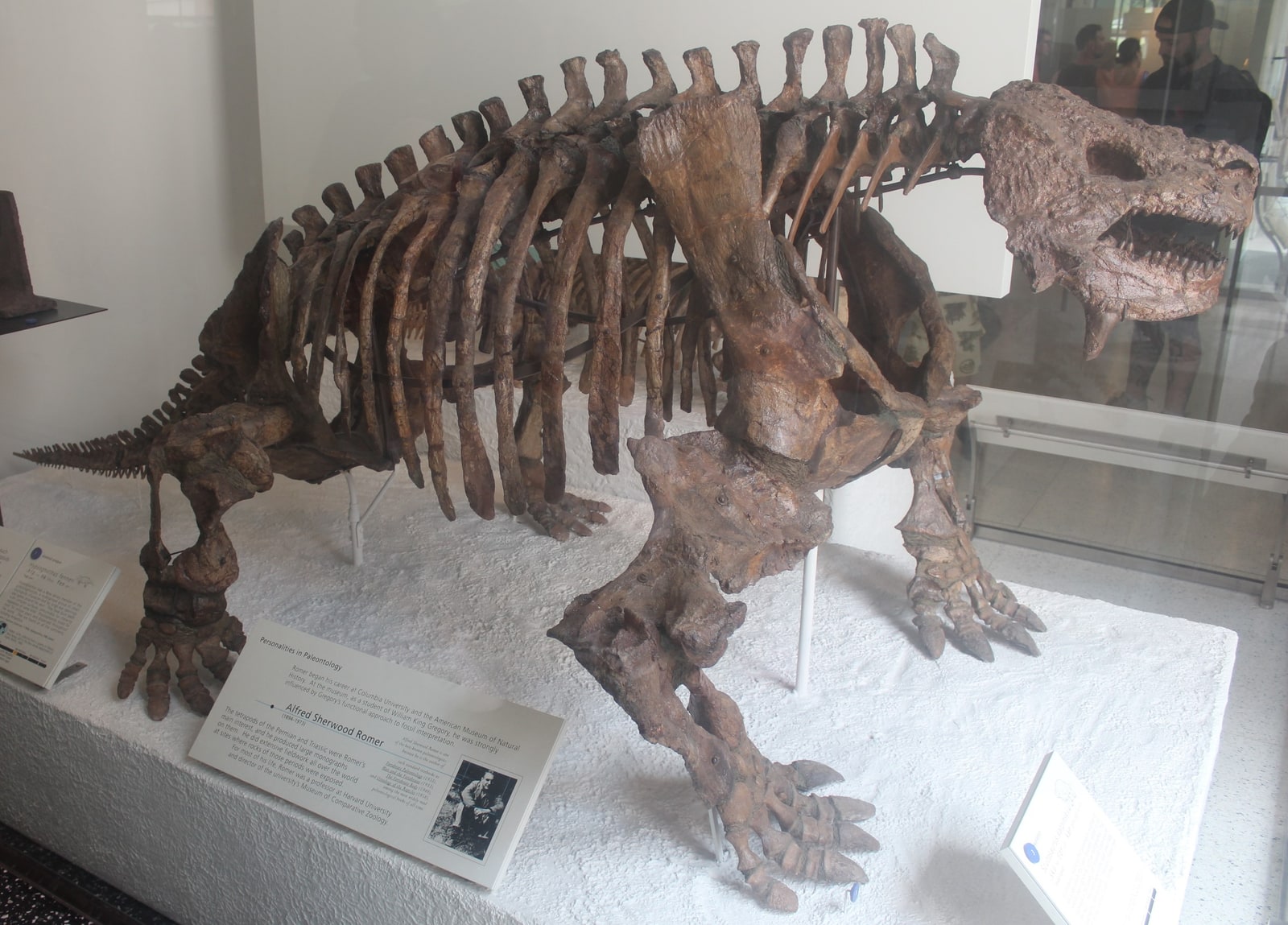
A broad rib cage, stout limbs, a skull edged with knobs: the mounted Scutosaurus at the American Museum of Natural History makes its bulk visible even without flesh. The ribs enclose an impressive amount of empty space. Looking at that space raises two questions a skeleton alone cannot answer immediately: how heavy was the living animal, and how did it become so large?[1]
Scutosaurus karpinskii belonged to the herbivorous pareiasaurs of the Late Permian, roughly a quarter of a billion years ago. Several nearly complete skeletons come from Sokolki in Russia's Arkhangelsk region. Flattened, leaf-shaped teeth support plant eating; the capacious body suggests room for a large digestive tract.[2]
Putting flesh around the ribs
In 2021, Marco Romano and colleagues used photographs to build a digital model of the Moscow specimen PIN 2005/1537. They added different amounts of soft tissue and tested different tissue densities. Their preferred estimate was about 1,160 kilograms; the full modeled range ran from roughly 1,000 to 1,460 kilograms.[2]
This is a reconstruction of one large individual, not a measurement taken in life. The range exposes the uncertainty in the missing flesh. Even its lower end leaves a substantial herbivore to feed and support.[2]
A fast start, then a slower life
The route to that bulk survives inside the bones. In a 2019 study, Elizaveta Boitsova and colleagues examined growth series of Scutosaurus and another Russian pareiasaur, Deltavjatia. Both deposited tissue associated with rapid early growth, interrupted by lines recording pauses. Later, the outer bone became more slowly formed and less vascular.[3]
The timing differed. The researchers placed the slowdown at about half the maximum body size in Deltavjatia, but around three-quarters in Scutosaurus. A longer initial period of rapid skeletal growth helped the latter reach its greater size.[3]
This gives the museum animal a life history. Its adult proportions were an outcome assembled over time, with a growing youngster eventually entering a slower phase. The microscopic record also resists the assumption that an extinct reptile must have grown slowly throughout its life. It documents changing growth, although it cannot by itself recover a complete annual calendar or the conditions behind every pause.[3]
A bony coat with taxonomic consequences
The animal's outer covering supplies a different kind of evidence. Pareiasaur skin contained bony plates called osteoderms. Their arrangement and shape can help distinguish animals whose overall outlines look similar.[4]
A 2025 study by E. I. Boyarinova and V. K. Golubev compared these coverings across eastern European pareiasaurs. It found useful differences at both genus and species level. The authors treated Scutosaurus karpinskii, S. tuberculatus and S. itilensis separately, whereas the 2021 body-mass study followed a broader, single-species interpretation.[4][2]
Here, S. karpinskii follows the identification used in the growth and mass studies. The distinction matters when assembling a portrait: a feature described in one named specimen should not automatically become a characteristic of every animal historically assigned to the genus. The bony coat carries information about identity as well as appearance. Even an imposing, familiar museum skeleton can sit within a classification that researchers are still refining.[4]
How firmly can we put it on land?
A heavy body makes water an appealing imagined refuge. Yet bulk alone cannot establish an aquatic lifestyle, and the 2019 study found that pareiasaur bone microstructure did not clearly resolve that question.[3]
Independent evidence comes from chemistry. In 2014, Aurore Canoville, Daniel Thomas and Anusuya Chinsamy compared stable isotopes in South African pareiasaurs and other animals from the same fossil assemblages. The pareiasaurs' tooth-enamel oxygen values resembled those of terrestrial carnivores more closely than those of the accompanying dinocephalians. The results supported life on land for the sampled pareiasaurs and suggested that the large herbivores occupied different ecological niches.[5]
The geographical and temporal boundary is essential: these were earlier South African relatives, not Russian Scutosaurus. Their chemistry strengthens a terrestrial interpretation for part of the family without measuring this species' own dependence on water. Neither a shared ancestry nor a similar barrel-shaped body makes the animals ecologically interchangeable.[5]
Return to the mount and its empty rib cage. We can now populate that outline with more than imagined flesh: a substantial adult, a prolonged early growth phase, and skin bones that remain useful for identifying specimens. Its movements between dry ground and water are harder to recover. The most convincing portrait gives each kind of evidence its proper reach, leaving a living animal more specific than its silhouette and less complete than a museum pose might suggest.
Sources
- Jonathan Chen, “Scutosaurus AMNH.jpg,” Wikimedia Commons (photographed July 7, 2024)—photograph and identification of the AMNH 5148 mount; CC BY-SA 4.0.
- Marco Romano et al., “Volumetric Body Mass Estimate and in vivo Reconstruction of the Russian Pareiasaur Scutosaurus karpinskii,” Frontiers in Ecology and Evolution (2021)—specimen context, anatomy, taxonomy and mass assumptions.
- Elizaveta A. Boitsova et al., “Bone histology of two pareiasaurs from Russia … with implications for pareiasaurian palaeobiology,” Biological Journal of the Linnean Society (2019)—institutional publication record and abstract covering growth and ecological limits.
- E. I. Boyarinova and V. K. Golubev, “Postcranial osteoderms of Late Permian pareiasaurs from Eastern Europe – II,” Paleontological Journal, no. 3 (2025)—English abstract of the Russian article; diagnostic armor and species treatment.
- Aurore Canoville, Daniel B. Thomas and Anusuya Chinsamy, “Insights into the habitat of Middle Permian pareiasaurs (Parareptilia) from preliminary isotopic analyses,” Lethaia (2014), author-hosted paper—South African comparison, not a direct test of Scutosaurus.