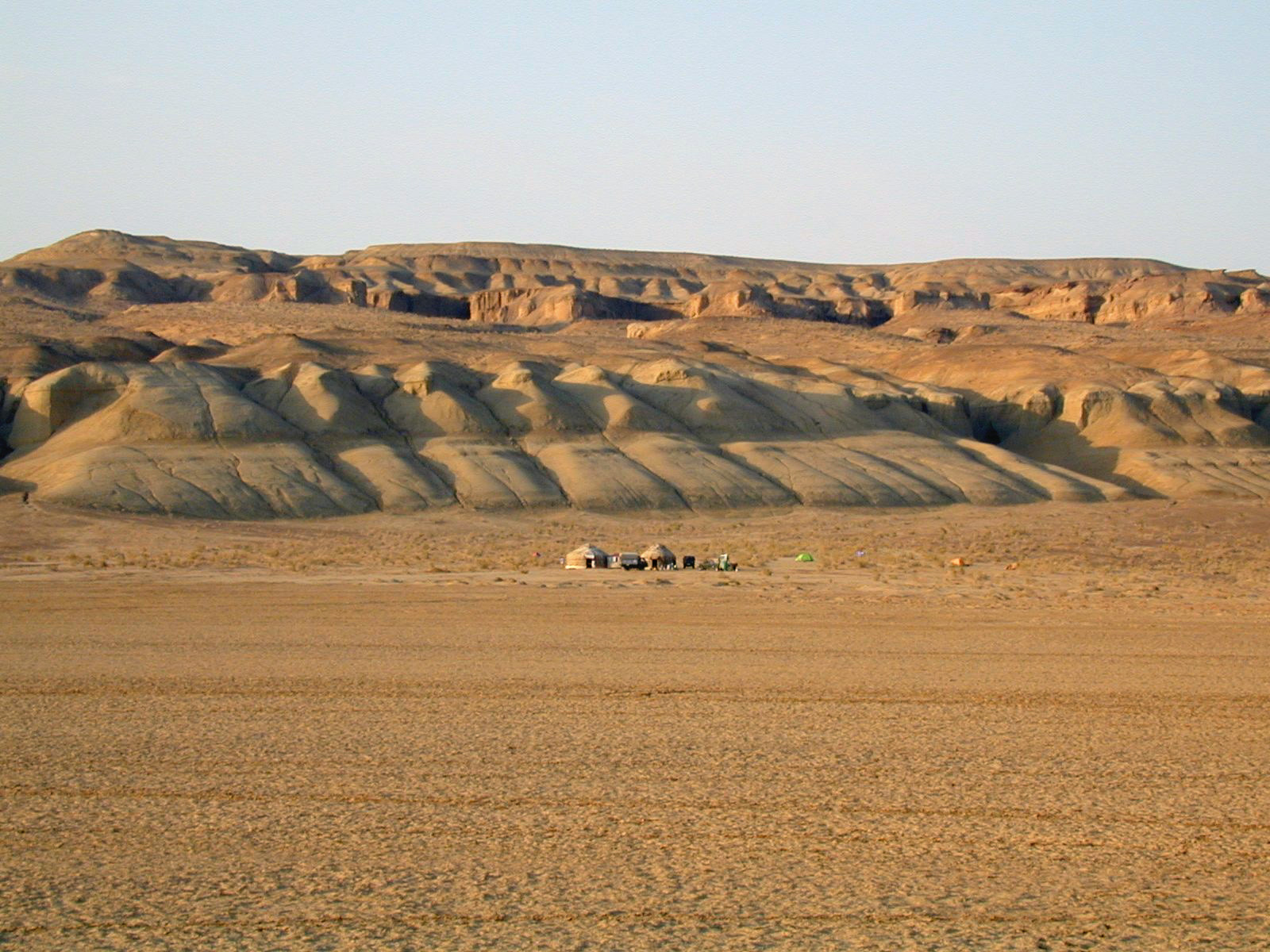

The Kyzylkum Desert does not look like a fish archive. At Dzharakuduk in Uzbekistan, paleontologists work an eroded escarpment of pale sand and gravel under a continental sky. Yet the Turonian-age Bissekty Formation records rivers moving through a coastal landscape roughly 90 million years ago, and its most revealing aquatic fossils are often not graceful skeletons pressed into slabs. They are isolated vertebrae, jaw pieces, teeth, fin spines, and scales—small objects whose identities have to be argued from anatomy before they can be plotted on a map.[2][3]
Donald Brinkman's Royal Tyrrell Museum lecture is valuable because it keeps changing scale. It begins with the work of identifying fragmentary fish remains, builds those fragments into an assemblage, and then asks what the assemblage says about movement between the Asian and North American parts of Laurasia.[1][4] The paired peer-reviewed study, published in the February 2026 volume of Cretaceous Research, makes the stakes precise: the Bissekty sample contains four basal neopterygians and 13 teleosts, including lineages whose distribution changed during the Turonian thermal maximum.[2]
That scale shift is also the video's main trap. Similar fossils on two continents can suggest biological connection, but they do not automatically reveal a direct route, a single direction of travel, or one moment of migration. Watch the lecture for how the argument is assembled: specimen to morphotype, morphotype to local census, local census to time-bounded comparison. Each step adds reach, and each step adds uncertainty.
Image context: the cover photograph shows the actual Dzharakuduk field setting rather than a life reconstruction. The expedition camp sits below the cliffs where fossil-bearing beds were collected. It belongs here because the article's continental argument depends on material recovered from a specific, difficult landscape—not on a clean paleogeographic arrow drawn after the fact.[5]
The Viewing
Start with fragments, not the continental map
The best way into the lecture is to resist the map for a while. Most Bissekty fishes are represented by isolated elements because a river system disarticulated, transported, sorted, and redeposited bodies. Teleosts are especially difficult in this state: many named fossil species are diagnosed from articulated skeletons, while Bissekty frequently offers one centrum or part of a dentary. Brinkman and colleagues therefore combine conventional taxonomy with recurring anatomical morphotypes, allowing distinctive fragments to participate in abundance and distribution analyses without pretending every fragment can be named to species.[2]
This is not a downgrade from “real” paleontology. It is the method matched to the archive. A complete fish skeleton can preserve relationships among bones, but it may represent one animal in one unusual burial event. Thousands of isolated elements can reveal which body parts and lineages repeatedly entered a channel deposit—provided recovery and transport filters remain visible. In the study's screened sample, bowfin-like Amia and an elopomorph related to Paratarpon are represented by particularly abundant vertebral material. Those counts are useful as relative evidence within the sample, not as a literal head count of the river.[2]
The distinction matters when the video moves from recognition to comparison. “The same fish” can mean several things: the same named species, the same genus, a close relative, or an indistinguishable fragmentary morphotype. The 2026 paper carefully uses all of those levels. A continental story built from them must preserve the difference rather than smoothing every resemblance into identity.[2]
The river carried a coastal signal
Bissekty is often introduced as a non-marine fauna, and that is broadly useful. The formation is dominated by cross-bedded fluvial sandstone and conglomerate, between older and younger units deposited in marginal or shallow seas.[2] But “non-marine” should not conjure an isolated freshwater lake far from salt water. Redman and Leighton's analysis of the formation found terrestrial remains mixed with marine and brackish-tolerant aquatic material in fossil-rich conglomerates, along with abrasion, fragmentation, imbrication, and winnowing that testify to transport.[3]
That geological texture changes the fish story. Some animals lived in rivers; some tolerated brackish water; some remains may have been moved between nearby environments before burial. The assemblage is therefore a sample of a connected coastal drainage system, filtered first by ecology and then by current, grain size, durability, and collection. When the lecture compares Bissekty with other Late Cretaceous fish faunas, the comparison works best among deposits with reasonably similar taphonomic settings. Otherwise, a difference attributed to climate or geography might partly be a difference in how bodies became fragments.
The same caution applies to absence. A fish can be missing because it did not live there, because its bones did not survive transport, because the productive bed was not sampled, or because diagnostic pieces remain unidentified. Absence becomes more persuasive when sampling is large, methods are comparable, and multiple anatomical signals agree. It is never made strong merely by leaving an empty cell in a table.
Climate opened a gate; it did not erase geography
During the Late Cretaceous, Asia and North America belonged to Laurasia and retained a high-latitude connection. That connection was not an all-season highway. For ectothermic animals, temperature could determine whether northern habitats formed a viable corridor or a physiological barrier. The study treats the Turonian thermal maximum as a period when dispersal through that high-latitude connection became more plausible, while still recognizing strong regional endemism.[2]
The Bissekty census contains the pattern that makes this hypothesis interesting. Compared with earlier Cenomanian assemblages, two formerly prominent kinds—a Scheenstia-type lepidotid and a pycnodont—are absent, while seven taxa appear. All seven newcomers are closely related to, or indistinguishable from, forms known in North America. Yet only two are recorded there during the Turonian; the others enter the North American record step by step later in the Late Cretaceous.[2]
That timing prevents an easy slogan. Shared forms support exchange across Laurasia, but the fossil record does not reduce to “Asia exported seven fishes to North America” at one date. Sampling gaps can make a lineage appear later than it truly arrived. A high-latitude connection can permit movement in either direction. One Bissekty characiform also belongs to a group thought to have originated in Gondwana, adding a northward or intercontinental layer that a simple Asia–North America shuttle cannot contain.[2]
The stronger reading is conditional: exceptional warmth changed the permeability of geography. It did not abolish distance, habitat, or chronology. Climate made some dispersal paths more usable; fossils from multiple regions and ages are still needed to reconstruct who moved, when, and in which direction.
Turnover here is mostly an arrival story
“Climate-driven ecological change” can sound like a miniature mass extinction, but that is not what the Bissekty result shows. The authors describe low disappearance among the nine taxa known from preceding Cenomanian assemblages: seven persist into the comparison, while two are absent. Much of the reorganization comes from addition—the seven first appearances—rather than wholesale replacement.[2]
That is a subtle but important point to carry away from the video. Climate can reorganize a fauna by enabling range expansion, connecting drainage systems, or changing which lineages can occupy a region. Extinction is only one mechanism. In Bissekty, the conspicuous signal is a mixture of persistence and arrival, with derived teleosts such as a characiform and an acanthomorph joining an assemblage still dominated by early-diverging lineages.[2]
It also explains why fish fragments can do work that a spectacular dinosaur skeleton cannot. An isolated tyrannosaur bone may transform a lineage history, but it says little by itself about the composition of a river. Repeated fish vertebrae and jaw pieces—collected systematically, sorted by anatomy, and compared with similarly assembled faunas—can register ecological turnover at community scale. Their evidential power comes from accumulation.
What to keep after the lecture
The lecture's largest map rests on its smallest objects. That does not make the argument fragile; it makes its dependency chain inspectable. The formation supplies transported fragments. Screening enlarges the sample. Comparative anatomy turns selected fragments into taxa or bounded morphotypes. Stratigraphy fixes the comparison in time. Only then can paleobiogeography test whether warmth made a northern connection more passable.[1][2][3]
The Dzharakuduk field photograph is a useful final check on that chain. A desert cliff is not evidence of a Cretaceous migration by itself. Neither is one fish centrum. The scientific story emerges when locality, bed, recovery method, anatomy, abundance, age, and comparison survive together. Bissekty becomes a border crossing not because the desert once contained a signpost between continents, but because thousands of modest fossils let researchers measure when distant faunas began to resemble one another—and where that resemblance still stops short of proof.
Sources
- Royal Tyrrell Museum of Palaeontology, “Late Cretaceous Fishes of Uzbekistan: Dispersal and Climate-Driven Ecological Change,” Donald B. Brinkman, YouTube lecture, 2026.
- Donald B. Brinkman et al., “Fish Faunas from the Bissekty Formation (Turonian), Uzbekistan: Insights into Biogeographic Connectivity and Climate-Driven Faunal Turnover,” Cretaceous Research 179 (2026), article 106252.
- Cory M. Redman and Lindsey R. Leighton, “Multivariate Faunal Analyses of the Turonian Bissekty Formation: Variation in the Degree of Marine Influence in Temporally and Spatially Averaged Fossil Assemblages,” PALAIOS 24 (2009).
- Royal Tyrrell Museum of Palaeontology, “Speaker Series,” official 2026 schedule identifying Brinkman and the lecture's institutional provenance.
- PBS News, “Before T. rex became humongous, it learned to hear footsteps,” source page for the real Dzharakuduk expedition-camp photograph used as the cover image.