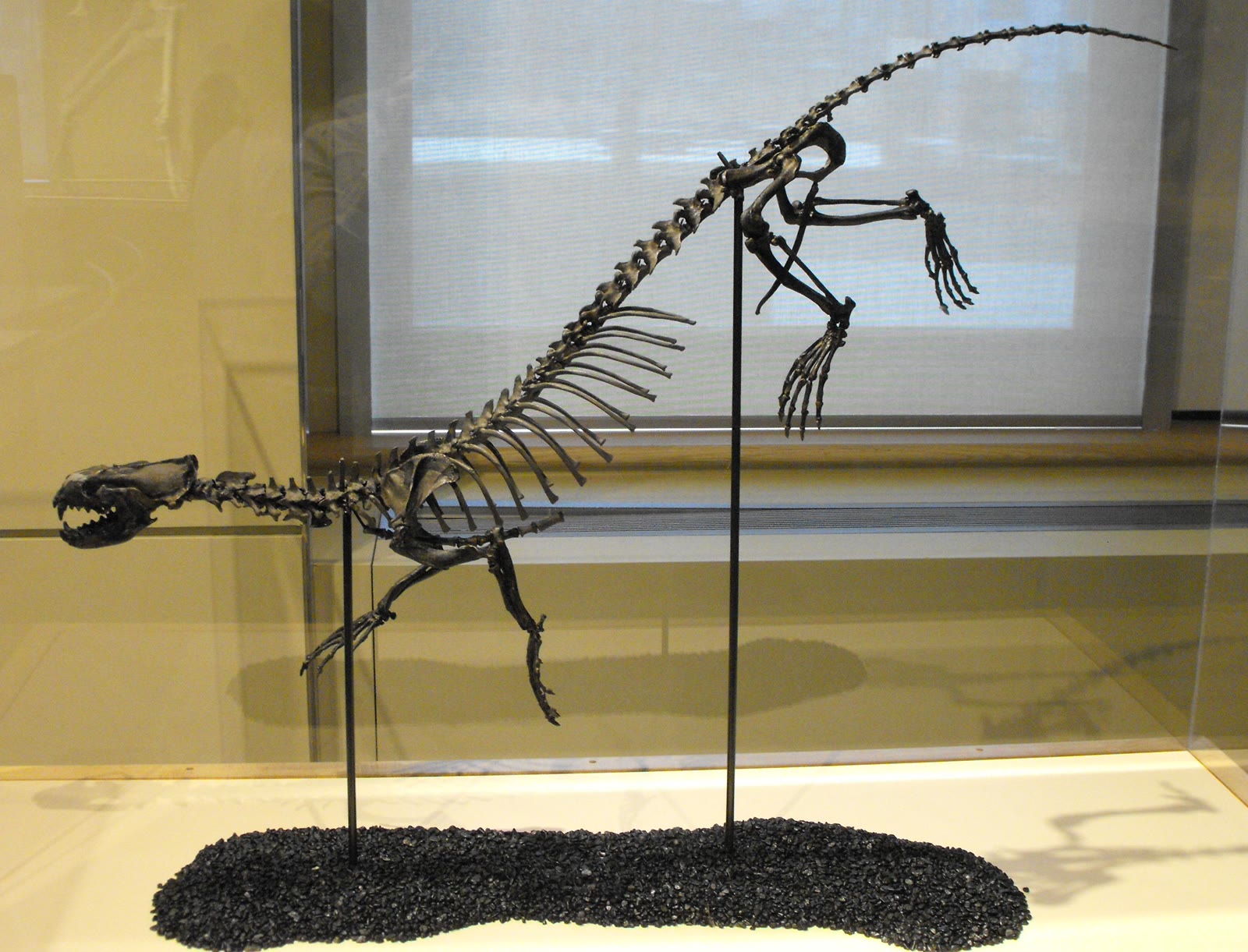
The first thing to notice about Puijila darwini is what it lacks. Its feet are not flippers. Its tail is long. Its forelimbs and hind limbs retain proportions closer to those of a land carnivore than to those of a living seal. If the origin of pinnipeds—seals, sea lions, and walruses—were a costume change from paws to paddles, this skeleton would be standing in the wrong outfit.[1]
That is precisely why it matters. Puijila is a nearly complete early Miocene carnivore from a lake deposit on Devon Island in Nunavut, dated to roughly 21–24 million years ago. It combines a body still capable of four-footed movement with a shoulder, pelvis, limbs, and probable webbed feet that point toward habitual swimming. It does not preserve the instant a terrestrial ancestor became a seal. It preserves something scientifically better: one branch near the pinniped stem carrying an unfinished, mixed set of adaptations.[1][3]
Read beside the marine, flippered Enaliarctos and the three living pinniped families, Puijila breaks the transition into separate problems. Feet had to push against water. The spine had to bend differently. Feeding had to work while the face was submerged. Limbs eventually became flippers, but even then evolution did not settle on one way to use them. The lineage is not a parade of increasingly seal-shaped animals. It is a record of functions being redistributed across the body.[2][3][4]
Image context: the cover is a real museum photograph of a mounted Puijila darwini skeleton based on the nearly complete holotype, not a life restoration. The long vertebral column, tail, and four limbs are visible together. That whole-body view is essential because the evolutionary argument depends on a mosaic of retained and modified regions rather than on one supposedly decisive bone.[1][7]
A swimming foot before a flipper
The original 2009 description starts with a useful tension. Puijila retained a long tail and comparatively terrestrial limb proportions, yet several parts of its skeleton are difficult to explain as those of an ordinary land carnivore. Its shoulder blade expands toward the rear and top. The humerus carries a prominent ridge for shoulder and chest-muscle attachment. The ilium is shortened, the femur is relatively short, and the finger and toe bones are flattened.[1]
Flattened phalanges support the inference that the feet were webbed. They do not preserve webbing itself. No skin membrane survived, and a broad digit is not already a flipper. The strongest reading therefore stops at a functional boundary: Puijila had enlarged, probably webbed extremities that could move water while its limbs remained recognizably weight-bearing.[1] This is comparative inference anchored in bone, not a photograph of behavior.
The lake setting strengthens that interpretation without turning habitat into anatomy. The skeleton came from the Haughton Formation inside the Haughton impact-crater region, where Canadian Museum of Nature expeditions have recovered a diverse early Miocene Arctic fauna.[1][6] Lacustrine sediment establishes that the animal entered a freshwater depositional system. It does not prove that this individual spent every day in the lake, hunted like an otter, or never reached a coast.
What the fossil securely joins is more modest and more consequential: a freshwater setting, a nearly complete skeleton, land-capable limbs, and a suite of swimming-related modifications. The transition toward pinniped life therefore cannot be confined to a marine shoreline or dated only from the appearance of unmistakable flippers.[1][3]
A family tree, not an escalator
It is tempting to arrange three silhouettes in a row: a terrestrial carnivore, then Puijila, then a modern seal. That diagram would be clean and almost certainly wrong in its implied genealogy. Stem fossils are usually side branches that preserve combinations near major divergences, not documented parents of later species.
The dates make the ladder especially unsafe. Puijila overlaps in broad time with Enaliarctos, a more aquatically specialized pinnipedimorph known from late Oligocene or early Miocene marine rocks along western North America. A nearly complete Enaliarctos mealsi skeleton from California is about 23 million years old and already has limbs modified as flippers.[2] One animal does not simply wait for the other to finish evolving. Their coexistence tells us that early pan-pinnipeds occupied different points in ecological and anatomical space at roughly the same time.
Later analyses have also changed how confidently those branches can be placed. A 2020 total-evidence study combined living-animal molecular data with anatomical characters from 44 fossil and 23 living caniform genera. It recovered Puijila and the European freshwater form Potamotherium on the pinniped stem, outside more derived pinnipedimorphs such as Enaliarctos, while supporting a single origin for living pinnipeds.[3] A denser 2024 metatree likewise placed Puijila and Potamotherium as early pan-pinniped branches, estimated the broader lineage's origin near 29 million years ago, and placed the origin of crown pinnipeds near 24.7 million years ago.[4]
Those numbers are modelled branch estimates, not the measured age of the Puijila skeleton. Nor do matching tree positions make Puijila a proven direct ancestor. The defensible claim is relational: its anatomy helps reconstruct conditions near the shift from terrestrial arctoid carnivores toward the more specialized aquatic body of pinnipedimorphs.[3][4]
Enaliarctos had flippers, but not a modern division of labor
Where Puijila keeps paws and probable webbing in view, Enaliarctos shows what a later mechanical package could do. The virtually complete E. mealsi skeleton has limbs transformed into flippers and skeletal evidence that the axial body, foreflippers, and hind flippers all contributed to propulsion. Its elongated hind limbs carry prominent processes for powerful musculature, implying greater competence on land than in living pinnipeds.[2]
That combination matters because modern groups partition the job differently. Sea lions and fur seals generate most thrust with their foreflippers; true seals emphasize the hind flippers and side-to-side movement of the rear body; walruses use a different mixture again. Total-evidence reconstruction suggests that several apparently shared aquatic traits evolved in parallel within a single pinniped lineage rather than arriving once as an indivisible ancestral kit.[3]
The lineage therefore contains two kinds of mosaic. Early forms combined land and water functions within one skeleton. Later branches repeatedly tuned an already aquatic skeleton in different ways. “The evolution of flippers” is too small a description. The real transition involved propulsion, steering, support on land, spinal flexibility, and muscle leverage—and these systems did not all cross the threshold together.[2][3]
Feeding underwater leaves clues outside the teeth
Swimming is only half of becoming aquatic. A predator must also locate and seize food when vision, scent, and water movement behave differently. Modern pinnipeds use sensitive whiskers to detect hydrodynamic trails, but whiskers themselves are not preserved in known stem-pinniped fossils.[5]
Skulls provide a cautious proxy. The infraorbital foramen carries nerves and vessels toward the muzzle, and early stem forms including Puijila have an enlarged opening. That is consistent with an important sensory role for the whisker field. It is not a direct measure of whisker number or sensitivity: a few densely innervated whiskers and many less sensitive ones can demand similar nerve pathways.[5]
This uncertainty is productive. The probable webbing at one end of Puijila and the enlarged facial nerve passage at the other suggest that locomotion and underwater prey detection were both changing before the full flippered silhouette appeared.[1][5] Neither feature, alone, makes the animal a seal. Together with the rest of the skeleton and its phylogenetic position, they make a semiaquatic stage more anatomically specific.
Fresh water was a phase; the birthplace remains open
The 2009 paper proposed that Puijila supported a freshwater transitional phase and might point to the Arctic as an early center of pinniped evolution.[1] The first half has aged better than the second. Freshwater-associated stem taxa now sit plausibly near the base of the lineage in broad phylogenetic analyses.[3][4] Geography is harder.
The most densely sampled 2024 time tree could not recover a well-supported ancestral range for all pan-pinnipeds. Puijila pulls attention toward the Canadian Arctic, but Potamotherium occurs in European lake deposits, other possible early arctoids are Asian, and the earliest clearly flippered forms cluster around the North Pacific. Fossils identify several theaters without yet isolating one birthplace.[4]
That distinction prevents a strong fossil from carrying a weak map. Puijila shows that freshwater adaptation belongs inside the origin story. It does not prove that every pinniped ancestor passed through Arctic lakes, that the Devon Island population founded later marine groups, or that a single dispersal route connected all known stem forms.[1][4]
The fossil's best lesson is anatomical, not mascot-driven. A long-tailed animal with land-proportioned limbs could already have a swimming shoulder, a shortened pelvis and femur, flattened digits, and a face plausibly wired for underwater sensing. A flippered contemporary could still combine its spine and all four limbs in propulsion while remaining more mobile ashore than living seals. Later descendants could inherit one origin and evolve several swimming solutions.[1][2][3][5]
Seen this way, Puijila is not valuable because it looks exactly halfway between two familiar animals. It is valuable because it refuses the halfway picture. The skeleton shows a lineage solving water one subsystem at a time—feet before flippers, fresh water before fully marine specialization, and sensory change alongside locomotion. Seal bodies were assembled, not switched on.
Sources
- Natalia Rybczynski, Mary R. Dawson, and Richard H. Tedford, “A semi-aquatic Arctic mammalian carnivore from the Miocene epoch and origin of Pinnipedia,” Nature 458 (2009) — primary description of the Puijila darwini holotype, anatomy, age, lake setting, and original phylogenetic interpretation.
- Annalisa Berta, Clayton E. Ray, and André R. Wyss, “Skeleton of the oldest known pinniped, Enaliarctos mealsi,” Science 244 (1989) — primary whole-skeleton evidence for axial, foreflipper, and hind-flipper propulsion and retained movement on land.
- Ryan S. Paterson et al., “A Total Evidence Phylogenetic Analysis of Pinniped Phylogeny and the Possibility of Parallel Evolution Within a Monophyletic Framework,” Frontiers in Ecology and Evolution 7 (2020) — combined fossil, anatomical, and molecular test of Puijila's position and pinniped character evolution.
- Travis Park et al., “Charting the course of pinniped evolution: insights from molecular phylogeny and fossil record integration,” Evolution 78 (2024) — densely sampled time tree, divergence estimates, and limits on biogeographic inference.
- George A. Lyras et al., “Fossil brains provide evidence of underwater feeding in early seals,” Communications Biology 6 (2023) — sensory evidence and inference boundaries for underwater foraging in stem pinnipeds.
- Canadian Museum of Nature, “The Haughton Crater: An Arctic hotspot for fossils” — institutional context for the Devon Island locality, field program, and discovery of Puijila.
- Wikimedia Commons, “File:Puijila darwini (fossil).jpg” — source page and metadata for Kevin Guertin's 2010 photograph of the mounted skeleton used as the cover image.