

A dinosaur skeleton can look nearly complete and still be missing something fundamental. Bones preserve anatomy. They do not preserve, on their own, the coordinates of the outcrop, the layer in which they lay, the orientation of the body, the neighboring fossils, or the notes that connect every fragment to a day in the field. Remove a specimen without that record and the object may retain its spectacle while losing part of its ability to answer questions.
That is why a locality label is not paperwork attached after discovery. It is part of the fossil as scientific evidence. The same is true of the later record: who exported the material, what permits accompanied it, which pieces were restored or combined, where it was accessioned, and whether another researcher can inspect it. Paleobiologists call this larger package an “extended specimen”—the physical fossil plus its geographic, stratigraphic, ecological, morphological, and curatorial data.[7]
The two videos in this collection follow those records through one unusually visible case. CNA Insider reconstructs the route by which a Tarbosaurus bataar skeleton from Mongolia reached a New York auction.[1] A Library of Congress recording then gives paleontologist Bolortsetseg Minjin's account of stopping the sale, repatriating the skeleton, and turning its return into a museum and education project.[2][4] Watched together, the videos show that provenance has at least three layers: origin in the rock, custody after excavation, and durable access in a repository.
One boundary matters from the start. A commercial fossil is not automatically a smuggled fossil, and laws differ among countries and land categories. This particular Tarbosaurus case was not a general argument inferred from dislike of auctions. U.S. authorities alleged that the specimen violated Mongolia's fossil-ownership and export laws and entered the United States under false origin, description, and value declarations.[3] Keeping that distinction visible makes the scientific argument stronger: legality, field context, and research accessibility overlap, but they are not interchangeable.
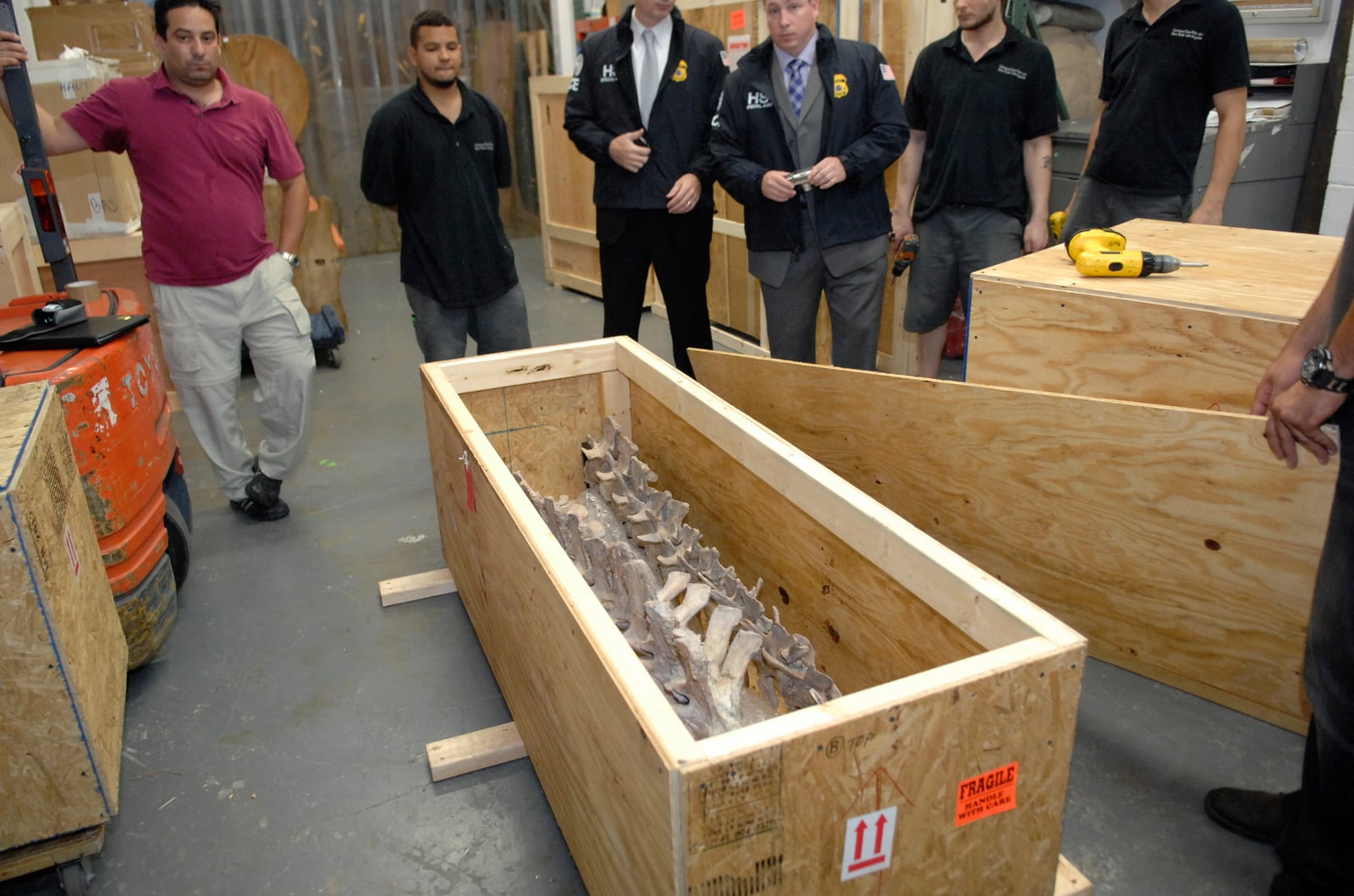
Image context: the cover photograph makes custody physical. The returned dinosaur is not posed as a seamless museum animal; part of the mount lies in an open plywood crate, surrounded by handlers, officials, tools, labels, and other boxes. It is an archival photograph of a specimen changing hands, and therefore of provenance being rebuilt in public.[8]
1. An auction makes price visible—and evidence easy to overlook
CNA Insider's documentary segment starts with the most legible part of the fossil market: a spectacular object, a sale room, and a number.[1] Its value for this collection is not that it turns every collector into a villain. It is that the camera follows the point where geological material becomes a luxury commodity, then asks what happened before the catalog and what may happen after the hammer falls.
The Justice Department's 2012 forfeiture announcement, which summarizes allegations in the civil complaint, supplies the documentary's hardest anchors. Customs paperwork listed Great Britain as the skeleton's country of origin and valued the shipment at $15,000. The 2012 auction catalog estimated $950,000 to $1.5 million, and the winning bid reached $1,052,500. The import description broke the shipment into rough fossil heads, bones, reptiles, and a lizard rather than identifying a mounted Mongolian tyrannosaur.[3] Price became extraordinarily precise while origin became vague.
That asymmetry is worth watching more closely than the sale itself. A finished mount encourages the eye to read one animal. A shipment, however, may contain separately prepared pieces, restored gaps, supporting armatures, and material whose association has to be demonstrated. Even when every visible bone is genuine, “nearly complete” does not answer whether the elements came from one individual, one quarry, or one stratigraphic horizon. A market catalog can describe appearance and dimensions; it cannot substitute for field records.
In the Tarbosaurus case, specialists could recover part of the origin story. According to the Justice Department's summary of the complaint, paleontologists identified the animal as a taxon known from Mongolia and, after examining its anatomy and preservation, concluded that it had been unearthed in the western Gobi sometime between 1995 and 2005.[3] That was enough to support a legal case. It was not the same as recovering an exact grid square, quarry map, sedimentary position, or association with other bones.
Research can sometimes narrow an erased locality. A 2018 study compared elemental signatures in fossils and sediments from Mongolia's Nemegt Basin using portable X-ray fluorescence. The two formations' chemical compositions largely overlapped, but sorting the data by geographic and stratigraphic occurrence produced more discriminating clusters that could help compare unknown samples with documented ones.[6] This is an impressive forensic tool, not a time machine. Chemistry may constrain a source region or formation; it cannot recreate the position of each bone, the order of excavation, or observations never written down.
The documentary therefore works best when the auction is treated as the middle of a chain. Before it lie extraction, preparation, export, and description. After it lie ownership, storage, possible resale, and access. The million-dollar number records only one event in that sequence. A fossil's scientific value depends on whether the less glamorous records survived alongside it.
2. Repatriation is the beginning of a new record, not reverse shipping
The Library of Congress video changes both voice and scale. Recorded at the 13th Annual International Mongolian Studies Conference on February 15, 2019, it preserves Minjin's first-person account rather than a distant summary of the case.[2][4] Her paleontology keynote follows an opening historical presentation, and her own section moves through commercialization, advocacy, the multi-year repatriation effort, and education in the Gobi. That structure matters: the returned skeleton is a turning point, not the ending.
Minjin's account makes the slow coalition behind the dramatic return visible. After recognizing the auction listing in May 2012, she alerted contacts in Mongolia, examined the skeleton, helped assemble specialist evidence, and worked across the Mongolian president's office, lawyers, U.S. Homeland Security Investigations, and federal prosecutors.[2][4] The chain of custody was not repaired by a single expert declaration. It was rebuilt through correspondence, examination, court action, cataloging, transport, and cooperation between institutions.
Pay particular attention to what happens after the 2013 ceremony. Minjin describes cataloging the material before shipment. In Ulaanbaatar, the returned Tarbosaurus became specimen number one in the new Central Museum of Mongolian Dinosaurs. A temporary exhibition drew about half a million visitors in three months, and later returns expanded the collection.[2][4][5] Those details shift the meaning of repatriation. The dinosaur did not merely cross a border in the opposite direction; it entered a stable public record and became usable for local teaching, training, and identity.
The keynote is also more nuanced than a demand to empty every foreign museum. During the question period, Minjin acknowledges that international collections have enabled major discoveries and protected fossils, while insisting that Mongolian researchers and communities must participate in the knowledge produced from their own heritage.[2] Repository location shapes who can afford to study a specimen, who can train beside it, and who encounters it as part of a shared natural history. Access is not an afterthought to ownership.
This is where repatriation can repair what the auction route could not. It can restore lawful custody, assign a permanent catalog number, stabilize access, and support conservation and future research. It cannot retroactively recover every lost field observation. The scientific result is therefore neither “nothing was lost” nor “the fossil is useless.” It is a specimen with a damaged early record and a much stronger future one.
Three records should travel with every important fossil
The first record is geological provenance: locality, formation, horizon, sediment, orientation, association, collector, date, and field method. These facts let later researchers test whether bones belong together, place the animal in time and environment, and revisit the site. A label can contain errors, but an explicit label is an auditable claim. An absent label is an unanswered question.
The second is custody and conservation history: permits, export documents, transfers, preparation, restoration, casting, sampling, and damage. This record distinguishes a documented specimen from an object whose apparent wholeness hides an uncertain assembly. In the Tarbosaurus case, mismatched declarations and the later forensic examination became central because the field chain had already been broken.[3]
The third is repository and access: a stable institution, catalog number, storage conditions, and a realistic path for qualified researchers and the source community to examine the material. Current work on data equity in paleobiology emphasizes that fossils and their associated data must remain findable and reusable, and that specimens disappearing into inaccessible collections can narrow both the scientific sample and who gets to produce knowledge from it.[7]
The two videos reveal different failure modes because they look from opposite ends of the chain. CNA Insider shows how a seamless mount and an exact price can conceal an uncertain route.[1] Minjin shows how legal return becomes scientifically and socially meaningful only through cataloging, curation, exhibition, and education.[2][4][5] Neither video alone completes the lesson. The market story explains the loss; the stewardship story explains what can still be rebuilt.
So the next time a fossil appears in a display case—or in a shipping crate—read beyond the animal's silhouette. Ask where it was found, what documentation traveled with it, what was added during preparation, and where it can be studied again. The smallest paper label may carry no anatomy at all. It can still be the part that allows the bones to remain evidence.
Sources
- CNA Insider, “The Million-Dollar Dinosaur Fossil Heist: From Mongolia To New York Auction | Bones Of Contention,” YouTube video.
- Library of Congress, “Lessons Learned from the Repatriation of Mongolian Dinosaurs,” Bolortsetseg Minjin, YouTube video.
- U.S. Attorney's Office, Southern District of New York, “Manhattan U.S. Attorney Announces Action Seeking Forfeiture of Tyrannosaurus Bataar Dinosaur Skeleton Looted from the Gobi Desert in Mongolia,” June 18, 2012.
- Library of Congress, “Keynote Presentations and Collections Display at the 13th Annual International Mongolian Studies Conference,” official report on Minjin's February 15, 2019 talk.
- Institute for the Study of Mongolian Dinosaurs, “Fossil Repatriation” — project history and returned-specimen context.
- F. Fanti et al., “Geochemical fingerprinting as a tool for repatriating poached dinosaur fossils in Mongolia,” Palaeogeography, Palaeoclimatology, Palaeoecology 494 (2018).
- Emma M. Dunne et al., “Data equity in paleobiology: progress, challenges, and future outlook,” Paleobiology 51, no. 1 (2025).
- Michael Johnson, “U.S. ICE return Tarbosaurus bataar skeleton to Mongolia 2013,” archival photograph, Wikimedia Commons, public domain.