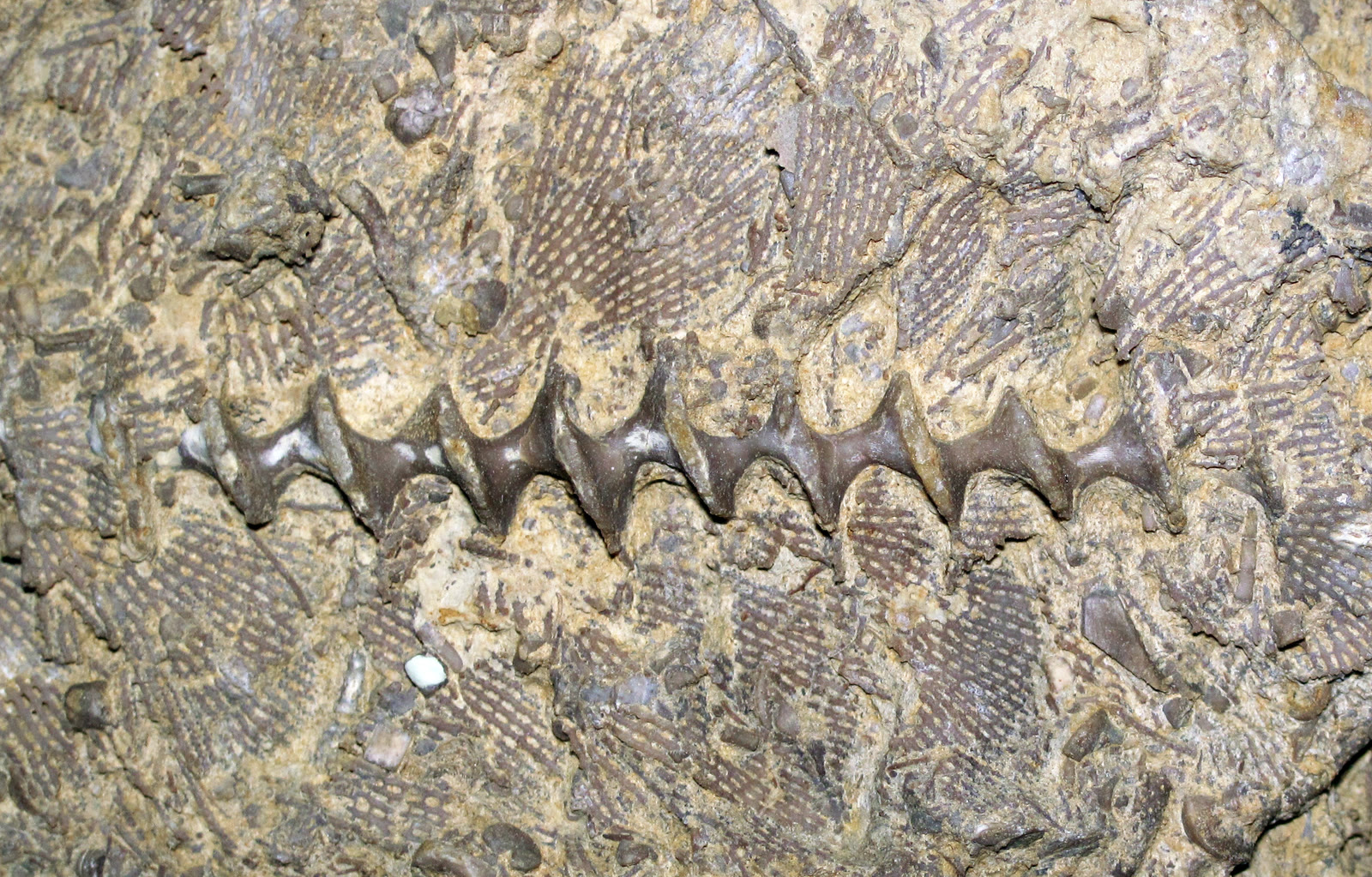
The cover fossil looks like a machine part caught in stone. A dark helix runs through pale limestone; around it lie scraps of finer latticework. The image record identifies the fossil as Archimedes but does not preserve its collection locality or a secure stratigraphic age, so the photograph cannot carry a species name or formation-level claim.[6] It can still correct the most common mistake about the genus at a glance.
The screw was not the whole animal.
Archimedes was a fenestrate bryozoan, a colonial marine animal from the middle to late Paleozoic. The National Park Service records the genus from sites including Mammoth Cave National Park and explains its famous form precisely: the durable screw is a central axis that supported a spiraling, lace-like frond rarely found still attached.[1] Each tiny skeletal chamber along that frond belonged to one zooid in a colony of repeated feeding units. What usually reaches a museum drawer is therefore not a solitary creature with a bizarre shell. It is the surviving framework of a much larger living construction.[1][2]
That reversal—from screw-shaped organism to broken colonial architecture—is what makes Archimedes worth a taxon profile. Its fossils join three scales that are easy to separate in the imagination: sub-millimetre zooids, a three-dimensional feeding fan, and populations able to turn breakage itself into another route for growth.
The screw is the part built to survive
Fenestrate bryozoans grew rigid, erect colonies made of narrow branches linked into a mesh. The name “fenestrate” points to the windows in that lattice. Feeding zooids opened from one side of each branch, while branch division and cross-connections extended the sheet.[4] In Archimedes, that sheet did not remain a flat fan. It wound around a central helical support.
The fossil record edits that architecture by strength. Thin branches and their connections were exposed to currents, burial, compaction, and later weathering. They commonly fragmented. The thicker axial screw was more likely to remain recognizable after the frond came apart, which is why loose Archimedes fossils can resemble drill bits or the internal mould of an unfamiliar shell.[1][6]
The cover specimen makes the preservational filter unusually clear. The axis dominates, but it is not alone: delicate mesh fragments remain in the limestone beside it.[6] They are not decorative debris. They are pieces of the surface that carried most of the colony's feeding bodies. The photograph therefore captures both the memorable fossil and the missing-animal problem that memorable fossil creates.
This is also why a reconstruction should not quietly promote the screw into a fleshy organ. The helix is direct skeletal evidence. The full extent and orientation of the lacy frond can be reconstructed from better-preserved colonies and attachment scars.[1][3] The soft crowns that emerged to feed are not preserved in this image; their presence comes from bryozoan anatomy and from the chambered skeletons in which zooids lived.[2][5]
One colony held many mouths
A bryozoan colony begins with a sexually produced larva, but it enlarges by asexual budding. The founding zooid produces additional modules, and those modules repeat until the colony has built an encrusting sheet, a branch, a dome, a fan, or—in this case—a spiral framework.[2][5] The individual zooids are tiny. Their mineralized chambers carry openings through which living feeding structures could extend.[2]
That means the scale of Archimedes is deceptive in both directions. The screw is too small a description of the colony because it leaves out the frond. “The animal” is too singular a description because the colony was composed of many zooids connected by shared growth. A single hand specimen records a society of cloned modules, not one large body folded into a helix.
The feeding organ of each ordinary zooid was a lophophore, a crown of ciliated tentacles used to move suspended particles toward the mouth. No lophophore is mineralized in the familiar Archimedes screw. Yet its lost position is not arbitrary. Rows of zooecial apertures on the frond branches mark where feeding units faced the water.[2][4] The fossil preserves the address of a missing soft anatomy.
Colony form mattered because feeding took place in moving water. McKinney and Jackson's synthesis of bryozoan evolution treats feeding as a major sculptor of colony shape and erect growth as a negotiation with flow and breakage.[5] The helical Archimedes design placed a broad mesh around a vertical axis rather than in one flat plane. It is reasonable to infer that this arrangement exposed many zooids to passing water, but a bare screw does not reveal one exact current direction, filtering rate, or posture on the seafloor. Those functional details depend on colony completeness, sedimentary setting, and comparison with living bryozoans.[3][5]
Breakage could become reproduction
Fragility sounds like a design failure until the broken colonies are counted.
Frank McKinney's study of Carboniferous Archimedes found that true attachment bases were rare, while many colonies showed signs of starting from older branch fragments. Axial screws could arise from a pre-existing set of branches; young colonies could begin along the margins of older whorls; separate colonies could fuse laterally.[3] These are not the traces expected if every colony began only when a larva settled on bare substrate.
The alternative was clonal multiplication by fragmentation. A piece detached, survived, and budded a new colony. In favorable Chesterian-age seas of eastern North America, McKinney inferred populations dominated by a few genetic individuals expressed through hundreds or even thousands of physically separate colonies. Dense stands were especially successful in sheltered water behind submarine carbonate shoals.[3]
That result changes the meaning of a broken fossil. Some damage happened during death, burial, or collection and destroyed information. Some breakage happened while the colony was alive and may have prolonged its genetic life. The same modular construction that made the fine frond easy to fragment also made a surviving fragment capable of becoming a new starting point.[3][5]
The distinction cannot be diagnosed from every loose screw. A solitary axis in limestone does not announce whether it grew from a larva, an attached base, or an older colony fragment. The population-level case comes from repeated growth patterns across many specimens.[3] Archimedes is strongest scientifically when the striking object is returned to that larger sample.
A famous silhouette is not enough for a species name
The corkscrew is so distinctive that Archimedes became the first fenestrate bryozoan genus characterized in print: David Dale Owen used the name in 1838 for a fossil already described by Charles Alexandre Lesueur for its screw-like form.[4] Recognition, however, is not the same as diagnosis.
Hageman and McKinney's morphometric study shows why fenestrate classification moved beyond overall silhouette. Paleontologists compare the number and arrangement of zooecial rows, branch spacing and division, crossbars, chamber shape, internal partitions, surface nodes, and other characters. Their analysis of more than a thousand operational units from fifteen genera found that established genera generally formed coherent clusters even when tested with external measurements different from the characters originally used to define them.[4]
That supports Archimedes as more than a convenient label for anything screw-shaped. It also warns against forcing a species name onto an attractive photograph. The cover image has the diagnostic genus-level helix and associated mesh, but its locality is unrecorded and the fine characters needed for species-level work are not documented.[6] “Archimedes sp.” is not an incomplete caption to be improved by confidence. It is the correct boundary around the available evidence.
The colony survives as an uneven ledger
Read carefully, an Archimedes fossil preserves several different claims with different strengths.
The helix itself is direct evidence of a stout axial support. Attached or adjacent mesh records the fenestrate frond. Zooecial chambers place repeated modules along that feeding surface.[1][2][4][6] Comparative anatomy restores retractable lophophores to those modules, but not their color or moment-to-moment behavior.[2][5] Recurrent growth from branches supports fragmentation as a route to clonal multiplication, yet any one isolated specimen may leave its own origin unresolved.[3]
The result is stranger than the drill-bit fossil and more coherent than a mystery-object label. Archimedes was a Carboniferous colonial animal that built lace around a screw, distributed tiny feeding bodies across that lace, accepted fragility as part of erect growth, and sometimes used fragments to begin again. Fossilization usually keeps the central support and spends the rest. The screw endures because the colony fell apart—but understanding the screw requires putting the colony back.
Sources
- National Park Service, “Fossil Bryozoans” (updated 2024)—institutional overview of Paleozoic bryozoans and the Archimedes axis with its rarely attached spiraling frond.
- The Paleontological Society, Frank K. McKinney, “Bryozoans”—illustrated institutional guide to zooids, colony budding, lophophore feeding, fenestrate flow, and the Archimedes screw-and-frond body plan.
- Frank K. McKinney, “Asexual colony multiplication by fragmentation: an important mode of genet longevity in the Carboniferous bryozoan Archimedes,” Paleobiology 9 (1983)—specimen evidence for fragment-founded colonies and dense clonal populations.
- Steven J. Hageman and Frank K. McKinney, “Discrimination of Fenestrate Bryozoan Genera in Morphospace,” Palaeontologia Electronica 13.2 (2010)—fenestrate architecture, the naming history of Archimedes, and morphometric tests of genus-level distinctions.
- Frank K. McKinney and Jeremy B. C. Jackson, Bryozoan Evolution, University of Chicago Press (1991)—synthesis of modular construction, colony growth, feeding, flow, breakage, and adaptive form.
- James St. John, “Archimedes sp. (fenestate bryozoan) in limestone 2,” 2021 specimen photograph, Wikimedia Commons, CC BY 2.0—source and provenance record for the cover image.