The same small crustacean can live in a quiet lagoon and a much saltier estuary. For a paleontologist, that adaptability creates a problem. Finding its empty shell does not immediately reveal how salty the vanished water was. In Portuguese coastal surveys, Cyprideis torosa occupied habitats with markedly different salinities, while leaving thousands of empty shells in modern sediments and Holocene deposits.[1]
The answer may lie in details smaller than the shell itself. Across its surface are microscopic structures called sieve pores. Their outlines can help recover differences that the animal's presence alone leaves unresolved. Reading them requires a change of scale: from identifying the creature to examining how it built its covering.[3][4]
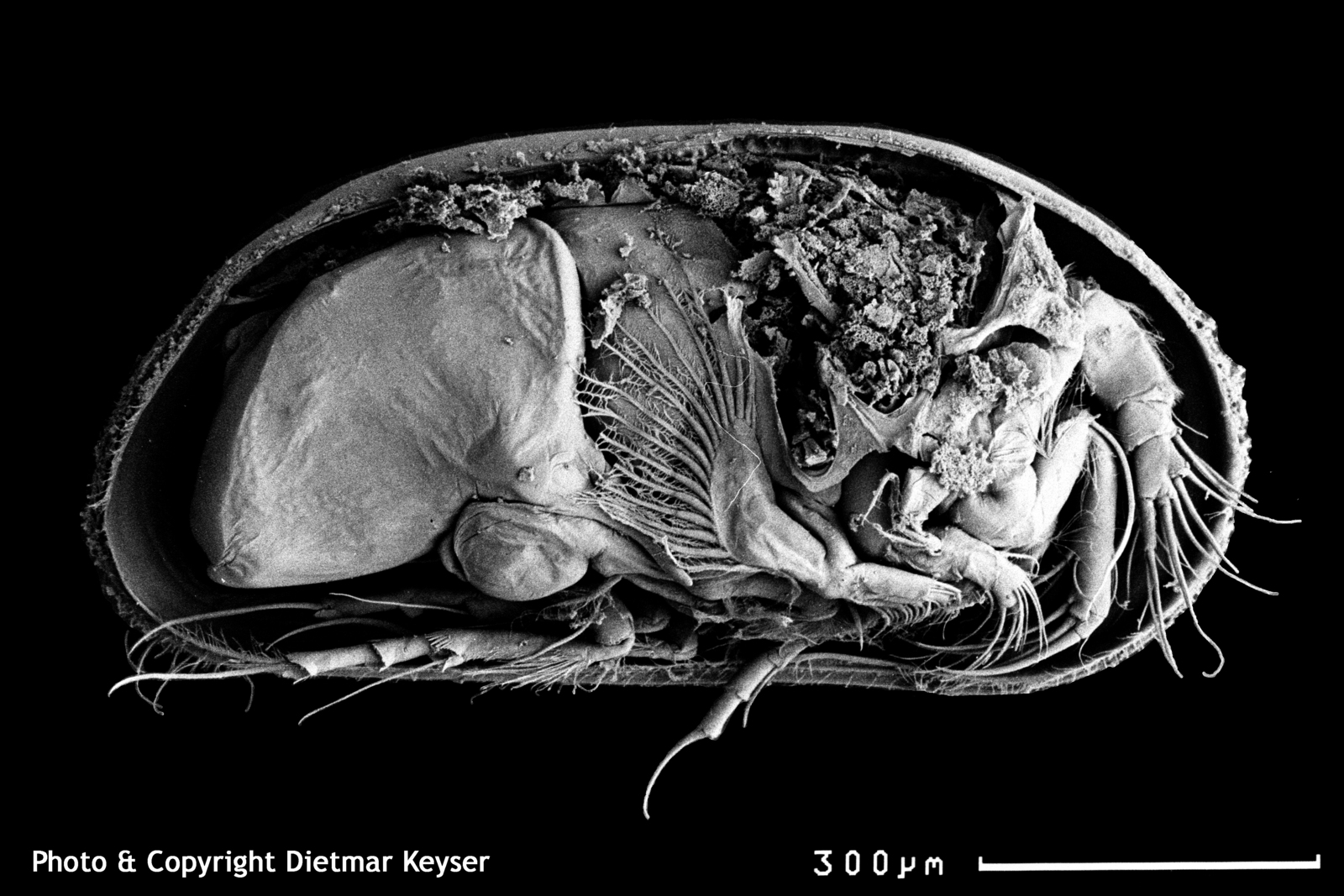
A surface with openings
An ostracod encloses its body between two shell valves. Pore canals pass through the calcified covering, connecting the animal with the outside water. Some are simple passages; sieve-type pores contain a perforated plate, with an opening for a sensory bristle. The surface is therefore part of a living interface, rather than an inert box.[3]
These structures also have a long history. Alan Lord and colleagues examined prominently developed sieve pores in Middle Jurassic ostracods in a 2020 study, using their architecture to help distinguish taxa. Yet the authors emphasized how much remained unknown about their biological functions. The associated bristles have sensory roles, but a salinity correlation does not by itself establish the physiological mechanism producing a particular outline.[3]
That distinction matters when a fossil starts to resemble a measuring instrument. A useful empirical relationship can exist before its mechanism is fully understood. It still has to be demonstrated for the animal being measured.
Counting shapes, testing water
In C. torosa, researchers classify sieve-pore outlines as round, elongated or irregular, then calculate their proportions. Round forms generally become less common as salinity rises. The measurement concerns a population of pores, rather than one conspicuous hole.[4]
Peter Frenzel, Judith Ewald and Anna Pint tested that relationship in culture experiments reported in 2017. Across salinities of approximately 0.6–14.8, the animals supported the expected trend. However, the experimental relationship differed somewhat from an earlier calibration. The authors considered lower calcium concentrations a likely contributor and cautioned that ionic composition could complicate numerical reconstructions, particularly in inland waters whose dissolved salts differ from seawater.[4]
There is a temporal catch, too. The pore outline becomes fixed as the new valve mineralizes after moulting. In fluctuating coastal water, the resulting shell need not represent the site's average salinity. It records the conditions under which that particular covering formed.[4]
The practical consequence is a distinction between recognizing a trend and assigning an exact value. A sequence suggesting freshening may be persuasive even where the chemistry of the ancient water makes a precise salinity estimate harder to defend.
Following a delta through its shells
A fossil application comes from the Kızılırmak Delta on Turkey's Black Sea coast. In a 2019 study, Christopher Berndt and colleagues combined C. torosa pore analysis with the identities of other ostracods in a 14.5-metre sediment core. Their reconstruction followed changes between lagoons and deltaic lakes over approximately 7,900 years of the Holocene.[5]
C. torosa dominated lagoon phases, while changes in its companions helped identify marine and riverine influence. Later assemblages included species associated with fresher conditions. The pores contributed one line of evidence within a changing community, rather than supplying the entire environmental history themselves.[5]
This is where a tolerant species becomes especially useful. Its continued presence across different conditions can preserve a series of comparable shells. Other species help establish the setting; variations within C. torosa help investigate changes inside it. The reconstruction gains strength when those observations agree, while disagreement gives researchers something specific to question.[1][5]
A relative that would not keep the same scale
Moving further back in time exposes a sharper limit. Francesco Grossi and colleagues examined Cyprideis agrigentina from the late Miocene deposits at Eraclea Minoa, Sicily, associated with the final stages of the Messinian Salinity Crisis. The attraction was clear: another species of the same genus, with pores that could be counted in the same way.[6]
Their 2015 study compared pore-derived salinities with environmental estimates from fossil assemblages and geochemistry. The results did not correlate. The authors concluded that C. agrigentina could not serve as a salinity gauge for that succession. A relationship calibrated in the living species had failed its test in the extinct relative.[6]
That failure leaves the successful work on C. torosa intact, but changes how far it can travel. Similar-looking structures do not guarantee identical responses to water chemistry. Before importing a numerical conversion into an older deposit, researchers need evidence that the biological comparison holds.
An empty valve can thus carry two intertwined stories: the identity of the animal and the conditions under which its shell formed. The most convincing reconstruction keeps both in view. Under a microscope, a round pore is a shape. With the right comparisons, it becomes evidence of water that disappeared thousands of years ago.
Sources
- M. C. Cabral and colleagues, “Cyprideis torosa (Jones, 1850) in mainland Portugal: what do we know?”, Journal of Micropalaeontology 36 (2017), 94–112 — living populations, coastal habitats and Holocene occurrences.
- Dietmar Keyser, “Cyprideis torosa (male),” World Ostracoda Database photogallery (2012) — specimen photograph with the right valve removed.
- Alan R. Lord, M. Cristina Cabral and Dan L. Danielopol, “Sieve-type normal pore canals in Jurassic ostracods: A review with description of a new genus,” Acta Palaeontologica Polonica 65 (2020), 313–349 — pore anatomy, fossil examples and functional uncertainties.
- Peter Frenzel, Judith Ewald and Anna Pint, “Salinity-dependent sieve pore variability in Cyprideis torosa: an experiment,” Journal of Micropalaeontology 36 (2017), 57–62 — culture validation, ionic composition and the timing of shell formation.
- Christopher Berndt and colleagues, “Holocene marginal marine ostracod successions from the Kızılırmak River delta; Implications for depositional environments and sea-level changes at the Southern Black Sea coast,” Sedimentary Geology 382 (2019), 103–121 — institutional abstract describing the core and combined fossil evidence.
- Francesco Grossi and colleagues, “Is Cyprideis agrigentina Decima a good paleosalinometer for the Messinian Salinity Crisis? Morphometrical and geochemical analyses from the Eraclea Minoa section (Sicily),” Palaeogeography, Palaeoclimatology, Palaeoecology 419 (2015), 75–89 — comparison of pore-derived salinity with independent environmental evidence.