The first thing the Albany postal clerks wanted a stranger to know about their dog was where to send him back. They bought him a leather collar and had a tag attached. It gave his address as “Owney, Post Office, Albany, N.Y.” There was room for a town and an institution, and apparently no need to name any particular person who would take him in. [1]
Owney had turned up at the Albany post office in 1888. He rode the mail wagons to the depot and eventually made the run down to New York City and back in a railway mail car. The prospect that worried his friends was easy to picture. A dog that could get himself to New York could get himself considerably farther. The address gave the clerk at the far end of the journey something to do if that happened. [1]
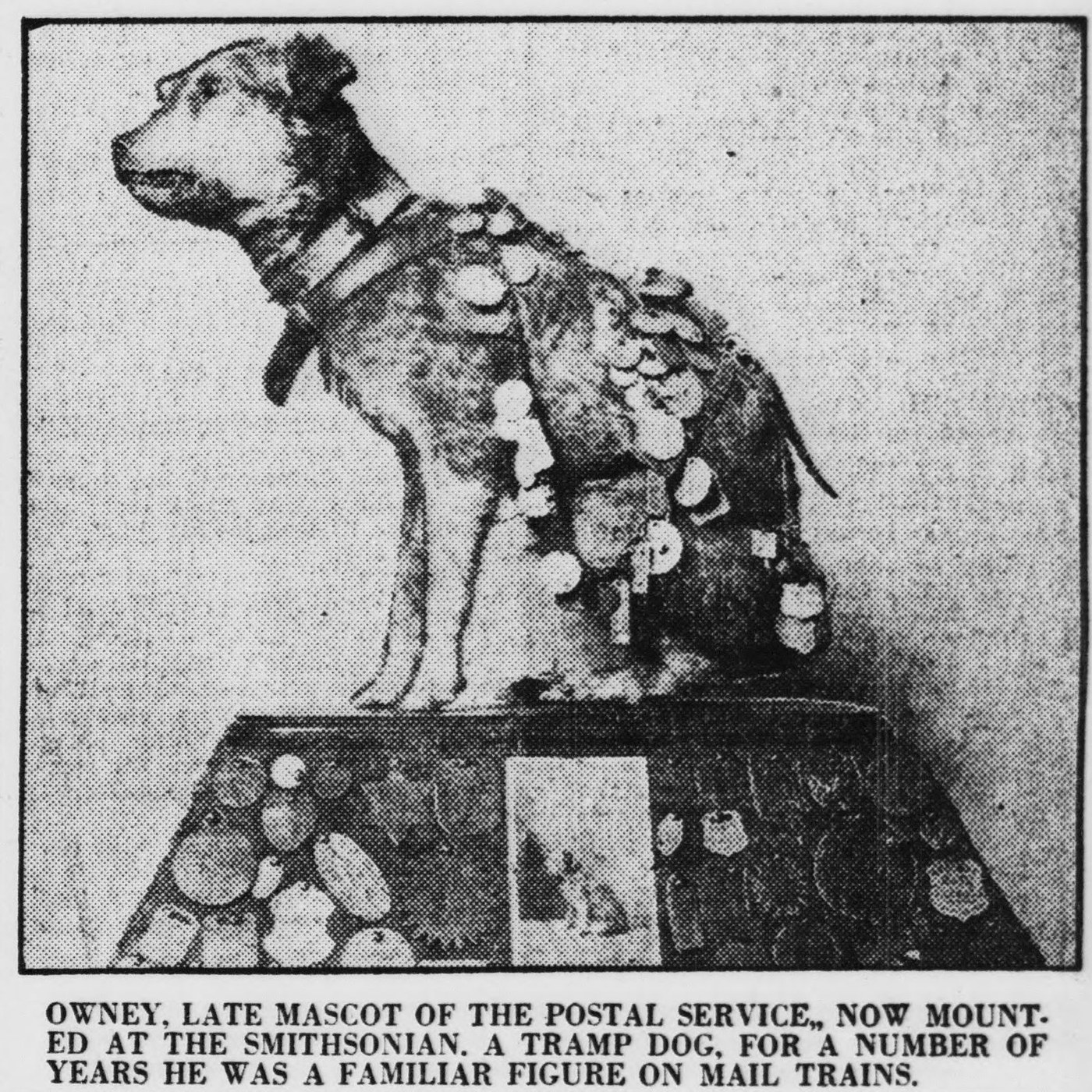
Other clerks saw an opportunity in the collar. They had metal baggage tags to hand, each capable of identifying a rail line. They began fastening them to Owney. Someone receiving him could now read two things on the same dog. Albany was where he belonged. The other tags told where colleagues had seen him along the way. Eventually the distinction had a physical consequence. An address weighed very little. The accumulated record of his travels weighed enough for Postmaster General John Wanamaker to give him a jacket to spread the load. [1]
A berth out of Tacoma
By August 1895, people who had never handled a mailbag could follow Owney. In Oregon the Dayton Herald printed a dispatch from Tacoma announcing his trip around the world. It credited the dog with inspecting a steamer at the dock and taking an interest in it. Then came the part for which an interested dog needed help. The assistant postmaster made arrangements. Captain John Panton would take him aboard the Victoria as his guest and see him onto another ship in Hong Kong. [3]
The dispatch was written in the future tense. It tells us what Tacoma expected of the captain. For the outcome, the Library of Congress newspaper guide places Owney back in New York on December 23 after a journey that took him to Japan, China and Singapore. On the railway, a clerk might let the familiar dog ride another stretch. For the ocean crossing, someone had to secure his passage in advance and someone had to agree to receive him. The Oregon reader got to enjoy the idea of a dog choosing his own ship because the paper could also name the man who would take him aboard. [2][3]
A classroom version of the story offers a glimpse of what survived the telling. In the American Humane Education Society’s The Teacher’s Helper in Humane Education, Owney walks up the gangplank of his own accord. The author gives him thoughts and motives, including a belief that the mailbags make good traveling companions because people look after them. We have to take those thoughts as a storyteller’s invention. But the schoolbook also gives the dog letters of introduction to carry overseas. Even in a tale written to let children see the journey through Owney’s eyes, the humans at the next port need to know who he is. [4]
When Owney died in Ohio in 1897, railway mail clerks pooled their money to have his body preserved. Postal headquarters in Washington received him, and the Post Office Department entrusted him to the Smithsonian in 1911. Look again at the newspaper photograph. The small discs run down his flank almost to the stand. Each took a moment to attach, when somebody with access to a baggage tag had the dog within reach. For all the distance in Owney’s story, that is the part of a railway clerk’s working day we can still see. [1][2]
Sources
- United States Postal Service, The United States Postal Service: An American History, 1775–2006, p. 17, on the collar, railway tags and clerks’ collection for Owney.
- Library of Congress, “Owney, the Railway Mail Dog,” historical timeline and photograph from the Washington Evening Star, July 24, 1927.
- “The Postal Clerks’ Dog,” Dayton Herald, August 23, 1895, p. 2. Digitized by the University of Oregon.
- Francis H. Rowley, The Teacher’s Helper in Humane Education, “The Story of Owney, the Postal Dog,” pp. 28–29. NC State University Libraries.