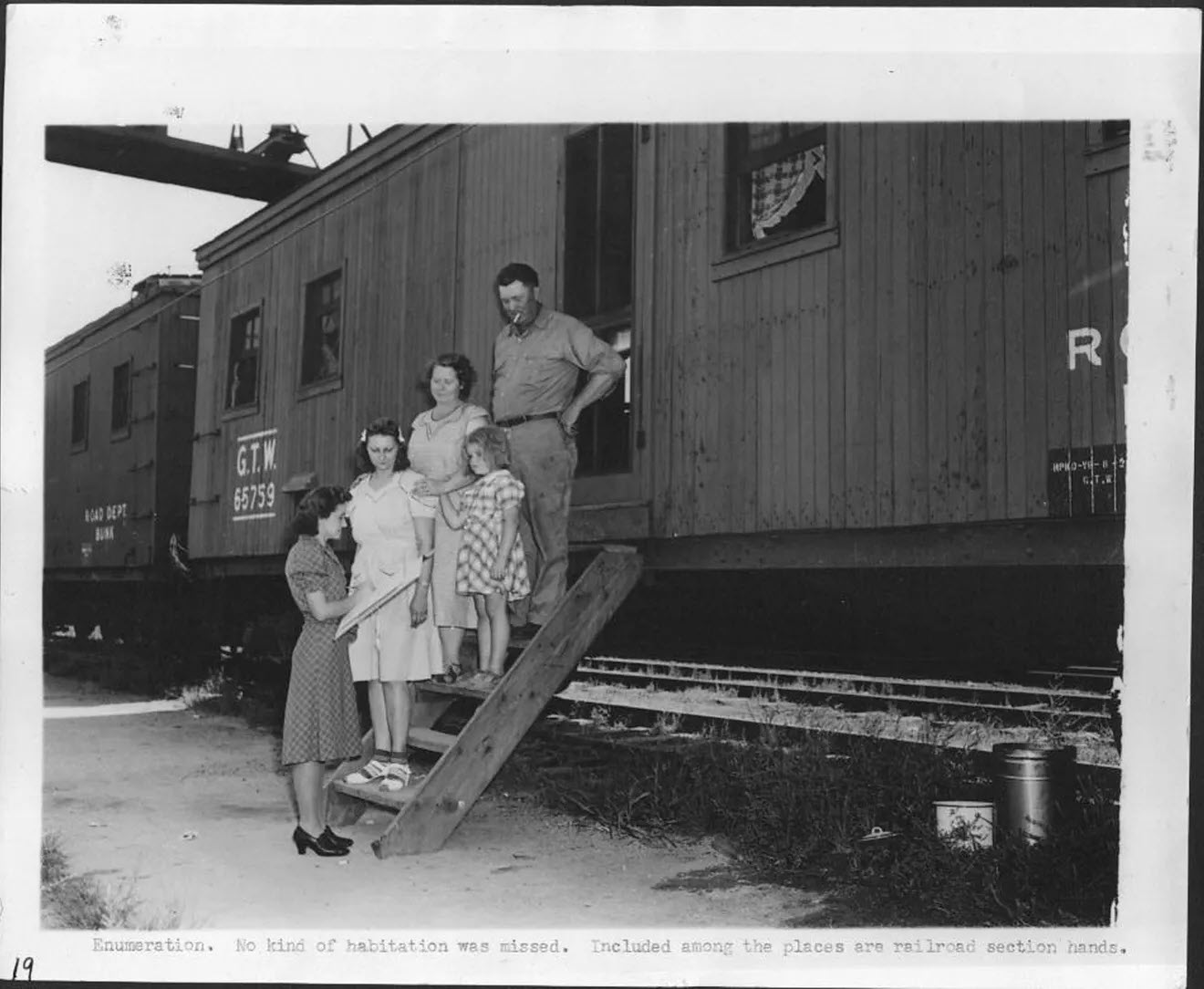
A Bureau of the Census photograph from April 1940 shows an enumerator interviewing a family outside the railroad car where they lived. Four people stand on the wooden steps. The enumerator stands on the ground with the schedule in her hands. To find out whom the enumerator credited with the answers, we would need a different record. On the population schedule, among the names in column seven, we would look for a small X with a circle drawn around it. [1][2]
Paragraph 446 of the enumerators’ instructions tells the census taker where to put the mark. It belongs after the name of the household member who supplied the information about the people living there. The handwriting stays the same across the page because the enumerator holds the pen. The circle lets a reader recover one more participant in the making of the record. Earlier federal schedules had left that person unidentified. [2][3]
Consider what happens to an ordinary piece of family history as a result. You find your grandfather on the sheet. Reading across his line, you discover where he lived on April 1, 1935, five years before the census. You might write in your notes that he told the census taker he had lived there. Now read down the names at the address. Suppose the X sits beside his sister. You still have evidence of his earlier residence. You also have a reason to credit his sister for the account. Nothing on the sheet tells you whether she remembered the move herself or asked her brother before she answered. [2][3]
A neighbor in the margin
The instructions make room for a person who has no line in the household at all. When someone outside it supplied the answers, the enumerator was to write a note in the left margin alongside the household. The Bureau even supplied the wording of an example in paragraph 446, “Information from John Brown, neighbor.” John Brown is a specimen name in a manual. His position on the page solves a practical problem. Enter him in the name column and a later reader could count him as another resident. Put him in the margin and he can speak for the address while continuing to live next door. [2]
A neighbor might come into the count after considerable effort to reach the residents. Paragraph 372 deals with a household that would be away throughout the local canvass. It directs the enumerator to seek out someone who could supply the information. If a household member worked nearby, the enumerator could try the workplace. A more distant place of employment called for the supervisor’s help. The beautifully even rows of the finished schedule give little sense of the distances someone might have gone to fill them. [2]
The identity of the speaker mattered especially when the question required a fine distinction. For the week of March 24–30, 1940, the schedule distinguished ordinary employment from work on a public emergency project. Someone building a road for the WPA could quite reasonably be described by a neighbor as working. The Bureau wanted that job counted in its own category. Archivist Constance Potter records that one common error was to enter relief workers simply as employed. The circle can tell a historian whom the enumerator heard from. Diagnosing an error on any particular line would take further evidence, such as a record of the worker’s assignment that week. [2][3]
Wages introduced a further wrinkle. Census takers carried a separate income form for people who preferred to give the figure privately. They could fill it out, seal it in an envelope and hand it back for mailing. Even a carefully placed circle therefore has a limit. It identifies the household informant. It cannot establish that this person knew a housemate’s pay or spoke the amount aloud. [4]
There are two ways to take a note from the 1940 census. One is to copy the person's name and follow the line to the fact you came for. The other takes a little more of the page with it. Copy the name beside the circled X, or the neighbor’s name at the edge, alongside the entry. Years later, if another record gives a different account of the same move or the same job, you will still know whose recollection you have in hand. [2]
Sources
- U.S. Census Bureau, 1940 Census: Conducting the Count at Railroad Yards, April 1940 photograph.
- U.S. Bureau of the Census, Instructions to Enumerators: Population and Agriculture, especially paragraphs 372 and 446.
- Constance Potter, “New Questions in the 1940 Census,” National Archives, Prologue, Winter 2010.
- U.S. Census Bureau, 1940 Census Instructions to Enumerators, historical notes on the population schedule and confidential income form.