Zigbee2MQTT is often introduced as the thing you install when you want to stop using a proprietary Zigbee hub. That is true, but the more useful engineering read is narrower: Zigbee2MQTT turns a smart home into a message bus problem. A coordinator owns the Zigbee network. A broker owns transport. Device definitions translate vendor-specific behavior into normalized capabilities. Integrations such as Home Assistant discovery sit downstream of that bus rather than absorbing the whole system.[1][3][4][5]
That separation is why the project still matters in 2026. Smart-home stacks fail most painfully when every vendor app is both transport, identity layer, rule engine, dashboard, firmware updater, and state store. Zigbee2MQTT does not make the home simple. It makes the boundaries nameable. If a motion sensor stops reporting, the operator can ask whether the problem is mesh reachability, coordinator firmware, serial transport, MQTT connectivity, device definition support, retained state, or automation logic. That is already a better failure model than "the cloud app is confused."
As of this article's creation, the Koenkk/zigbee2mqtt repository reports 15,204 stars, 1,946 forks, 510 open issues, a latest push on 2026-06-08T23:53:48Z, and GPL-3.0 licensing through the GitHub API.[6] The latest release endpoint reports 2.11.0, published on 2026-06-01T18:41:53Z.[7] Those numbers are not a quality guarantee, but they do show a living maintenance surface around a project whose usefulness depends on adapter changes, device additions, and ongoing protocol edge cases.
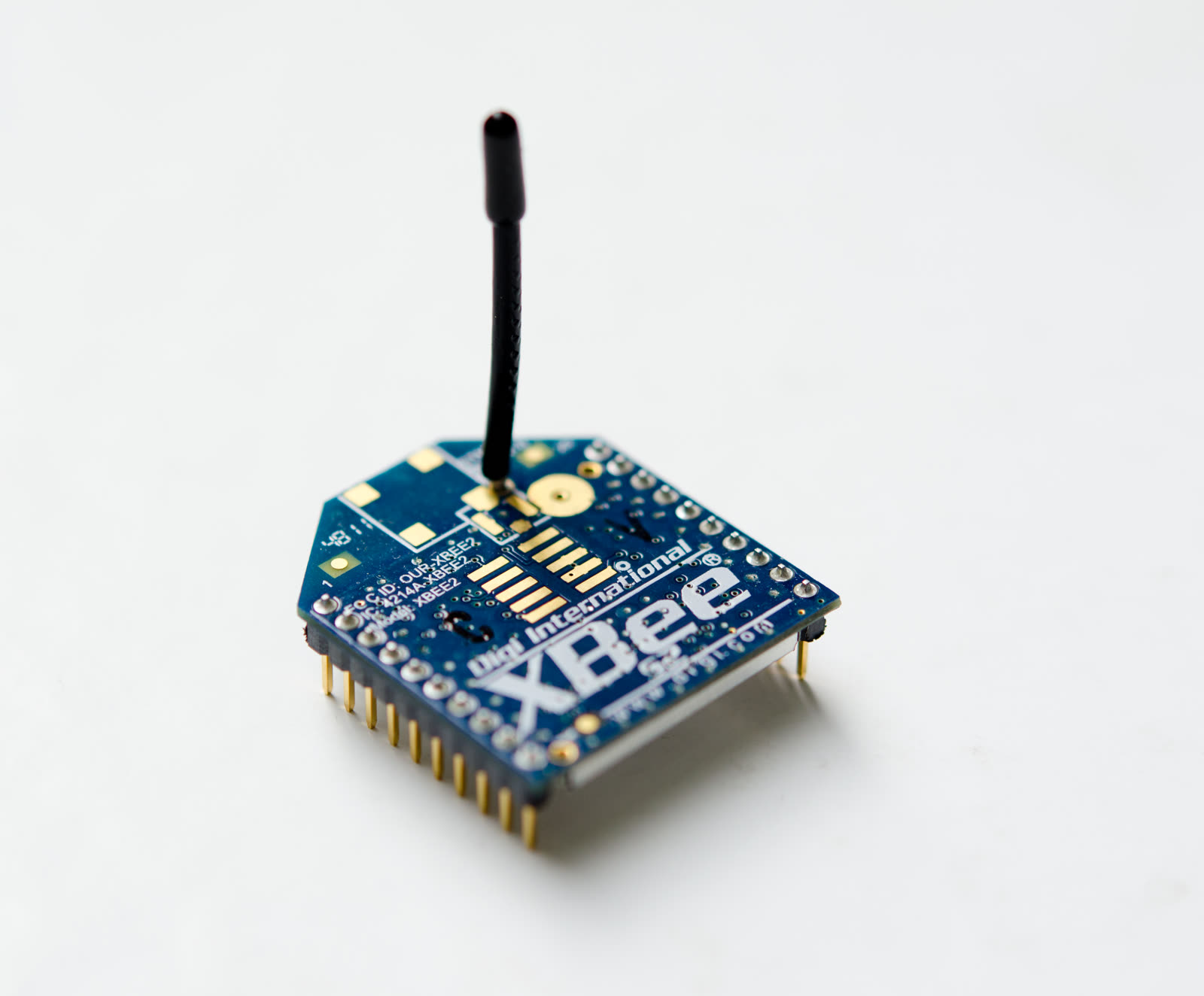
Image context: the photograph shows an XBee Series 2 ZigBee module with an antenna, not a Zigbee2MQTT UI. That is deliberate. The article is about the bridge between a physical low-power mesh and a software event fabric. If the radio and coordinator layer is unreliable, no amount of dashboard polish above it will make the system trustworthy.[9]
The coordinator is the hard boundary
Zigbee2MQTT's getting-started guide states the basic shape clearly: the software connects to a Zigbee adapter and an MQTT broker, then bridges Zigbee devices into MQTT messages.[1] The adapter is not a decoration. It is the coordinator for the local Zigbee network, the piece of hardware that talks over the radio mesh and exposes that network to the host running Zigbee2MQTT.
That means adapter choice is architecture, not shopping. The supported-adapters guide distinguishes families such as zStack, EmberZNet, deCONZ, and ZiGate, and it repeatedly points operators toward coordinator firmware, USB extension cables, backup support, transmit power, and network stability considerations.[2] Those details matter because Zigbee is not IP with a friendlier name. It is a low-power mesh of coordinators, routers, and end devices where placement, interference, firmware, and route formation can decide whether an automation is dependable.
The adoption lesson is simple: do not evaluate Zigbee2MQTT only by the list of devices it supports. Evaluate the coordinator path first. Can the adapter run recommended firmware? Is it on a stable USB extension away from RF noise? Does the deployment need backup and restore for coordinator migration? Are routers placed deliberately enough that sleepy battery devices have a path home? A brittle coordinator makes everything above it look flaky.
MQTT keeps the hub from becoming the platform
The second boundary is MQTT. Zigbee2MQTT requires an MQTT server connection to operate, and the MQTT configuration surface includes server, base_topic, authentication fields, TLS certificate paths, client_id, retained-message behavior, and availability options.[3] That is the most important design clue in the project. Zigbee2MQTT is not trying to be the final application. It publishes and receives messages through a broker so other systems can subscribe, command, store, visualize, and automate.
The default base_topic of zigbee2mqtt is more than a namespace convenience.[3] It is the root of the operational contract. Devices publish state under predictable topics. Commands arrive through corresponding set topics. Availability and bridge-level messages can be handled separately. If a team treats MQTT as an opaque detail hidden inside a container compose file, it loses the main benefit of the architecture. The broker is where observability, ACLs, retained state, persistence, and cross-application integration become possible.
This is also where Zigbee2MQTT differs from a normal vendor hub. A hub usually owns both protocol translation and product experience. Zigbee2MQTT deliberately stops earlier. It converts the Zigbee side into an open message surface, then lets the operator decide whether Home Assistant, Node-RED, custom services, metrics collectors, or scripts should consume it. That increases responsibility, but it also prevents the integration point from being trapped inside one UI.
The boundary condition is equally clear. If a household wants one polished appliance with no broker, no logs, and no topic discipline, Zigbee2MQTT is probably too exposed. It becomes compelling when the operator wants local control, visible transport, and the ability to debug or extend behavior outside a single smart-home app.
Device definitions are the translation layer
The third boundary is capability mapping. Zigbee devices do not all behave like generic light bulbs, switches, meters, and sensors. Zigbee2MQTT's exposes documentation describes how devices publish capability descriptions: binary values, numeric values, text values, composites, enumerations, access flags for get/set/state, labels, units, value ranges, and presets.[4] This is the layer that turns messy device reality into something applications can reason about.
That is why device support is not just a compatibility table. It is a translation contract. A plug may expose switch state and power. A sensor may expose occupancy, illuminance, battery, link quality, and tamper state. A light may expose brightness, color temperature, color mode, transition behavior, effects, or vendor-specific extras. If those exposes are wrong or incomplete, the device may pair successfully while still being operationally half-understood.
For engineers, this is the most interesting part of Zigbee2MQTT. The project is not only shuttling bytes from a radio to a broker. It is maintaining a shared semantic dictionary for thousands of devices. That dictionary has to survive cheap clones, regional variants, sleepy end devices, firmware revisions, and vendors that do not design for cross-platform clarity. The open-source value sits precisely there: each supported quirk can become shared knowledge instead of being rediscovered in separate vendor islands.
The risk is that the dictionary becomes a trust boundary. Automations should be written as if a capability description can change when a device definition improves. For critical routines, prefer simple, observable state transitions over elaborate assumptions about every optional property. When a newly supported device matters, inspect its exposes output before building routines on top of it.[4]
Home Assistant discovery is downstream, not destiny
The Home Assistant integration makes Zigbee2MQTT easier to adopt, but it should not be mistaken for the whole architecture. The integration guide describes MQTT discovery, including how Zigbee2MQTT can publish discovery payloads so Home Assistant creates entities automatically.[5] That is a useful bridge because most users do not want to hand-build every entity. It is also a reminder that Home Assistant is a consumer of the MQTT surface, not the only possible owner of the system.
This distinction keeps deployments cleaner. If Home Assistant is temporarily down, the broker and Zigbee2MQTT can still be inspected. If a custom service needs to react to a sensor, it can subscribe without scraping Home Assistant state. If the dashboard model changes, the underlying message topics can remain stable. Conversely, if the broker is unhealthy, Home Assistant discovery will not save the deployment because the transport layer beneath it is broken.
An independent smart-home article on cloud versus local automation frames the broader reason this matters: local automation trades vendor convenience for local control, privacy, and resilience, while adding operator responsibility.[8] Zigbee2MQTT is a concrete example of that trade. It gives the operator a local, inspectable bridge, but it also asks them to operate the broker, coordinator, updates, backups, logs, and radio environment deliberately.[1][2][3]
Where it fits
Zigbee2MQTT is strongest when the operator already accepts that a smart home is infrastructure. Good fits include mixed-vendor Zigbee deployments, privacy-sensitive homes, home labs, small offices, workshops, rental-property maintenance setups, and local-first automation systems where one broker can serve several consumers. It is especially useful when the failure mode of vendor hubs is the real problem: inaccessible logs, unclear routing, forced clouds, missing device capabilities, and brittle app-to-app handoffs.
It is weaker when the goal is a managed consumer appliance with a support number. The project exposes too many real surfaces for that: adapter firmware, serial paths, MQTT broker configuration, topic design, Home Assistant discovery, database persistence if you add it, and device definition edge cases. Those surfaces are the point, but they are also work.
A conservative rollout starts with the mesh, not the dashboard. Pick a recommended coordinator. Put it on a USB extension or a stable network path. Pair a few routers before judging sleepy sensors. Configure MQTT with explicit authentication and a stable base_topic. Watch actual topics before writing automations. Confirm the exposes for each device class. Only then let Home Assistant discovery create the friendly entity layer.[2][3][4][5]
The reason to care about Zigbee2MQTT is not that it removes every smart-home headache. It replaces an opaque hub problem with explicit system boundaries: radio coordinator, Zigbee mesh, message broker, device capability dictionary, and downstream integrations. That is a very open-source kind of improvement. It does not promise magic. It gives the operator a system they can inspect.
Sources
- Zigbee2MQTT, "Getting started" - official overview of the Zigbee adapter, MQTT broker, installation flow, and basic bridge role.
- Zigbee2MQTT, "Supported Adapters" - coordinator families, firmware notes, backup support, USB/network placement, and adapter-selection constraints.
- Zigbee2MQTT, "MQTT" configuration docs - required MQTT server connection,
base_topic, TLS, authentication, client ID, and availability settings. - Zigbee2MQTT, "Exposes" - capability-description model, access flags, binary/numeric/text/composite exposes, and example device mappings.
- Zigbee2MQTT, "Home Assistant integration" - MQTT discovery behavior and Home Assistant entity integration path.
- GitHub API,
Koenkk/zigbee2mqttrepository metadata snapshot - stars, forks, open issues, recent push activity, default branch, and license at article creation time. - GitHub API,
Koenkk/zigbee2mqttlatest release endpoint - current release tag and publication timestamp at article creation time. - Steve Ovens, "Cloud vs local home automation," Opensource.com, November 16, 2020 - independent context on local automation tradeoffs, privacy, and operator responsibility.
- Wikimedia Commons, "File:XBee Series 2 with Whip Antenna.jpg" - source page for the real ZigBee module photograph used as the article image.