If you are evaluating SeaweedFS in 2026, the useful question is not whether it can look like an object store, a file system, and an S3 endpoint at the same time. The useful question is whether your team is comfortable operating the boundaries that make that trick work. SeaweedFS keeps the master narrow, pushes object placement down to volume servers, adds the filer as a separate metadata plane, and then lets the S3 gateway ride on top of that stack.[1][2][3][4] That architecture is elegant when you read it correctly. It is also easy to misread if you expect one uniform storage layer that automatically heals every problem for you.
The core design wager is simple. SeaweedFS started as a blob store for many small files and tried to avoid a central metadata hot spot by having the master manage volume placement rather than every file's metadata.[1] The payoff is a system that can scale out with surprisingly little central coordination. The cost is that you have to think in volumes, collections, filer stores, and repair workflows, not only in buckets and folders.[1][2][5]
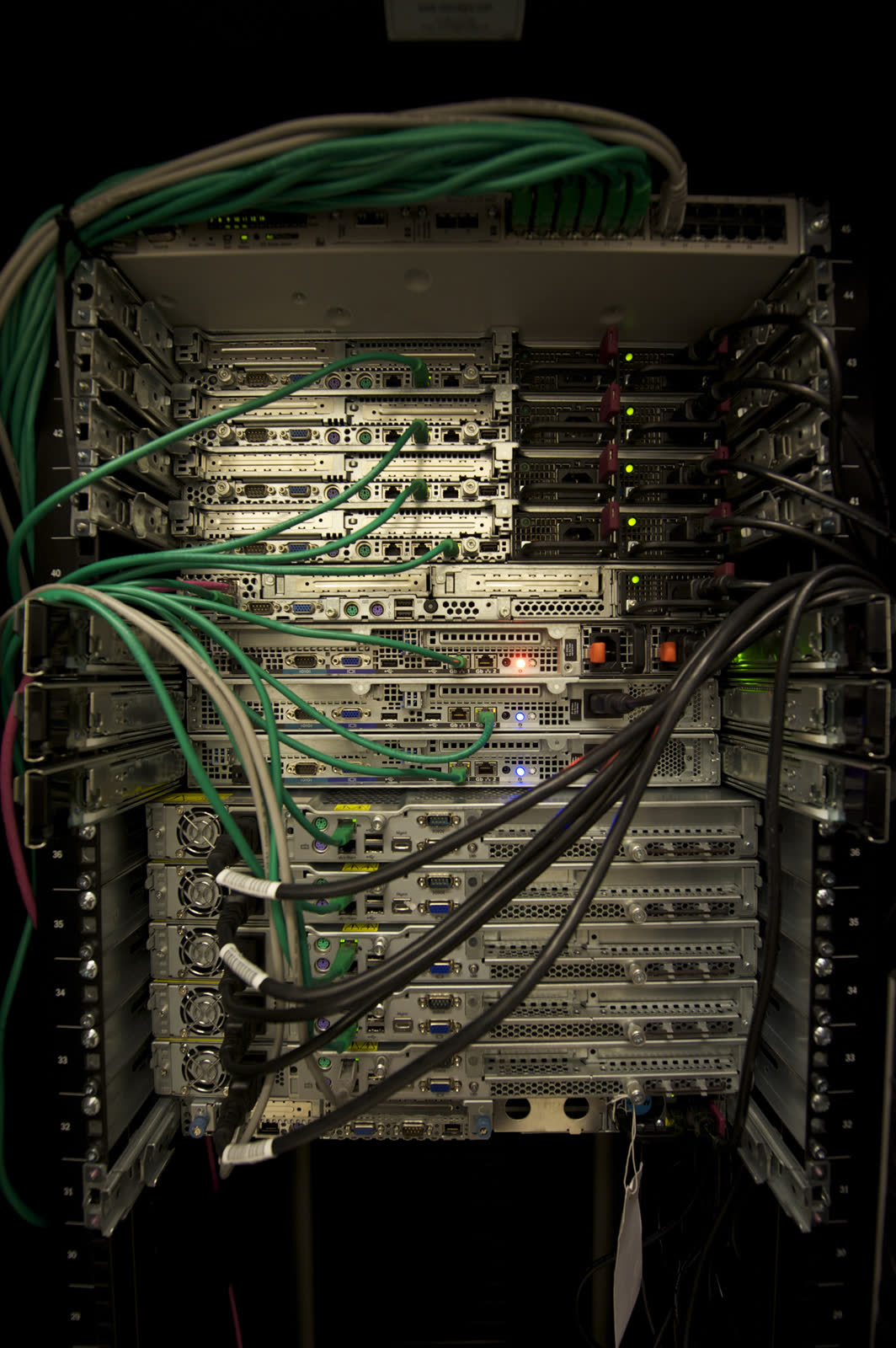
Image context: the cover uses a real Wikimedia Commons server-room photograph rather than a diagram because SeaweedFS performance and durability are decided by actual storage layout: racks, disks, volume growth, and the maintenance work needed to keep replicas and warm-storage shards healthy.[10]
1. The master should stay small because SeaweedFS does not want a global per-object control plane
The components page makes the first boundary explicit. The master service keeps a consistent view of cluster topology, participates in leader election through Raft, assigns file ids, and decides which volumes should receive writes.[2] The README makes the architectural intent even clearer: the master manages volumes on volume servers, while the volume servers manage files and file metadata, which is how SeaweedFS tries to keep concurrency pressure away from the center.[1]
That is the right starting point for an architecture note because it explains both the attraction and the limit. SeaweedFS is appealing when you want a narrow coordinator that knows where writable capacity lives without becoming the permanent owner of every file lookup.[1][2] It becomes less appealing if your organization expects the top of the stack to own every namespace and every repair decision automatically.
The master cluster guidance also stays conservative for a reason. SeaweedFS recommends an odd number of masters and says that one or three is typical; the point is not to build a huge management fleet, but to keep a small set of stable servers with a majority view of the cluster.[2] Inference from the docs: if your control-plane habit is "add more coordinators whenever you feel nervous," SeaweedFS is not asking for that instinct.
2. The volume layer is the real object store, and that changes how you should reason about scale
The volume service packs many objects into larger volume files, with redundancy and replication managed at the volume level rather than for each object.[2] That is why the basic write path in the README looks different from S3-style marketing language. The client first asks the master for an fid and a target volume server through /dir/assign, and only then writes the blob to a volume server.[1] This is the key indirection layer in the system.
That indirection has a concrete operational consequence: growth happens by adding or moving volumes and volume servers, not by pretending every bucket is an isolated appliance.[1][2][5] The project docs are explicit that clusters need periodic balancing and replica repair, and that missing replicas turn a volume read-only until you fix replication with volume.fix.replication or the newer admin/plugin workflow.[5] SeaweedFS is strong on write acknowledgement, but it does not promise instant automatic self-repair as soon as a replica disappears.[5]
This is one of the clearest boundaries in the whole design. In the replication guide, writes are described as strongly consistent because all configured replicas must acknowledge the write before the request succeeds, with W = N and R = 1 for the normal replicated path.[6] That is a serious durability posture on the write path.[6] The same guide then says that missing replicas are not repaired automatically right away; the volume becomes read-only, and repair is handled deliberately through weed shell commands such as volume.fix.replication.[5][6] In plain engineering terms: SeaweedFS prefers to avoid accidental over-replication during transient failures, but the price is that operators need an explicit repair loop.
3. The filer is a second metadata plane, and that is where many teams misread the system
Once you add directories, HTTP paths, FUSE mounts, or S3 semantics, you are no longer living only in the volume world. The filer introduces a path-oriented metadata plane backed by a configurable filer store.[1][3] The filer docs say it keeps a persistent connection to the master for volume-location updates, reads metadata from a filer store such as MySQL, Postgres, Redis, LevelDB, SQLite, or etcd, and writes file metadata plus chunk references after streaming content to volume servers.[3]
That split is the reason SeaweedFS can serve more than one personality. The volume layer stores blobs efficiently; the filer turns those blobs into directories and file entries; the S3 gateway then maps bucket operations into the filer model.[3][4] Architecturally, that is powerful. Operationally, it means teams should stop thinking of "SeaweedFS metadata" as one thing.
The filer scaling docs make the second warning explicit. Multiple filers are supported, peer discovery is automatic, and embedded stores such as LevelDB, RocksDB, or SQLite can synchronize across filer instances.[7] But the same page says that when you run multiple replicated embedded filers, the setup is only eventually consistent, which can surprise you behind a load balancer unless you add sticky-session or hashing logic.[7] That is the kind of sentence an architecture review should circle in red. SeaweedFS gives you a lot of flexibility in the filer layer, but it expects you to choose the consistency and load-balancing model on purpose.
4. S3 compatibility is real, but every bucket is also a collection and volume-growth plan
The S3 API page describes weed s3 as a stateless gateway that bridges the Amazon S3 API to SeaweedFS Filer.[4] That is a solid architectural choice: it keeps the S3 surface separate from the core storage and lets you scale the gateway horizontally.[4] It also means the S3 lane inherits the filer and collection model underneath, and the docs are unusually candid about that.
Each bucket is stored in its own collection and mapped to /buckets/<bucket_name> by default.[4] The same page warns that one collection usually uses seven volumes, each with a default 30 GB size, so a cluster can run out of volumes quickly if you create many buckets without adjusting -volumeSizeLimitMB or path-specific configuration such as fs.configure -locationPrefix=/buckets/ -volumeGrowthCount=1 -apply.[4] That is a high-value detail because it turns an abstract "S3-compatible" label into a planning constraint you can actually model.
The practical implication is that SeaweedFS is a better fit for teams who are willing to think about bucket cardinality, volume-growth policy, and collection layout ahead of time.[4] If your mental model of S3 is infinite bucket sprawl with no cluster-shape consequences, SeaweedFS will eventually force you to become more honest.
5. Warm storage is a separate lane, not a free optimization checkbox
SeaweedFS's erasure-coding story is another place where the docs reward close reading. The warm-storage page says the open-source implementation uses Reed-Solomon 10+4, tolerates the loss of four shards, and does so at roughly 1.4x storage overhead rather than the far larger footprint of heavy replication.[1][8] The same page also tells you exactly where the tradeoff lands: the system seals warm data, skips loading volume indexes into memory, and accepts an extra network hop on ordinary reads from erasure-coded volumes.[8]
This matters because erasure coding here is not a background magic spell on the normal write path. It is a distinct lifecycle for quieter, fuller volumes, now handled by the erasure_coding plugin worker with explicit thresholds for fullness ratio, quiet period, and minimum volume size.[8] The page also says only one replicated copy is erasure-coded and the original copies are purged after successful encoding.[8] That is a strong clue about intended use: EC is the warm-storage lane, not the first answer for hot mutable data.
The performance examples reinforce the point. SeaweedFS shows normal EC reads at roughly half the throughput of normal volume reads in the benchmark example because of the extra network hop, with degraded but still readable behavior when one of four servers is down.[8] You can absolutely use that trade if the goal is lower storage cost for warm data. You should not pretend it is free.
6. The 2026 maintenance signal is modest but healthy
The latest SeaweedFS release, 4.17, was published on 2026-03-11, and the release notes are narrow in a reassuring way: fixes in the admin UI and worker path, plus S3-side corrections such as persistent bucket counter metrics and a ListObjects trailing-slash prefix fix.[9] That is not a flashy release story. It is a good one for this particular project.
Inference from the current release and the surrounding docs: SeaweedFS is being maintained where the architecture actually bites operators, namely the admin/worker plane and the S3 compatibility layer.[4][5][8][9] For a storage system with several personalities, that is the right place to look for health.
Best-fit boundary and mismatch boundary
SeaweedFS is a strong fit when your team wants one OSS system that can cover blob storage, file-style access, and an S3-compatible gateway, and when you are willing to operate the boundaries between master, volume, filer, and warm-storage workflows deliberately.[1][2][3][4][5][8] It is especially attractive when many small files and storage-efficiency tradeoffs matter more than presenting one perfectly uniform control plane.
It is a weaker fit when your organization wants every repair action to be automatic, wants embedded filer replicas behind a generic load balancer without consistency tradeoffs, or expects S3 buckets to behave like a purely logical abstraction with no volume-layout consequences.[4][5][7] SeaweedFS can do a lot, but it keeps asking the operator to remember what layer they are actually using.
Bottom line
SeaweedFS in 2026 is best understood as a layered storage system with narrow control at the top and explicit operating responsibilities lower down. The master should stay small. The filer should be treated as its own metadata plane. The S3 gateway should be read as a stateless bridge, not as the storage system itself. And every bucket should be sized against collections, volumes, and storage tiers rather than only against an API surface.[1][2][3][4][5][8]
Teams that read those boundaries clearly can get a great deal of flexibility out of SeaweedFS. Teams that flatten them into "an S3 clone with extra features" will eventually fight the design instead of using it.
Sources
- SeaweedFS README: project overview, object-store model, quick-start topology, filer role, and erasure-coding overview.
- SeaweedFS wiki, "Components" — master, volume, filer, S3 service, and collection concepts.
- SeaweedFS wiki, "Directories and Files" — filer read/write path, filer stores, and scaling model.
- SeaweedFS wiki, "Amazon S3 API" — stateless S3 gateway, per-bucket collections, and volume-growth guidance.
- SeaweedFS wiki, "Volume Management" — admin/plugin maintenance flow,
volume.fix.replication, balancing, and maintenance mode. - SeaweedFS wiki, "Replication" — replication-string semantics,
W = NandR = 1, and repair posture. - SeaweedFS wiki, "Filer Store Replication" — peer discovery, embedded-store synchronization, and eventual-consistency caveat.
- SeaweedFS wiki, "Erasure Coding for warm storage" — 10+4 EC design, plugin-worker thresholds, repair model, and read-performance tradeoffs.
- SeaweedFS GitHub release 4.17 — published 2026-03-11 with admin/worker and S3 fixes.
- Wikimedia Commons file page for the server-rack photograph used as the article image.