
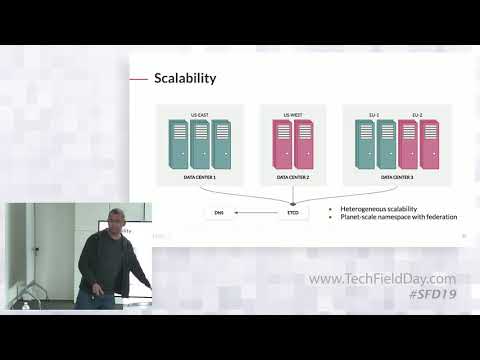
A lot of object-storage explainers flatten the hard part. They promise S3 compatibility, horizontal scale, and erasure coding, then quietly hide the control machinery that makes those promises true. Somewhere behind the API there is often a metadata service, a lock service, a database, or at least a clean division between the request-serving surface and the subsystem that decides what an object really is. AB Periasamy's MinIO internals talk is useful because it keeps returning to the opposite design claim: MinIO wants to behave like a single-layer object server, with coding, placement, and recovery pushed directly into the object path rather than delegated to a separate metadata tier.[1][3][4][5]
That remains a live way to read MinIO in 2026. The current erasure-coding docs still center the system on erasure sets, quorum, and failure-domain-aware distribution.[3] The healing docs still present repair as background storage behavior plus explicit admin actions when needed, not as a separate coordination product.[4] And the versioning/metadata deep dive makes the architectural bet even clearer by showing that object versions and metadata are tracked in xl.meta, right next to the storage layout that has to survive failures.[5] The talk is from 2020, but the design spine it describes is still visible in MinIO's current written materials.
My inference from the talk and the docs is that MinIO makes the strongest sense when you stop describing it as "an S3-compatible alternative" and start describing it as a refusal to create a second system.[1][3][4][5] The real product is not the API surface alone. The real product is the decision to keep erasure coding, metadata, and self-repair inside the same operational frame, so operators are not asked to run one storage fleet and one metadata-control fleet beside it.
Image context: the cover uses Anand Babu Periasamy's portrait from MinIO's about page. It fits because this article is anchored on a speaker explaining his own system's internal discipline rather than on a generic stock image of data-center racks or object-storage icons.[2]
Around 0:50, MinIO is framed as a data-path system before it is framed as a storage product
The first crucial move arrives early. Periasamy says MinIO is "just a webserver," calls it a single-layer architecture, and insists that consistency, atomicity, inline erasure coding, and encryption happen before the application gets its response.[1] That wording matters because it shifts the architecture discussion away from branding and toward commit semantics. If the acknowledgment comes back only after the object has been encoded and durably placed, then MinIO is not merely proxying writes into a later durability stage. The durability work is already on the hot path.
That is the right lens for the rest of the video. The erasure-coding docs describe parity, read/write quorum, and the way MinIO distributes erasure sets across failure domains.[3] Those are not background implementation details. They are the concrete reason a "simple" object server can claim durability without pointing to a separate metadata cluster. The system answers a write only after object data and parity have crossed that threshold.[1][3]
This is also where MinIO separates itself from a lot of scale-out storage storytelling. Many systems achieve conceptual neatness by splitting the fast request path from the slower truth-maintenance path. MinIO's pitch is stricter: keep the truth-maintenance path inside the same server process and make the object operation itself carry the burden. That can look almost too simple in slides. In engineering terms, it means the storage layer cannot afford to be vague about quorum or placement because it has nowhere else to hide mistakes.
Around 2:08, the absence of a metadata node is the real architectural thesis
The talk's most revealing section starts when Periasamy says there is no metadata node, no lock server, and no special control machine; every server comes up with the same capabilities and becomes part of the distributed object store.[1] That is more than a scalability slogan. It is a statement about failure shape. Once you remove the separate metadata tier, you remove an obvious coordination bottleneck, but you also give up the convenience of solving object truth in one central place.
MinIO compensates by making object placement legible and finite. In the talk's default example, an object is striped across sixteen drives with eight data and eight parity, and the striping is spread horizontally rather than concentrated inside one node.[1] The current documentation generalizes this through erasure sets and failure-domain-aware placement: MinIO distributes encoded shards so that hardware loss is absorbed by parity and quorum rules instead of by a separate controller replaying object state from a catalog.[3] The architecture is therefore decentralized in a narrow way. Nodes are equal, but object layout is not random.
That distinction is worth holding onto because "no metadata node" can sound like "no metadata problem." The exact opposite is true. MinIO still has to know where object shards belong, which fragments remain readable, and when recovery is possible. It simply chooses to encode those truths into the storage system's own object layout and quorum behavior instead of into an external metadata plane. The design is elegant precisely because it keeps those responsibilities visible rather than pretending they disappeared.
Later in the talk, metadata stops being an external catalog and becomes part of the object contract
A second useful shift arrives when the discussion turns to metadata structure and the audience asks the obvious distributed-storage question: where does the namespace truth live if there is no metadata database or lock server?[1] The best 2026 answer sits in MinIO's versioning and metadata deep dive. That post explains how object versions and metadata are recorded in xl.meta, a per-object metadata file that travels with the storage model rather than with a separate relational catalog.[5]
That design choice is more important than it first appears. Once version state and object metadata live beside the object's own storage record, recovery logic can stay local to the storage fleet. You do not have to reconcile a durable blob layer with an independently durable metadata layer after every partial failure.[4][5] The system still needs background scanning, quorum checks, and repair logic, but its repair target is one storage truth, not two systems that might drift apart.
This is the deeper reason MinIO can plausibly present itself as simple. Simplicity here does not mean fewer moving parts in the abstract. It means fewer categories of state that have to be made mutually consistent after something breaks. In practice that is an operational gift. It narrows the places where inconsistency can hide. It also raises the stakes on storage hygiene, because if the storage layer is the contract, sloppy recovery discipline is no longer buffered by an external metadata service that can paper over local damage.
Around 23:04, self-healing reveals what kind of simplicity MinIO is actually selling
The self-healing section is where MinIO's design stops sounding elegant and starts sounding operationally specific. Periasamy describes replacing a failed drive and letting the system begin healing automatically, then argues that parity choices should reflect how quickly an operator can swap failed hardware back into the set.[1] That is not just a resilience story. It is a declaration that redundancy policy and repair workflow belong to the same conversation.
The written docs support that reading. MinIO's healing documentation describes background scanning, bit-rot detection, and administrative healing tools for rebuilding damaged or missing fragments when the remaining object state is still sufficient.[4] The erasure-coding docs, meanwhile, tie storage efficiency and fault tolerance directly to parity choices and erasure-set structure.[3] Put together, the real lesson is that MinIO's simplicity is conditional. It feels simple when hardware replacement, healing cadence, and failure-domain planning are treated as ordinary storage operations. It feels much less simple if operators assume parity is a one-time design decision and healing is magic.
That is why the talk still rewards careful viewing. It is not mainly a talk about S3 API compatibility. It is a talk about what MinIO refuses to outsource. Object durability stays in the server. Metadata stays with the object contract. Repair stays inside the storage fleet. That refusal produces a system that can look unusually clean from the outside.[1][3][4][5] It also defines MinIO's boundary. If you want object storage whose resilience logic lives inside the storage path itself, the design is compelling. If you expect a separate control tier to absorb your operational disorder, you are asking MinIO to become a different kind of system.
Sources
- Tech Field Day, "AB Periasamy Presents the MinIO Internals," YouTube video, published January 26, 2020.
- MinIO, "About MinIO" - company about page with Anand Babu Periasamy portrait and team context.
- MinIO AIStor Documentation, "Erasure Coding" - erasure sets, parity, quorum, and failure-domain distribution.
- MinIO AIStor Documentation, "Healing" - background scanning, bit-rot detection, and repair workflow.
- MinIO, "MinIO Versioning, Metadata and Storage Deep Dive" -
xl.meta, object version layout, and metadata storage model.