Reproducible builds are easy to undersell as a niche packaging concern and easy to oversell as a cure for supply-chain compromise. Both readings miss the useful middle. The practical value is that a release artifact stops being a thing a consumer merely downloads and starts becoming a thing another party can independently recreate, byte for byte, from the claimed source, environment, and build instructions.[1]
That makes reproducibility an adoption problem more than a slogan problem. A team cannot "turn it on" across a modern estate by adding one CI badge. It has to decide which artifacts matter, which build inputs are allowed to vary, how timestamps and paths are normalized, where rebuild evidence lives, and what happens when a rebuild differs. The payoff is not mystical purity. It is a sharper boundary between source review, build execution, provenance, and release trust.
As of 2026-05-28T19:32:24Z UTC, the strongest adoption frame is this: use reproducible builds for the artifacts whose trust story would otherwise depend too heavily on one build machine, one CI vendor, or one maintainer release path. The Reproducible Builds definition is intentionally strict: same source code, same build environment, and same build instructions should let any party recreate bit-by-bit identical copies of the specified artifacts.[1] That "specified artifacts" phrase matters. Start with release tarballs, packages, container images, firmware, CLI binaries, or installers that people actually run; do not begin by trying to make every log file and intermediate scratch directory immortal.
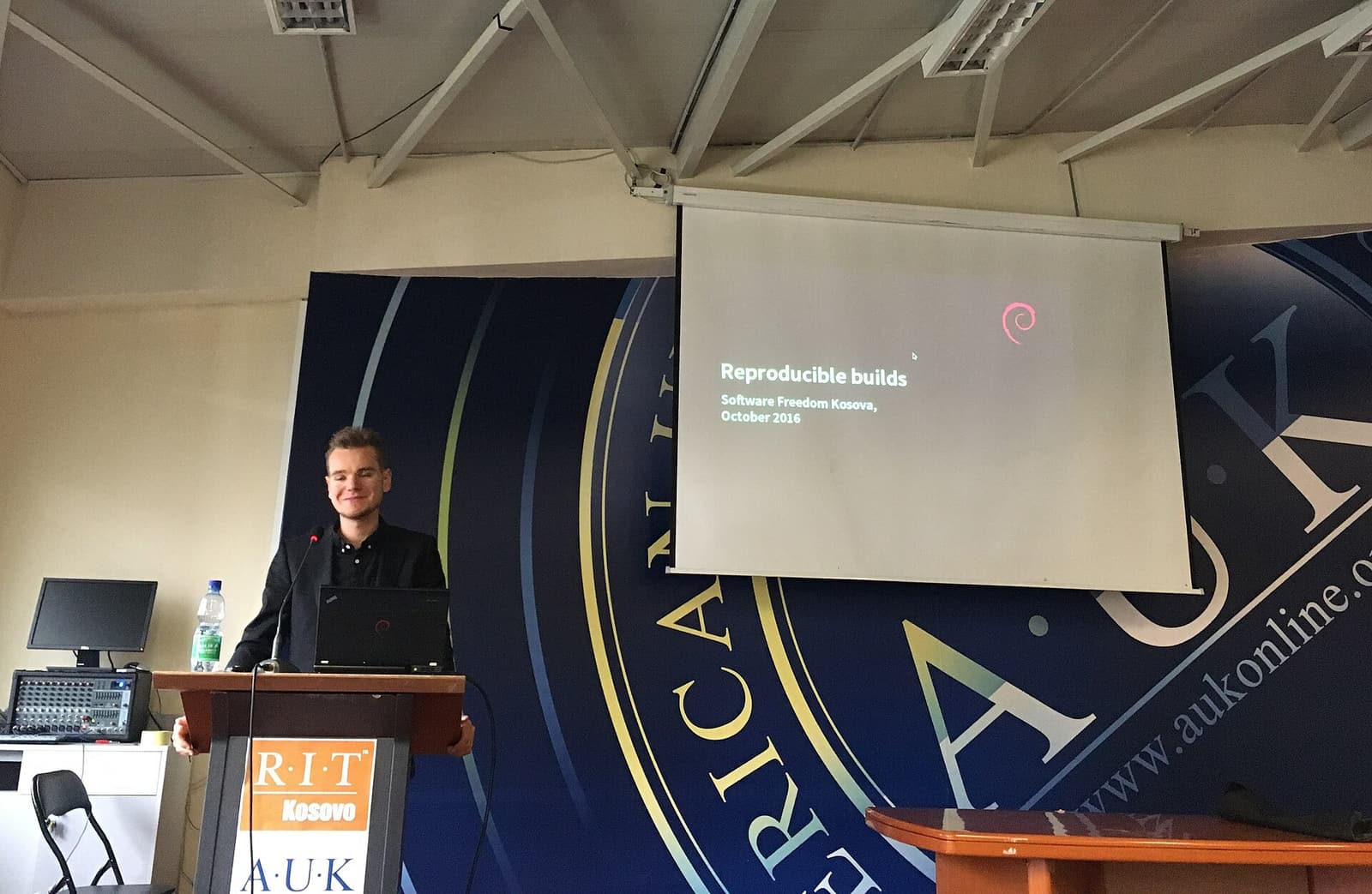
Image context: the cover uses a 2016 photograph of Chris Lamb speaking about Reproducible Builds at Software Freedom Kosova. It is a real archival conference image, not a diagram. The subject fits because this migration is partly technical and partly communal: reproducibility only becomes valuable when multiple parties know what to rebuild, how to compare it, and where to report divergence.[8]
Begin With The Artifact Boundary
The first migration question is not "is our build reproducible?" It is "which output are we asking someone else to verify?" The Reproducible Builds project treats artifacts as the desired primary outputs of a build, such as executables, distribution packages, or filesystem images, and distinguishes them from ancillary outputs like logs.[1] That definition prevents scope creep. If a team cannot name the artifact and the comparison method, it is not running a reproducibility program; it is running a general cleanup project.
The most useful initial candidates have three properties. They are distributed outside the build team. They carry meaningful security or operational risk if tampered with. And they can be rebuilt often enough that drift is noticed before the next incident review. A command-line release binary is a good candidate. A base container image used by hundreds of downstream services is a good candidate. A firmware blob shipped to production devices is a good candidate. A one-off preview bundle from a feature branch usually is not.
Once the artifact is named, write down the comparison contract. Reproducibility is verified by bit-by-bit comparison, usually through cryptographically secure hashes.[1] That sounds obvious, but it forces a useful discipline: a "close enough" rebuild is not the same control. If two packages differ only because one embedded a current timestamp, the fix is not to wave the difference away. The fix is to remove or normalize the timestamp so the next rebuild can converge.
Timestamps Are The First Migration Surface
Timestamps are the best starting point because they are common, boring, and surprisingly expensive when ignored. The Reproducible Builds documentation calls SOURCE_DATE_EPOCH a standardized environment variable that distributions can set centrally and build tools can consume to produce reproducible output.[2] In practice, it gives the build a source-derived time to use instead of "right now."
That distinction is small but decisive. A build that writes the current wall-clock time into a binary, archive, generated page, or image manifest has made every execution different by design. A build that derives time from source state can be rebuilt next week without pretending the source changed. The formal specification says SOURCE_DATE_EPOCH should be an integer Unix timestamp, deterministic across executions, and dependent only on source code, commonly the last modification time of source plus packaging changes.[2]
Containers make this concrete. Docker's reproducible-build guidance uses SOURCE_DATE_EPOCH with GitHub Actions and notes that Docker Buildx can propagate it into BuildKit behavior; the docs also show that image-layer file timestamps may need explicit rewriting through image exporter options.[4] That is the kind of migration detail teams should expect. Setting one variable is often necessary, but the archive format, image builder, language toolchain, and packaging step each decide how much determinism actually reaches the final artifact.
The adoption move is to make timestamp policy visible. For source releases, derive from the commit timestamp or changelog timestamp. For language packages, check the package manager's reproducible-build knobs. For containers, test whether the image digest stays stable across two clean builds from the same commit. If the digest changes, inspect whether file mtimes, generated metadata, package repository snapshots, or build arguments are moving underneath the team.
Paths, Order, Locale, And Randomness Come Next
After timestamps, the common failure modes are less glamorous: absolute build paths, unstable file ordering, locale differences, timezone differences, random values, and environment variables that leak from a developer laptop into release output.[1][3] The Reproducible Builds documentation separates these into manageable variance classes instead of treating nondeterminism as one vague enemy. That is the right mental model for migration.
Build paths are a good example. If a compiler embeds /home/alice/project in debug information while another rebuilder uses /build/worker/project, the resulting artifact may differ even when the source is identical. The build-path guidance recommends avoiding embedding full paths where possible or mapping them to stable prefixes when the toolchain supports it.[3] This is not cosmetic. It is the difference between "Alice's laptop built this" and "this source built this."
Stable input order has the same character. Filesystem iteration order, archive member order, glob expansion, and generated index ordering can all produce artifacts that differ without any semantic change. Sorting inputs before packaging is not sophisticated security engineering, but it is exactly the kind of mechanical fix that turns reproducibility from aspiration into an ordinary build property.[3]
Treat these fixes as a backlog with owners. One task may belong to the build system. One may belong to language packaging. One may belong to container base-image policy. One may require an upstream patch. The mistake is to wait for a perfect hermetic environment before removing easy variation. A team can get a lot of signal by making timestamps, paths, and ordering deterministic before it tries to solve every transitive dependency problem.
Rebuilds Need A Comparator, Not Just A Promise
A reproducible build program needs a way to explain differences. This is where diffoscope earns its keep. The tool describes itself as an in-depth comparator for files, archives, and directories; it recursively unpacks many archive and binary formats and turns differences into more human-readable output.[6] As of its site's current listing, diffoscope release 318 shipped on 2026-05-01, which is a useful maintenance signal for a tool sitting directly in the verification loop.[6]
In practice, the workflow should be simple. Build artifact A through the official release path. Build artifact B through an independent or at least freshly provisioned rebuild path. Compare hashes. If hashes match, record the result. If they do not, run diffoscope or an equivalent comparator and classify the difference: timestamp, path, ordering, dependency version, network fetch, compiler flag, generated randomness, or unexplained binary delta.
That classification is the value. A mismatch is not automatically evidence of compromise. It may be a mundane timestamp. It may be an undeclared dependency. It may be a CDN-fetched asset. It may be a poisoned toolchain. Reproducible builds help because they narrow the uncertainty. Without a rebuild, the team may not know there is a question. With a rebuild and a good comparator, the team can ask a better one.
The boundary should be explicit in incident policy. If a high-risk artifact fails reproducibility because of a known timestamp issue, the release may proceed under an exception with a tracked fix. If it fails because the source used by the release job cannot be reconstructed, the release should stop. If it fails because a dependency moved, the dependency pinning or snapshot policy is broken. If it fails for an unexplained binary delta, the burden of proof shifts to the release owner.
Pair Determinism With Provenance
Reproducibility and provenance solve adjacent problems, not the same problem. Reproducibility asks whether independent parties can recreate the same artifact from the claimed inputs. Provenance asks how the artifact was produced and whether that statement can be trusted. SLSA's current Build Track requirements make that split visible: producers choose an appropriate build platform, follow a consistent build process, and distribute provenance, while build platforms provide provenance generation and isolation properties at increasing levels.[5]
This matters because a reproducible malicious build is still malicious if the source or build instructions are malicious. Conversely, a non-reproducible build with strong provenance may tell you which trusted builder produced the artifact, but it may not let another party independently verify that the binary corresponds to the source in a bit-for-bit way. The two controls reinforce each other when they are wired together: provenance names the source, builder, parameters, and artifact digest; reproducibility tests whether the artifact can be recreated under the declared contract.[5]
For adoption, do not make teams choose between them. A modest first lane can produce provenance for every release artifact and run reproducibility checks on the highest-risk subset. Over time, expand the subset and tighten the build environment. That is more realistic than demanding instant full hermeticity across every artifact. SLSA also distinguishes isolated build platforms from hermetic builds, noting that hermeticity roughly means no network access during the build and requires substantial changes to platforms and individual builds.[5] That distinction keeps migration honest.
A Sensible Rollout
Start with one artifact family and one release path. For example: the Linux amd64 CLI tarball, the production base container image, or the firmware image used by a specific device line. Record the exact source revision, build command, dependency snapshot, environment assumptions, and expected artifact names. Then run two clean builds from the same inputs. The first metric is not perfection. It is whether the team can explain every difference.
Second, fix the boring sources of movement. Set SOURCE_DATE_EPOCH where supported. Normalize archive metadata. Sort file inputs. Remove absolute build paths from outputs or map them consistently. Pin dependency indexes or use package snapshots where the ecosystem allows it. Move network fetches out of the build or make them explicit inputs. Each fix should shrink the diff, not just silence a warning.
Third, add a rebuild lane that is independent enough to matter. Full independence may mean a separate organization, as with distribution rebuilders. In a company, it may begin as a separately provisioned runner with no shared workspace cache and a minimal set of declared inputs. That is weaker than public third-party verification, but still stronger than "the same CI job says it succeeded twice." The key is to avoid reusing hidden state that could make two builds match for the wrong reason.
Fourth, publish the result where consumers can use it. A private dashboard may be enough for internal platform teams. Public projects should consider publishing build instructions, checksums, provenance, and rebuild status in a place downstream users can actually find. Debian's reproducible-build testing pages show the public shape of this practice: suites, architectures, package states, and variations are tracked as a living verification surface rather than a one-time announcement.[7]
Finally, define the stop conditions. A release should not be blocked forever because a low-risk documentation artifact embeds a timestamp. A high-risk binary whose source cannot be reconstructed should not ship as if nothing happened. Between those extremes, reproducible builds give teams a decision ladder: known benign variance, tracked reproducibility bug, dependency snapshot failure, build isolation failure, or possible compromise.
Adoption Boundary
Reproducible builds are a strong fit when an artifact's trust story matters after it leaves the producer. They are especially useful for operating systems, package repositories, container bases, language package ecosystems, cryptographic tools, infrastructure CLIs, firmware, and projects with a meaningful downstream redistribution chain. They are less urgent for ephemeral internal previews, artifacts never consumed outside a tightly controlled deployment pipeline, or systems whose larger risk is runtime configuration rather than release integrity.
The main failure mode is ceremonial adoption. A team adds a reproducible-build claim, but nobody rebuilds. Or it normalizes timestamps, but leaves dependency indexes floating. Or it publishes provenance, but never checks that the artifact can be independently recreated. The better posture is narrower and stronger: choose the artifact, state the inputs, rebuild independently, compare cryptographic hashes, investigate differences, and publish the evidence.
Read this way, reproducible builds do not replace code review, signing, SBOMs, provenance, secure CI, or dependency hygiene. They connect those controls to the thing users actually execute. Source code may be public, provenance may be signed, and a release may still deserve one more question: can someone else build the same bytes?
Sources
- Reproducible Builds, "Definitions" - artifact boundary, same-source/same-environment/same-instructions definition, and bit-by-bit verification framing.
- Reproducible Builds, "
SOURCE_DATE_EPOCH" documentation and linked specification - standardized timestamp normalization behavior and examples across build tools. - Reproducible Builds documentation, "Build path" - build-path variance, path embedding, and prefix-mapping guidance for deterministic outputs.
- Docker Docs, "Reproducible builds with GitHub Actions" - Buildx, BuildKit,
SOURCE_DATE_EPOCH, image timestamp behavior, and exporter options. - SLSA v1.2, "Build: Requirements for producing artifacts" - build levels, provenance generation, isolation requirements, and distinction from hermetic builds.
- diffoscope project homepage - recursive file/archive/directory comparison, supported formats, and current release listing.
- Reproducible Builds Debian test overview - public rebuild tracking across Debian suites, architectures, package states, and tested variations.
- Wikimedia Commons, "File:SFK 2016 Reproducible builds by CHRIS LAMB.jpg" - archival conference photograph used as the article image.