Apache DataFusion is easy to undersell if it is described only as "a SQL engine in Rust." That phrase is true, but it points in the wrong direction. The more useful reading is architectural: DataFusion turns query planning and execution into a reusable boundary that other systems can embed, extend, and expose under their own product surface. The project itself describes DataFusion as an extensible query engine written in Rust, using Apache Arrow as its in-memory format, with SQL and DataFrame APIs, built-in CSV, Parquet, JSON, and Avro support, and extensive customization points.[2]
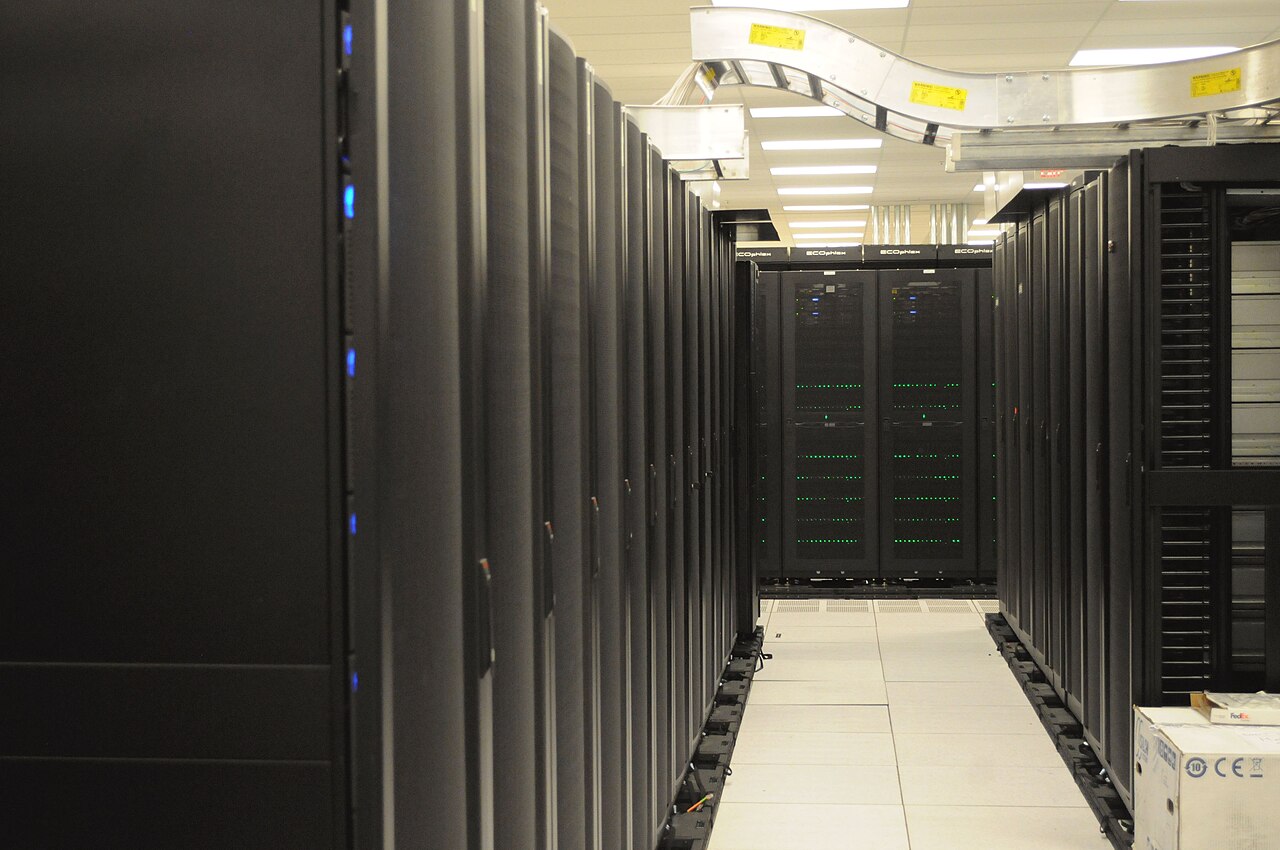
That combination makes DataFusion less like a finished database appliance and more like a shared engine room. The server-rack photograph above is a better image than a screenshot because the interesting work happens below the visible application layer.[1] A product can keep its catalog, security model, storage layout, file lifecycle, API, and user experience, while delegating a hard slice of database work to a common planner, optimizer, and executor.
The practical question is therefore not "Will DataFusion replace every database?" It is "Where should a team stop hand-rolling query behavior and start treating a query engine as infrastructure?"
The reusable part is the plan
DataFusion's strongest boundary is the logical plan. Its documentation defines a logical plan as a structured representation of a database query that describes high-level operations such as filtering, sorting, and joining, while abstracting away implementation details.[3] That sounds ordinary until you look at what it permits. SQL, the DataFrame API, and custom front ends can converge on the same intermediate representation before optimization and physical execution.
That convergence is the point. If a data application begins with a narrow requirement - "let users filter a table," "run aggregations over Parquet," "add SQL to an event store," "ship a local analytics mode" - the first implementation often grows as a pile of special cases. Predicates become custom code. Projection becomes custom code. Joins are avoided until customers demand them. Eventually the product owns a query planner by accident.
DataFusion offers a different line. Build or receive a logical plan, let optimizer rules rewrite it, lower it into a physical plan, and execute the resulting operators against Arrow-native data. The project documentation notes that logical plans sit between query input and optimized physical execution, and that the LogicalPlan type includes an extension variant for projects that need custom logical operators.[3] That extension hook matters because embedded engines rarely live in generic worlds. They live inside products with domain-specific tables, functions, permissions, and storage facts.
Physical plans are where reality enters
The clean separation between logical and physical plans is not academic decoration. DataFusion's explain-plan guide draws the boundary plainly: a logical plan is generated for SQL, DataFrame, or another language without knowledge of underlying data organization, while a physical plan is generated from the logical plan with consideration of hardware configuration and data layout.[4]
That is exactly the separation an embedded query engine needs. Product code can describe what a query means. Engine code can decide how to run it. A Parquet scan, a partitioned data source, a filter pushed closer to storage, a join strategy, and the number of CPU cores available are physical concerns. They should not leak into every caller that merely wants "customers in this segment, grouped by week."
DataFusion's recent release notes show why that boundary stays active rather than theoretical. The April 2026 DataFusion 53.0.0 post highlights planning and execution improvements such as limit-aware Parquet row group pruning, broader filter pushdown, faster planning, faster functions, and nested-field pushdown into data sources.[9] Those are engine-level improvements. A system embedding DataFusion can benefit from them without reinventing every optimization in its own application code, though upgrades still require testing because release notes also call out parser, optimizer, and physical-plan API changes.[9]
Arrow is the contract underneath
The engine boundary works because DataFusion is not inventing a private row format at the center. Its own Arrow guide states that DataFusion uses Apache Arrow as its native in-memory format and introduces RecordBatch as Arrow's standard unit for packaging data: equal-length columnar arrays under a schema, useful for streaming and parallel execution.[6] The Arrow columnar specification describes record batches as ordered collections of arrays with a shared length and schema, and defines serialization paths that can reconstruct batches without copying the underlying data buffers.[7]
This makes DataFusion's executor more portable across host systems than an engine that only speaks a private structure. A caller can think in terms of table providers, batches, streams, and columnar arrays rather than opaque records. That does not remove integration work. It moves the work onto a widely used memory contract.
The benefit is especially clear for analytical systems. Vectorized execution wants columns. File formats such as Parquet want projection and predicate pushdown. Python, Rust, Java, and other runtimes increasingly meet around Arrow-shaped data. When DataFusion produces and consumes Arrow batches, it fits into that larger ecosystem instead of forcing every embedding product to translate through a bespoke internal layout.
Extension points decide whether embedding is real
Reusable engines fail when they are reusable only in demos. DataFusion's architecture is stronger because extension is part of the design surface. The project homepage says DataFusion can be customized at many points, including data sources, query languages, functions, custom operators, and more.[2] Its custom table-provider documentation makes that concrete: a logical plan describes what a query computes, while the logical optimizer can rewrite the relational tree to reduce work, including pushing predicates closer to the data source.[5]
That table-provider boundary is the adoption hinge. A team can keep a specialized storage system, object-store layout, catalog, or domain source, then teach DataFusion how to scan it. The table provider becomes the contract between product-specific data ownership and generic relational execution. If the provider can report schema, expose statistics, respect projection, and push filters when possible, the engine has enough information to avoid treating every data source as a dumb file.
The same is true for functions and operators. Products often need domain expressions: geospatial predicates, observability functions, time-series windows, vector search glue, billing calculations, or compatibility functions for another SQL dialect. A query engine boundary is only useful if those differences can be attached without forking the whole engine. DataFusion's public design and the SIGMOD paper both emphasize modularity and extension across front ends, catalog and table integration, plan rewrites, and execution nodes.[2][8]
The adoption boundary is not "use DataFusion everywhere"
The right conclusion is narrower and more useful than hype. DataFusion is a strong fit when a team is building a database-like or analytics-like product but does not want to own a full query engine alone. It is especially plausible for embedded analytics, data quality tools, lakehouse utilities, observability stores, local-first analytical features, SQL layers over custom formats, and products that already depend on Arrow or Parquet.
It is a weaker fit when the desired object is a turnkey database service. DataFusion does not remove the need for authentication, authorization, tenancy, catalog design, storage compaction, metadata transactions, backup, replication, workload governance, operational UI, billing integration, or support boundaries. It gives a team a query engine, not a complete data platform.
That distinction should shape evaluations. The first prototype should not ask only whether DataFusion can run a sample SQL query. It should ask whether the product can express its data model through table providers, whether filters and projections are pushed far enough toward storage, whether custom functions remain maintainable, whether Arrow batches flow naturally through the rest of the system, and whether upgrade testing can absorb optimizer and physical-plan changes.
The architecture signal
DataFusion matters because it makes a database component reusable without pretending that every product should become the same database. SQL and DataFrame inputs converge into logical plans. Optimizer rules improve those plans. Physical planning accounts for data layout and hardware. Execution emits Arrow-native batches. Extension points let products keep their specific storage, functions, and front ends.
That is the architecture note: DataFusion's center of gravity is not the command line, a benchmark chart, or a single release. It is the boundary where product teams can stop growing private query engines by accident. The project is valuable when it lets them keep the parts that make their systems distinct while sharing the hard machinery of planning, optimization, and vectorized execution.
Sources
- Wikimedia Commons, "Front of server racks at NERSC.jpg" - Derrick Coetzee photograph used for the article image.
- Apache DataFusion, "Apache DataFusion" - project overview describing the Rust query engine, Arrow memory format, SQL and DataFrame APIs, built-in formats, and customization points.
- Apache DataFusion, "Building Logical Plans" - library guide explaining logical plans, physical execution as a later step, and the
LogicalPlanextension variant. - Apache DataFusion, "Reading Explain Plans" - user guide distinguishing logical plans from physical plans and explaining how physical planning accounts for data organization and hardware.
- Apache DataFusion, "Custom Table Provider" - library guide describing logical planning, optimizer rewrites, predicate pushdown, and table-provider integration.
- Apache DataFusion, "Gentle Arrow Introduction" - guide explaining DataFusion's native use of Arrow and RecordBatch as a columnar unit for streaming and parallel execution.
- Apache Arrow, "Arrow Columnar Format" - specification describing record batches, schemas, buffers, and zero-copy reconstruction in the Arrow IPC format.
- Andrew Lamb et al., "Apache Arrow DataFusion: A Fast, Embeddable, Modular Analytic Query Engine" - SIGMOD 2024 paper on DataFusion's embeddable, modular architecture and plan/execution stages.
- Apache DataFusion Blog, "Apache DataFusion 53.0.0 Released" - April 2026 release notes covering planning, pushdown, function, nested-field, release-engineering, and upgrade-surface changes.