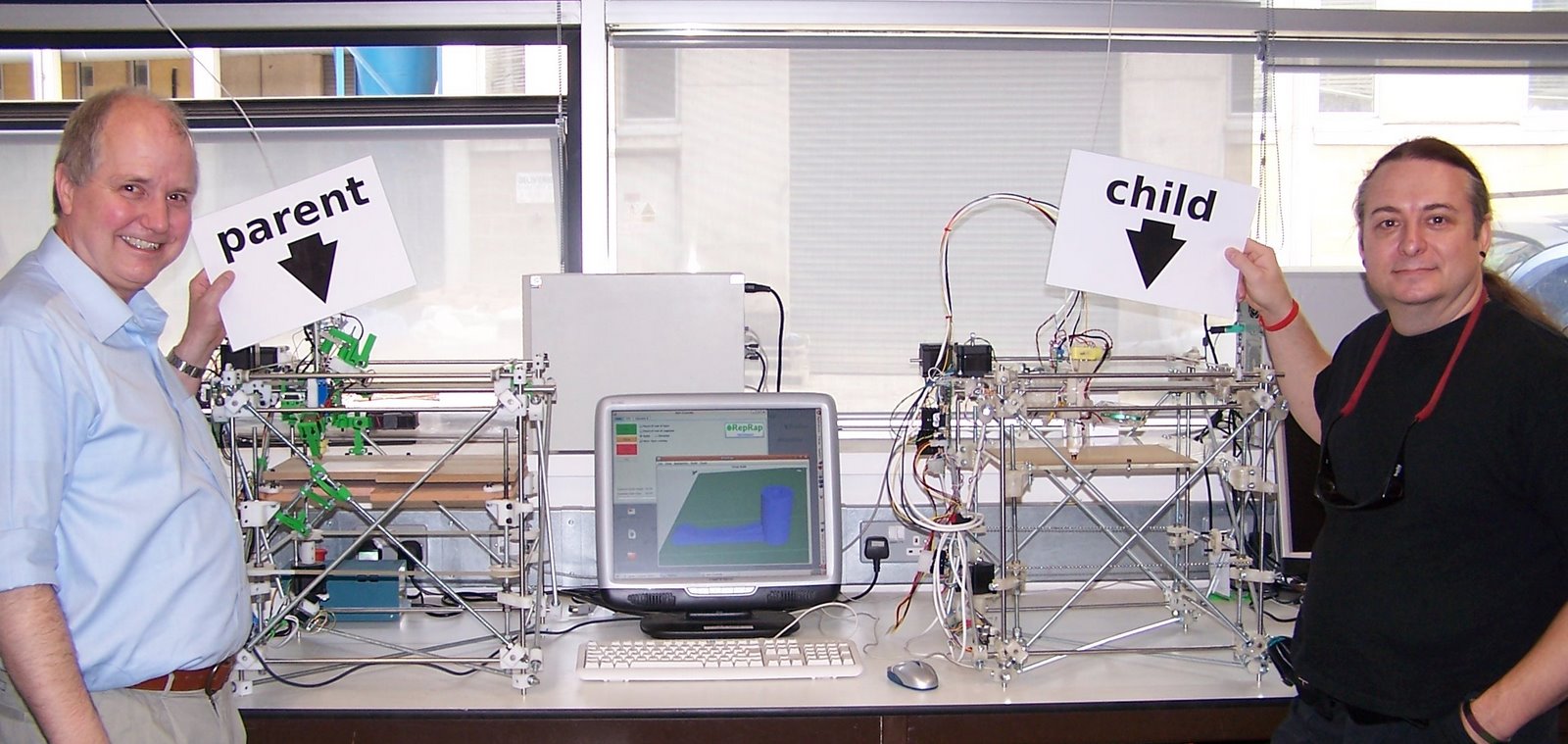
Two skeletal machines share the frame. Adrian Bowyer stands beside one; Vik Olliver stands beside the other. Each holds an arrowed sign: parent, child. Threaded rods cross at printed corner blocks, wires hang loose, and neither machine resembles an appliance. The RepRap on the left made the plastic parts for the complete working child on the right. On 29 May 2008, during testing at the University of Bath, that child made its first successful part—a timing-belt tensioner needed to complete itself—in about 20 minutes. The project paper called it a grandchild part because the child, rather than the parent, manufactured it.[1][2][8]
No whole printer crawled off the build plate. The parent did not make the motors, steel rods, belts, bearings, fasteners, controller, power supply, wire, or measuring tools. It did not assemble the child. RepRap's own technical account therefore used a careful category: assisted self-replication. The machine manufactured a significant subset of its successor, while people and an industrial supply network supplied the rest.[1]
That qualifier is not an embarrassing footnote. It is the architecture. RepRap became consequential because it placed a reproducible set of plastic mechanisms inside a much larger chain of editable designs, commodity components, electronics, firmware, slicing software, machine instructions, assembly knowledge, and human judgment. Treating the printer as the entire reproducing unit makes the 2008 scene look like either magic or failure. Treating the surrounding commons as the unit reveals what actually scaled.
The photograph records a handoff
The first child inherited geometry before it inherited motion. Its parent printed the rapid-prototyped pieces that located rods, held axes, supported the extruder, and joined the frame. Humans combined those pieces with the non-printed parts, wired the machine, and adjusted it until it could reproduce the parent's useful accuracy. The child-made tensioner demonstrated that the handoff had closed: a machine assembled from its parent's output could now supply printable output of its own.[1]
The famous replication percentage needs its denominator attached. The 2011 project paper reported that rapid-prototyped parts were 48% of the machine by part count when fasteners were excluded. Once nuts, bolts, and washers were counted, fasteners made up 73% of all pieces and the printed share fell to 13%. Those figures describe counts, not mass, cost, manufacturing difficulty, or functional importance. A motor and a washer each count as one part under the first arithmetic, even though only one supplies controlled torque.[1]
Calibration sat outside the machine too. The authors noted that screw adjusters let a child be tuned to its parent's accuracy, but the measurements typically came from digital calipers. RepRap could replace a broken printed bracket; it could not verify its own frame geometry or automatically square a newly assembled descendant. The achievement was narrower and more useful than autonomy: the parent reduced the amount of specialized fabrication needed for the next machine, and its design made the remaining inputs deliberately ordinary.[1]
That gives the ecosystem five linked layers. A break in any one can stop reproduction even when the other four remain open.
1. Printable geometry is useful only if it can mutate
A mesh that a printer can deposit is an output, not necessarily design source. An STL file may preserve the triangles on a finished surface while discarding dimensions, constraints, feature history, hole relationships, and the intent needed to change the part cleanly. It can reproduce one shape and still make the next adaptation needlessly difficult.
The Open Source Hardware Association draws the same boundary more generally: open hardware should publish the design in the preferred form for modification. For a mechanical part, that means the original editable CAD as well as useful exports; for electronics, it means schematics and board-layout source, not only a PDF picture or fabrication output.[6] In a RepRap lineage, printability copies a phenotype; editable source preserves the ability to fork it.
Source alone is not the whole inheritance. Each design also needs a bill of materials, units, tolerances, fastener specifications, assembly order, licensing, and an identifiable revision. A beautifully parameterized corner block is not reproducible if its repository never says which rod diameter it clamps or which bearing it locates. Conversely, an STL plus a shopping list may be enough to make an exact copy but too weak to support a new frame size or a substituted bearing. The healthy handoff carries both build artifacts and the information from which they were generated.[6]
2. Printed joints turn purchased parts into a machine
RepRap's first production design, Darwin, made procurement part of its architecture. Its roughly 500-millimeter cube used an open frame of M8 threaded steel rods held by printed pieces and M5 screws. Toothed belts moved the faster horizontal axes; threaded rods moved the comparatively quiet vertical axis; an MDF sheet served as the build platform. The machine ran from a single 12-volt supply and consumed about 60 watts in the configuration documented by its builders.[1]
These were not glamorous choices. That was their value. The project put custom geometry into parts the machine could make and pushed tensile strength, rotary motion, electrical power, heat, sensing, and precision surfaces into components that could be bought. A printed vertex encoded where commodity rods met. A printed extruder body located a motor, bearing, filament path, hot end, and nozzle that came from elsewhere. The machine's reproductive surface was therefore a collection of physical interfaces.
Interfaces are where a nominal copy becomes a real engineering fork. Change a rod diameter and every clamp changes. Substitute a stepper motor and shaft length, connector, current rating, or mounting pattern may move. Replace a thermistor and the firmware's temperature conversion must change with it. A bill of materials should distinguish exact dependencies from replaceable classes, then state the tolerance or configuration that makes a substitute valid. “Widely available” reduces supply risk; it does not make two parts interchangeable by declaration.
The parent-child photograph captures this division unusually well. The colored and white printed pieces are visually prominent, but they work because rods, belts, motors, wire, boards, and fasteners pass through them. Replication happened at those joints, not in the plastic alone.[1][8]
3. Electronics and firmware form a compatibility matrix
A controller board gives the frame nerves and reflexes. It reads thermistors and endstops, switches heaters and fans, and sends timed step-and-direction signals to motor drivers. Firmware turns machine instructions into that behavior while enforcing assumptions about pin assignments, kinematics, steps per unit, acceleration, temperature sensors, safe limits, and homing.
The RepRap wiki's electronics catalog is an imperfect but revealing artifact. It does not describe one blessed controller. It records boards such as RAMPS, Melzi, Sanguinololu, and later 32-bit designs alongside compatible firmware, schematics, board files, sources, and availability notes. The page is explicitly a work in progress, and some entries are stale; that is precisely why it reads like an ecosystem rather than a product sheet.[5]
Modularity allowed one layer to evolve without forcing every other layer to wait. A mechanical design could survive a controller change. A firmware project could support many frames. Plug-in stepper-driver modules could move between boards. But the compatibility was conditional. Matching a board name to a firmware name did not set motor current, choose the right thermistor curve, establish endstop polarity, or prove that a heater output was rated for the attached load.
Hardware openness also has multiple source surfaces. A board photograph is documentary. Gerbers can reproduce a particular board. Editable schematic and layout files support modification. A bill of materials identifies the components. Firmware source supplies behavior. Assembly and test instructions close the loop. The OSHWA guidance treats design files, documentation, and software as distinct things for good reason: losing any one can leave a nominally open controller impractical to repair or adapt.[6]
4. The slicer is a compiler, and G-code is not a universal ABI
RepRap separated the path from idea to motion into recognizable stages. CAD describes an object. CAM software slices that geometry into layers and chooses perimeters, infill, support, speeds, temperatures, and extrusion. The result is usually G-code, which a sender, storage device, or network service delivers to firmware. The firmware plans motion and drives the physical machine. The project's software documentation summarizes the chain as CAD, CAM, and firmware, even as the specific tools around each stage multiplied.[3]
This separation made experimentation cheap. A new slicer did not require a new controller board; a new board did not invalidate every CAD model. Yet the file between layers was never a complete portability contract. The RepRap G-code reference openly documents divergent firmware sub-flavors, partial implementations, and even command numbers that acquired more than one meaning. Common moves such as G1 travel widely, while heating, probing, calibration, macros, and machine management expose dialect boundaries.[4]
For that reason, a G-code file behaves more like a compiled artifact than durable source. It has already absorbed a machine profile: bed dimensions, nozzle width, filament assumptions, acceleration limits, temperatures, retraction, start and end sequences, and perhaps firmware-specific commands. Sending it to a different printer merely because both accept .gcode can produce a poor print or an unsafe command sequence.
A reproducible machine lineage should preserve the CAD source, the exported model, the slicer version and profile, the generated G-code when useful, the firmware revision, and the machine configuration that interprets it. That bundle lets a maintainer regenerate instructions when a nozzle, material, controller, or safety limit changes. Keeping only the final G-code is the software equivalent of keeping an STL while discarding the CAD.
5. People close the control loop
RepRap deliberately assigned dexterous and interpretive work to humans. People sourced components, cleared and chased holes in printed parts, assembled frames, routed cables, tensioned belts, loaded firmware, measured geometry, set currents, calibrated steps, established a nozzle-to-bed relationship, and judged whether a first layer was trustworthy. The 2011 paper framed that relationship as mutualism: the machine rewarded human assistance by making useful objects, including parts for more machines.[1]
That makes documentation and community memory operational dependencies, not social decoration. A repository may contain every CAD file yet omit the jig that makes assembly square. A firmware tree may build while its known-safe configuration survives only on one maintainer's SD card. A bill of materials may name a discontinued component without documenting the interface a substitute must satisfy. In each case, the files exist and the reproductive chain is still broken.
For a builder or project steward, the practical map is a recovery exercise:
- Can a new person obtain editable mechanical and electronic source, not just manufacturing exports?
- Can each purchased component be sourced or substituted from documented interface requirements?
- Can the firmware be built, flashed, and paired with an identified board revision?
- Can a slicer profile be regenerated from stated machine and material assumptions?
- Can assembly, calibration, and a safe first-motion test be completed without oral history?
The answers measure more than archival neatness. They reveal which layer has become a single point of failure.
The commons was the reproducing machine
RepRap's descendants did not spread through one centralized production line. Designs varied in a distributed community; builders selected what worked for their needs; firms packaged components, kits, and finished machines; software and hardware projects specialized. An independent study of RepRap as an innovation ecosystem argues that community and market actors often complemented one another: firms helped select, stabilize, and diffuse designs, improving usability and reliability. It also identifies the failure mode of a closed “dead-end derivative,” which can sell successfully while preventing the next round of design evolution because its source is no longer available.[7]
Commerce, in other words, was not outside the RepRap reproductive system. Suppliers and kit makers solved precisely the tasks the printer could not. The critical boundary was whether their work kept the interfaces and design knowledge available for another actor to modify. A closed product might manufacture excellent parts; an open lineage might manufacture future options.
This is the deeper claim in the 2008 photograph. The child did not prove that a desktop factory could autonomously copy itself. It proved that a machine could make a meaningful share of its successor when physical interfaces, editable information, commodity supply, and human skill were arranged as an open chain. The plastic crossed the room from parent to child. The design crossed every layer around them.
RepRap's first child inherited more than printed brackets. It inherited a commons capable of making the next change.
Sources
- Rhys Jones et al., “RepRap — the replicating rapid prototyper,” Robotica 29(1), 2011 — design choices, assisted replication, printable-part counts, calibration, software, and early diffusion.
- RepRap project wiki, “RepRap history” — project chronology and the 29 May 2008 parent-child replication milestone.
- RepRap project wiki, “Software” — the CAD, CAM/slicer, G-code, host, and firmware toolchain boundaries.
- RepRap project wiki, “G-code” — command structure, slicer handoff, firmware support matrix, and documented dialect divergence.
- RepRap project wiki, “List of electronics” — an archival catalog of controller boards, compatible firmware, licenses, design sources, and procurement notes.
- Open Source Hardware Association, “Open Source Hardware FAQ” — preferred source forms, editable CAD and board files, documentation, and modification requirements.
- Jan-Peter Ferdinand and Uli Meyer, “The social dynamics of heterogeneous innovation ecosystems: Effects of openness on community-firm relations,” International Journal of Engineering Business Management 9, 2017 — independent RepRap community/firm ecosystem analysis.
- Wikimedia Commons, “First replication.jpg” — the 1,600 × 759 archival photograph, event description, provenance, and license record.