Read the Docs is easy to undersell because its visible output is ordinary HTML. A project pushes documentation, a site updates, and readers get pages. The governance signal is in everything around that output: who owns the build, how much configuration lives in Git, what happens before a pull request merges, and how the service pays people to keep a public documentation commons running.
That makes Read the Docs more interesting than a "docs hosting" label suggests. The project is open source, but the operational product is a service boundary. It receives source control events, checks out repositories, builds documentation in controlled environments, publishes artifacts, serves versioned pages, and puts preview risk behind separate domains and explicit environment-variable rules.[1][2][3] For maintainers, the question is not whether static HTML could be hosted elsewhere. It is whether documentation should be treated as a governed release surface instead of an afterthought attached to code.
The Build Is The Contract
The strongest design choice is that Read the Docs makes the build process legible. Its build overview describes a sequence of jobs: checkout, system dependency installation, environment creation, dependency installation, documentation build, and upload.[2] The same page says the steps run inside a Docker container, using the configured build image, and recommends pinning versions to avoid unexpected failures.[2] That is a meaningful operating contract because documentation builds often fail from hidden environmental drift rather than from prose mistakes.
The .readthedocs.yaml file sharpens that contract. The configuration reference says the file belongs in the top level of the Git repository, applies to the exact version being built, and can store version-specific build settings.[3] It also validates supported options so typos fail the build instead of becoming silent web-interface folklore.[3] In practice, that moves docs infrastructure into review. Python, Node.js, Rust, Go, Ubuntu image choice, requirements files, Sphinx or MkDocs configuration, and output formats can all become part of the same diff as the documentation change.[3]
This is where Read the Docs still has a technical identity in 2026. It does not need to own the authoring tool. Its current documentation and anniversary post both point toward supporting any documentation tool that generates HTML, with Addons layered on top for reader-facing behavior.[4][5] That is a better long-term boundary than being "the Sphinx host." Sphinx, MkDocs, Jupyter Book, and custom HTML pipelines change at different speeds; the service boundary is strongest when it can say: bring a reproducible build, produce artifacts, and let the platform handle versions, previews, notifications, search, and publication mechanics.
Pull-Request Previews Change Who Catches Bad Docs
The most practical maintainer feature is pull-request previewing. Read the Docs can create and build a new documentation version when a pull request opens, rebuild it on new commits, report build status back as a check, and comment with a preview link plus changed-file context.[1] That changes the review workflow. Documentation stops being a promise that "it should render after merge" and becomes something reviewers can inspect before the change enters the live site.
The visual diff feature matters for the same reason. It highlights proposed documentation changes against the latest version, with a toggle between diff and normal preview.[1] That is not just polish. It gives maintainers a review surface for layout regressions, missing pages, broken navigation, or accidental rewrites that are hard to spot in raw Markdown or reStructuredText. A docs reviewer can judge the rendered result without pulling the branch locally or trusting a contributor's screenshot.
The security model is also unusually explicit. Read the Docs warns that anyone able to open a pull request can trigger a build when previews are enabled, so preview pages are served from separate domains: org.readthedocs.build and com.readthedocs.build.[1] It also states that pull-request builds can access only environment variables marked Public, and it warns about the risks of private previews on public repositories.[1] That is the correct framing. Documentation builds execute contributor-controlled input, often with extensions, generated API references, notebooks, diagrams, or install steps. A preview system that hides this risk would be easier to market and worse to operate.
Open Source Service Means Saying No
Read the Docs' open-source philosophy page is blunt about scope. It says the project was founded to improve documentation in the open-source community, that the code is open for contribution and learning, and that official support is limited to local development on the Python code base, use of the hosted Community service for open-source projects, and bug fixes relevant to running the public service.[6] It specifically declines to support company-internal installations or arbitrary installation issues outside the Read the Docs Python code.[6]
That is not a lack of generosity. It is governance discipline. The project is open source, but the scarce resource is maintainer time. If every internal deployment request becomes a support obligation, the public service gets weaker. Read the Docs is drawing a boundary between code availability and service stewardship: you may use the code, but the maintainers' official attention stays aligned with the public documentation mission.[6]
This is the same logic behind the project's sustainability account. In its 2024 anniversary post, Read the Docs describes a service-oriented open-core model: a free Community service for open-source projects, supported by a single non-tracking ad, and a paid Business service for commercial and private documentation needs.[5] The post is candid that donations, consulting, and grants were tried, but either underfunded the work or pulled attention away from the core product.[5] The important signal is not the word "ads"; it is the claim that revenue should rise when the documentation service becomes more useful, while preserving enough trust that projects still want to host public docs there.[5]
An independent Django Chat interview with Holscher reinforces the same service shape from another angle. He describes the original insight as rebuilding documentation automatically on commit rather than through a hand-rolled cron job, then connects the modern platform to pull requests, notifications, preview builds, versioning, redirects, search indexing, and support.[8] That history explains why Read the Docs has survived as infrastructure. It absorbed a recurring maintenance chore that thousands of projects could each rebuild badly, then made the shared version boring enough to depend on.
The Adoption Boundary
Read the Docs is a strong fit when documentation is part of the release contract: libraries with multiple supported versions, APIs with generated references, scientific or infrastructure projects where examples must build, and teams that want documentation review to happen before merge. It is also a good fit when maintainers need docs publishing to be less magical. A Git-backed config, pinned tools, clear build logs, preview URLs, and a service team that owns the platform are all practical advantages over a pile of ad hoc CI scripts.[1][2][3][8]
It is a weaker fit when a project wants total control over every hosting and build primitive, or when documentation is just a tiny static page that never changes. The platform's value appears when build state, version state, and review state are all real problems. If a project has no versions, no previews, no generated content, no custom dependencies, and no maintainer review bottleneck, plain static hosting may be simpler.
The operational caution is that Read the Docs does not make documentation sustainable by itself. It can make the build reproducible, the preview visible, and the service boundary clearer. It cannot decide whether a project writes useful explanations, maintains old-version pages responsibly, prunes broken links, or assigns humans to review docs with the same seriousness as code. The tool moves documentation into the engineering system. The project still has to treat that system as part of maintenance.
That is the governance signal worth keeping. Read the Docs has lasted because it keeps refusing to be only a publish button. Its best feature is the boring one: it turns documentation into a repeatable service workflow, with enough technical boundaries and economic discipline that maintainers can ask better questions before readers inherit the mess.
Sources
- Read the Docs user documentation, "Pull request previews" - PR build events, build status checks, preview comments, visual diff, separate preview domains, and environment-variable security boundaries.
- Read the Docs user documentation, "Build process overview" - checkout, dependency, environment, build, upload, Docker-container execution, and version-pinning guidance.
- Read the Docs user documentation, "Configuration file reference" -
.readthedocs.yaml, Git-versioned config, validation, build tools, output formats, and dependency declarations. - Read the Docs user documentation, "Read the Docs Addons" - reader-facing platform features layered across documentation tools.
- Eric Holscher, "10 years of sustainable open source," Read the Docs blog, August 26, 2024 - sustainability model, service focus, trust constraints, team size, and broader-tool support direction.
- Read the Docs user documentation, "Read the Docs open source philosophy" - mission, official support scope, unsupported internal-installation boundary, and rationale.
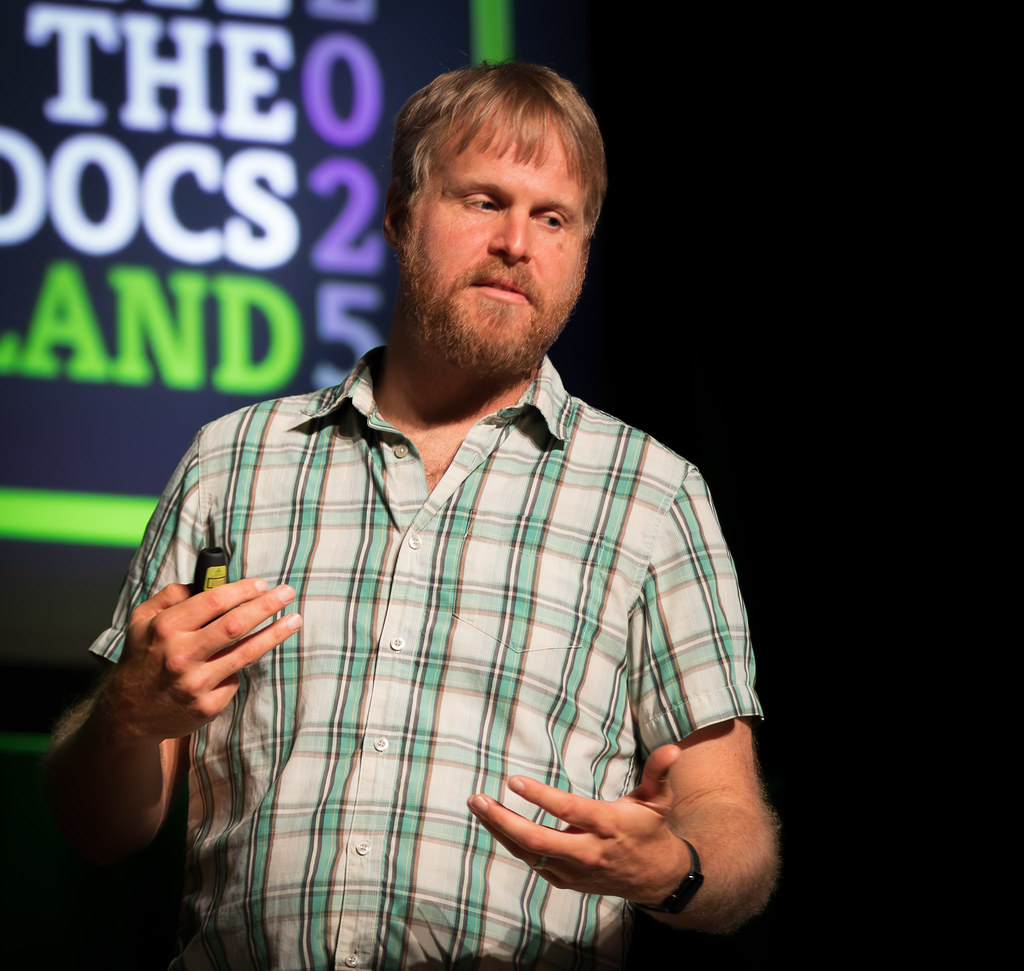
- Write the Docs, "Eric Holscher - conference introduction," Flickr, uploaded May 6, 2025 - real conference photograph used as the article image source.
- Django Chat, "Read The Docs - Eric Holscher" - independent interview transcript covering Read the Docs' origin, automatic docs rebuilds, scale, funding, previews, versioning, search, and support.