A mission-control screen can look like the mission itself. Open MCT is useful because its architecture makes a narrower promise: it turns mission data into an operator's navigable, time-aware workspace while leaving acquisition, retention, transport, and operational authority in the systems that actually own them.
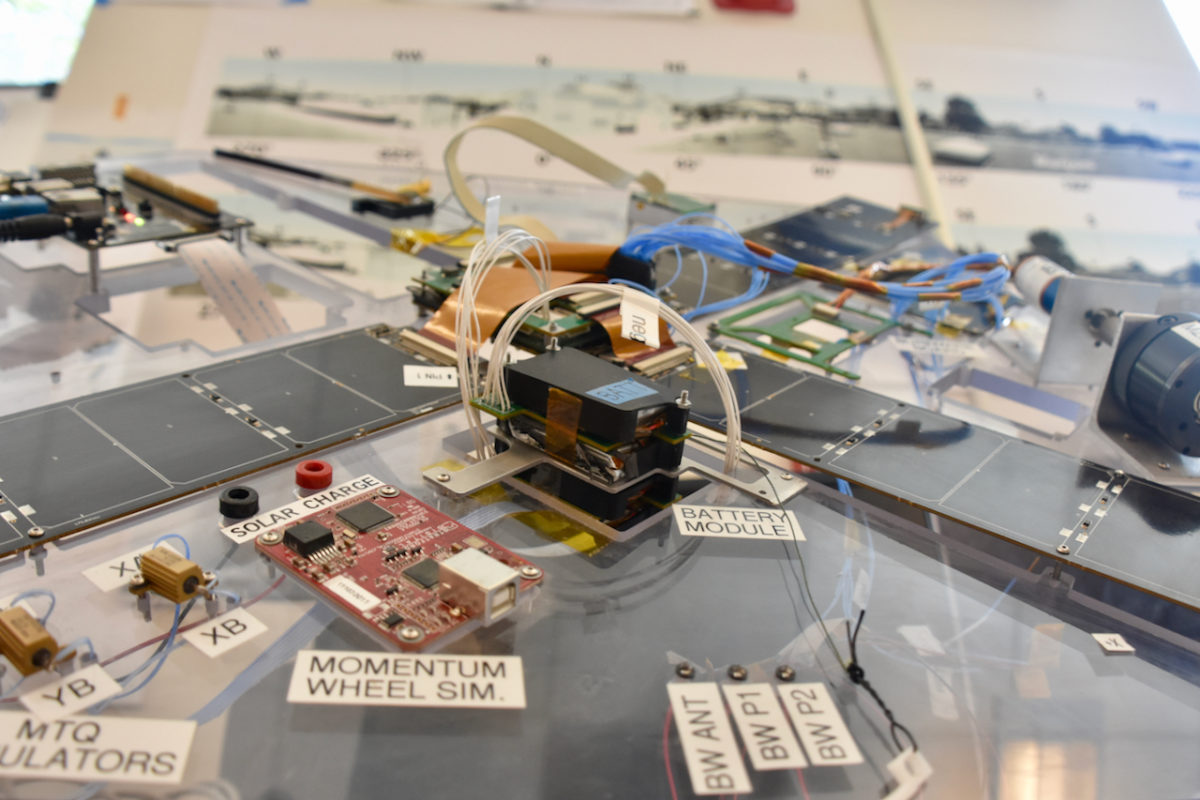
The distinction was visible during a LightSail 2 dress rehearsal on July 18, 2018. A deconstructed engineering clone called BenchSat transmitted packets through Cal Poly San Luis Obispo's ground-station path. Elsewhere in the building, team members watched subsystem telemetry in NASA's open-source Open Mission Control Technologies framework while the exercise also sent commands to the test article. The dashboard replaced a slower ritual of inspecting text files or moving readings into spreadsheets, but it did not replace the radio, packet path, command system, or spacecraft model.[6]
That is the right scene in which to understand Open MCT. NASA lists deployments spanning spacecraft analysis, human-spaceflight research, Earth-observation missions, rovers, and the non-NASA LightSail 2 project.[5] The framework can serve very different operations because it does not prescribe one mission database. It provides a vocabulary—domain objects, providers, time systems, views, composition, and plugins—for making a mission's own data legible.[1][2]
Image context: the cover is a documentary photograph of the LightSail BenchSat used in that readiness test, not a generic control-room image. Its labeled battery, solar-charging, antenna, and momentum-wheel components are the physical sources behind the telemetry objects an Open MCT integration has to describe.[6]
The first interface is an object, not a chart
Open MCT begins with a domain object. A temperature sensor, spacecraft subsystem, folder, plot, display layout, or command entry can be represented as an object with a type and a composite identifier made from a namespace and key. The identifier says what the thing is called inside the application; the type lets Open MCT decide which actions and views apply to it.[2]
That sounds like ordinary application modeling, but it creates the framework's most important separation. The left-hand tree does not have to mirror a database table or telemetry topic. An Object Provider registered with openmct.objects.addProvider(namespace, provider) can resolve an identifier from a mission dictionary, persistence service, or another source. A Composition Provider can then supply the identifiers that belong beneath a spacecraft, instrument, subsystem, or operator-defined folder.[2]
The practical consequence is that mission vocabulary becomes an explicit integration artifact. If one backend calls a channel eps.batt_v and an operator needs to see “Battery Bus Voltage” beneath “Electrical Power,” the adapter owns that translation. Stable identifiers matter because saved layouts, links, and compositions refer back to them. Rename or recycle them casually and the damage appears in operator workspaces rather than in a compiler error.
This is also the first adoption test. A team that cannot produce a governed telemetry dictionary—with stable channel identity, units, meaning, and ownership—will not be rescued by a polished plot. Open MCT can organize domain knowledge, but it cannot invent a durable ontology from inconsistent upstream names.
Telemetry enters through two doors
A telemetry integration has two separate jobs. First, metadata describes the fields a view may use: keys, human-readable names, units, formats, and hints such as domain for the horizontal axis or range for a measured value. Second, a Telemetry Provider supplies the actual data for an object.[2]
The provider API keeps history and the live stream distinct. Historical support is expressed through supportsRequest and request; a request receives start, end, and domain bounds and returns a promise containing telemetry datums. Real-time support uses supportsSubscribe and subscribe; each subscription delivers new datums through a callback and must return its own unsubscribe function because several views may subscribe to the same object at once.[2] NASA's tutorial makes the split concrete with separate historical and real-time plugins connected to a small reference telemetry server.[3]
This division is more than API neatness. Historical queries and live delivery usually have different failure modes. A store may answer a four-hour trend slowly while the stream remains healthy. A socket may disconnect while archived data is intact. A plot may create several subscriptions to the same channel. An adapter that treats all three cases as “get telemetry” will leak connections, duplicate data, or make a quiet archive look like a live vehicle.
The interface therefore needs operational behavior, not only parsing code. Historical results must be ordered in the active time domain. Requests should honor their bounds and cancellation. Subscriptions must clean up when a view closes. A reconnect policy must distinguish a gap from a repeated sample. The backend needs a strategy for aggregation or downsampling when a wide fixed-time query would otherwise return more points than a browser can use. Open MCT exposes the seam; the integrator decides whether it is reliable.
Time is shared application state
Mission telemetry does not become coherent merely because every datum has a timestamp. Open MCT always has an active time system, and telemetry metadata must expose a value whose key matches that system. A source mapping can translate a backend field such as timestamp into the active utc domain. The Time Conductor then gives views common bounds and two different modes: Real-time, where a clock advances a moving window, and Fixed, where the operator investigates a chosen interval.[2]
Shared time is what lets a temperature plot, event table, image view, and subsystem display move through the same episode together. It is also a sharp failure boundary. Seconds interpreted as milliseconds can produce an apparently empty display. Spacecraft event time, ground-receipt time, and database-ingest time may all be valid fields, but they answer different questions. Two providers can each be internally correct and still misalign if their time-system contract differs.
For a production integration, time should be tested with a known event whose occurrence is visible in more than one channel. Move from Real-time into a fixed window, reload the workspace, switch sources if the mission uses more than one time basis, and confirm that plots and tables still tell the same story. A synchronized wrong answer is more dangerous than an obvious blank panel.
Composition is where operators do the design work
Open MCT's plugins add capabilities through openmct.install(). The core project itself uses the plugin pattern, and the public catalog includes object persistence, time controls, status indicators, themes, summary widgets, and integrations. NASA labels bundled options such as Local Storage and CouchDB as stable while marking community integrations separately when they have not been verified by the project.[1][4]
The architecture lets operators compose displays from reusable objects instead of waiting for a developer to hard-code every console. A power specialist can place voltage, current, temperature, limits, and events together; another role can reuse some of the same telemetry in a different layout. Because plots and layouts are objects too, the workspace becomes part of the mission's operational knowledge rather than a transient set of browser tabs.
That flexibility transfers responsibility rather than eliminating it. Browser Local Storage can be reasonable for a personal prototype, but it is not a shared operational record. A multi-user deployment needs a deliberate persistence provider, identity model, permissions, backup, migration, and rules for who may change a canonical display. Otherwise two operators can believe they are viewing “the power console” while loading different saved state.
The framework also does not turn every visual limit into flight authority. A red threshold may come from a mission dictionary, a local rule, or a draft limit evaluator. Teams need provenance for limits and configuration, especially when a display informs commanding. Open MCT can present the state vividly; the surrounding operating procedure must say which state is authoritative.
The backend remains visible
Real deployments demonstrate this division of labor. The Lunar Trailblazer ground-system paper describes stored telemetry flowing into an InfluxDB database, with Open MCT used for on-demand plotting, tables, overlays, and long-term trending. Mission-specific configuration was still required, and other ground-system components handled connectivity, commanding, storage, and planning.[7] The result was not one universal mission-control server. It was a set of services joined at explicit interfaces.
Open MCT's own repository makes the same point in less glamorous terms. It recommends consuming the project as a dependency with mission-specific plugins and packaging, pairing it with a real HTTP server, and treating its development server as development-only. The related quick-start example combines Apache, a YAMCS telemetry and command server, and CouchDB persistence rather than presenting the browser framework as the entire stack.[1]
This boundary is healthy, but it sets a minimum operational bar. A small research group with one coherent telemetry source can build a useful read-only workspace with a modest adapter and a managed web deployment. A team using the display during hazardous hardware tests or live spacecraft operations needs owners for the data service, adapter, persistence, authentication, network path, browser release, display configuration, alarms, and incident recovery. Open source removes neither that work nor the need to rehearse it.
Release activity is a pinning signal
Open MCT's public repository remained active in June 2026, while its latest non-prerelease GitHub release was v4.1.0, published in February 2025.[8][9] That combination is a useful maintenance signal: development is continuing, but the default branch and a stable deployment are not the same artifact.
An operations team should therefore pin an exact package or release, keep mission plugins in the same compatibility matrix, and promote upgrades through representative displays rather than a generic homepage. The repository's test surface includes unit, end-to-end, visual, performance, accessibility, mobile, CouchDB, and security-oriented checks.[1] A downstream integration still needs its own fixtures: real telemetry metadata, saved layouts, expected limits, historical ranges, disconnection behavior, and browser resource budgets.
The hardest regression is often semantic. A chart can render perfectly while using the wrong unit, time field, or channel identity. Screenshot comparison will not catch that. Preserve a small “golden pass” of telemetry with known events and expected cross-channel relationships, then exercise it after framework, adapter, database, and mission-dictionary changes.
Where the architecture earns its keep
Open MCT fits when the problem is to make heterogeneous, time-based operational data explorable and composable across roles. Its domain objects give mission concepts stable names. Object and Composition Providers translate mission structure into a navigable tree. Telemetry Providers keep history and live delivery explicit. The Time Conductor makes several views investigate one interval. Plugins allow a deployment to add only the persistence, visualization, and integration behavior it owns.[2][3]
It is a weaker fit when a team wants a sealed, turnkey control system with no adapter engineering, no mission data model, and no responsibility for backend operations. It may also be excessive for a few fixed charts over one conventional metrics store. The framework pays back its integration cost when operators need to rearrange evidence without dissolving the contracts beneath it.
The LightSail readiness test captures that payoff. BenchSat remained a physical spacecraft analogue. The ground station remained the packet path. Commands and telemetry still belonged to the mission system. Open MCT gave several people a shared way to see what those components were doing.[6] Its architecture is strongest when that final layer is treated neither as decoration nor as the whole mission, but as the place where carefully modeled evidence becomes usable judgment.
Sources
- NASA,
nasa/openmctrepository README — framework scope, plugin model, dependency-based deployment, production-server boundary, related integration examples, and test suites. - NASA, Open MCT
v4.1.0API reference — domain objects, object and composition providers, telemetry metadata and providers, time systems, modes, indicators, and API stability notes. - NASA,
nasa/openmct-tutorial— reference integration of a telemetry server with separate historical and real-time plugins. - NASA Open MCT, “Plugins” — bundled and community plugin roles, installation pattern, persistence options, and stable-versus-experimental labeling.
- NASA Open MCT, “Who's Using Open MCT” — official list of NASA and external mission deployments and the framework's role in MarCO operations.
- Jason Davis, “LightSail 2 team completes key mission review and dress rehearsal.” The Planetary Society, 2018 — independent account of the BenchSat readiness test, Open MCT workflow, and source page for the cover photograph.
- Elena Scire et al., “Lunar Trailblazer Ground System Development.” Proceedings of SPIE 13098, 2024 — operational placement of Open MCT alongside InfluxDB, AIT, mission configuration, and other ground-system services.
- NASA, Open MCT
v4.1.0release — current non-prerelease release page and publication date used for the deployment-lane check. - GitHub REST API,
nasa/openmctrepository metadata sampled on 2026-07-19 — default branch and repository push timestamp used for the maintenance check.