Ask who owns a problem in NetBSD and the answer changes with the problem. The Foundation board holds the legal and financial institution. The Core Group handles project-wide technical direction and difficult escalation. Release engineering, security, package security, systems administration, membership, and other recurring work have their own named groups and role addresses.[2][4][7]
That plural answer is NetBSD's most useful maintenance signal. Authority is distributed, but it is not supposed to be mysterious. A contributor deciding whether a change belongs on a release branch can find a documented pull-up process. Someone reporting a vulnerability can find a security contact. A dispute between developers has an escalation path. A donor can find an elected board and a yearly financial report. The project does not offer one corporate roadmap; it offers a directory of accountable rooms.
The arrangement also exposes its own constraint. Several people appear in more than one room, and many jobs remain volunteer jobs. Written ownership reduces ambiguity, but it cannot manufacture reviewer time or succession. For an adopter, the right question is therefore not merely whether NetBSD has governance. It is whether the handoffs still work when a real patch, release, incident, or funding decision arrives.
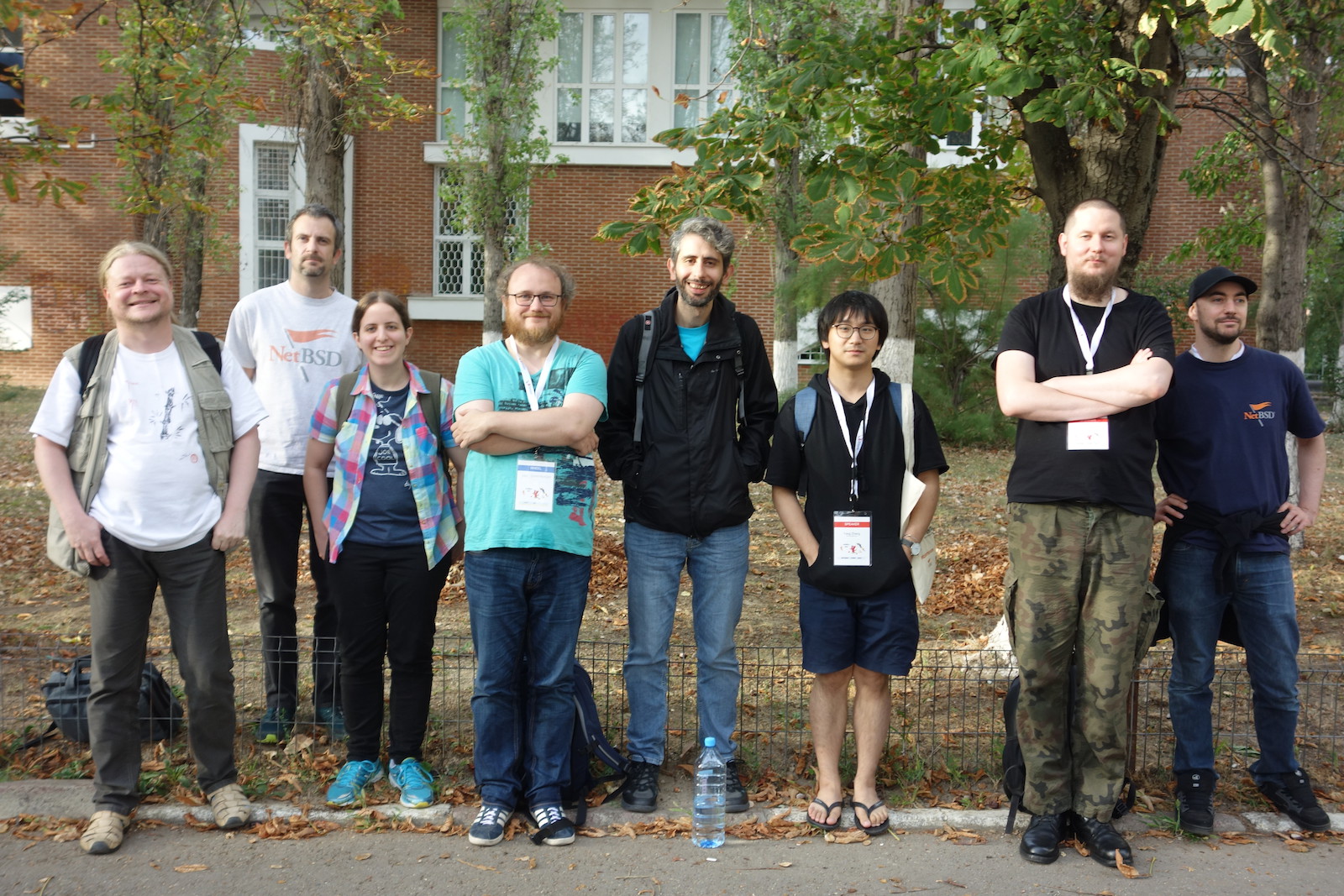
Image context: the cover photograph comes from the developer summit held alongside EuroBSDCon 2018. Eight contributors stand outside the venue in Bucharest during a day that included informal introductions and hands-on work. The small group is more revealing here than a desktop screenshot would be: NetBSD's institutional design ultimately depends on identifiable people continuing to meet, review, and take responsibility.[1]
The board holds the institution
The NetBSD Foundation is the project's legal shell. It owns several project servers, handles donations of money, hardware, services, and time, administers copyrights, and holds the NetBSD trademark. Its current page lists a seven-member board elected by the developer community, plus officers responsible for the corporation's routine business.[2]
The bylaws make that electorate unusually concrete. Foundation members are NetBSD developers who have signed the project development agreement. For voting purposes, an Active Member is normally someone who has committed to the source tree during the preceding 12 months and wishes to be counted as active. Directors must be Active Members, serve staggered two-year terms, and are chosen by the membership.[3]
This is not an election open to every user or donor. The developer application path begins with sponsorship by existing members, includes a 14-day period for member comments, then runs through a membership committee, a signed agreement, and account creation.[5] The sequence binds voting power to a high-trust contribution role. That protects a source tree whose committers can affect an entire operating system, but it also makes renewal dependent on existing developers noticing, sponsoring, and onboarding new people. A public procedure makes that tradeoff inspectable; it does not eliminate the social gate.
The board's mandate is institutional rather than a blanket technical veto. It manages Foundation affairs, assets, policy, and legal obligations. That distinction matters. A developer choosing a kernel interface should not have to treat the treasurer as a product manager, while a technical consensus cannot by itself sign a contract or file a nonprofit return. NetBSD gives those responsibilities different homes.[2][3]
Core is an escalation path, not a merge queue
NetBSD describes its seven-member Core Group as the equivalent of technical management: it sets project-wide direction and goals and considers serious architectural questions.[4] The commit rules reveal how that authority is meant to be used. An “obvious” fix can land without prior discussion; other fixes should receive review; significant features require discussion on a relevant technical list; and adding an entirely new package to the base system requires Core approval. If two developers cannot resolve a disagreement over a commit, Core becomes the mediation authority.[6]
In other words, Core does not approve every diff. Ordinary judgment stays close to developers and subsystem expertise, while Core is reserved for changes with wider consequences and conflicts that local discussion cannot settle. This is a useful shape for a mature operating system: central review of everything would become a bottleneck, but no escalation authority would turn cross-tree decisions into folklore.
The separation is functional, not perfectly personal. Taylor R. Campbell appears on both the current Foundation board and Core. Christos Zoulas is a Core member as well as the Foundation's secretary and treasurer.[2][4] The overlap can shorten communication between technical and corporate work. It is also a succession warning. A role graph is more resilient than unwritten influence only when enough different people can occupy its nodes.
That is why simple counts should be read carefully. Seven board members and seven Core members do not imply 14 independent maintainers. Nor does a long developer list tell an adopter who can review a particular driver, shepherd a release fix, answer a confidential report, or restore a failed build host. The more revealing evidence sits one level lower, in the project's operational groups.
Role accounts turn responsibility into a usable interface
NetBSD publishes groups for systems administration, release engineering, package release engineering, package security, the security officer, the broader security team, mirrors, accounts, and website maintenance. Each page pairs a role address such as [email protected] or [email protected] with a stated responsibility and named participants.[7] These addresses are not decorative contact boxes. They are the front doors to recurring maintenance work.
Release pull-ups show the model in motion. A fix intended for a stable branch goes to a branch-specific queue. The requesting developer must test the actual change on that branch, explain the problem, identify the revisions or supply a clean patch, and separate independent fixes. Pull-ups may not break the kernel ABI, shared-library interfaces, or binary compatibility within the release line. For pkgsrc, the documented norm adds a second set of eyes: nobody processes their own pull-up request.[8]
This process places work before authority in a form authority can evaluate. Release engineers are not asked to reconstruct a vague request from scratch. The developer who understands the fix supplies evidence; the team responsible for the stable branch decides whether that evidence satisfies the branch's compatibility promise. Email aliases and CVS revisions may look austere beside a modern forge, but the governance value lies in the explicit queue, preconditions, and reviewer separation.
The same structure helps outsiders distinguish availability from support. A named security team means there is a route for coordinated disclosure; it does not create a contractual response time. A release-engineering group means stable changes have owners; it does not guarantee that an organization's private hardware bug will become upstream's priority. Teams deploying NetBSD in a product still need internal competence, a commercial support arrangement, or enough schedule margin to participate upstream.
The balance sheet funds connective tissue
The Foundation's 2025 financial report puts the institution's scale in view. It recorded $80,607.21 in income, of which $79,700.91—nearly 99%—came from donations. Expenditures were $21,159.67, and the year ended with $314,748.48 on hand. The largest program categories were conferences at $5,966.87, consulting at $4,833.14, and travel at $4,489.60; legal work was the largest listed overhead item at $3,663.68.[9]
Those numbers describe a reserve almost 15 times that year's spending, but a reserve is not a maintainer roster. The spending pattern supports the connective tissue of a distributed project: bringing contributors together, buying bounded expert work, paying travel, and keeping the legal entity sound. Independent IRS-derived data assembled by ProPublica also lists zero compensation for the Foundation officers and directors named in its 2024 filing.[10]
The cautious inference is that the Foundation behaves more like a volunteer-led steward with a financial buffer than a payroll-heavy engineering vendor. That is an inference from the public categories and filing, not a claim that every contributor is unpaid or that reserves should be spent faster. The positive signal is continuity: the organization can absorb a lean donation year, cover legal duties, and fund targeted work. The limitation is equally clear: money in the bank does not automatically staff release engineering, security review, or an obscure hardware port.
This makes financial reporting part of the maintenance map rather than a fundraising appendix. If donations rise while operational teams lose reviewers, the project has liquidity but not necessarily capacity. If teams remain active but the Foundation cannot pay for infrastructure, travel, or legal needs, technical energy sits on a weaker base. NetBSD's design works when the corporate and technical sides remain distinct enough to be accountable and connected enough to help one another.
What adopters should watch
For a small lab, appliance maker, or infrastructure team, the governance signal is strongest when it can be tested without insider access. Are the relevant role pages current and staffed by more than one reachable person? Do release pull-up queues and automated test results show movement? Are supported branches and security notices clear? Does the Foundation continue to publish board membership and annual finances? Does the sponsor-and-membership path keep adding people who can eventually carry authority?[2][5][7][8][9]
The falsifier is a project that remains formally complete while its routes quietly stop working. A pristine set of bylaws would mean little if the same one or two people carried corporate, Core, security, and release duties; if role pages became historical artifacts; or if fixes waited in unobservable queues. Conversely, an occasional slow release is not by itself proof of governance failure. The stronger test is whether ownership, status, and reasons stay visible when schedules slip.
NetBSD's governance is not loud. It appears in a membership procedure, a list of names beside an email alias, the requirement that a release fix arrive tested, and a financial table that shows what the Foundation can actually fund. Together, those documents answer a practical question: when the system needs care, where does the work go next? As long as the named rooms remain occupied, “the answer is written down” is more than documentation. It is a maintenance capability.
Sources
- Maya Rashish, “EuroBSDCon 2018 travel report and obligatory pics,” NetBSD Blog (October 1, 2018) — developer-summit account and source page for the archival group photograph used in this article.
- The NetBSD Foundation, “The NetBSD Foundation, Inc.” — legal role, current board and officers, policies, resolutions, and public-report index.
- The NetBSD Foundation, “Bylaws of The NetBSD Foundation” — active-member definition, board qualifications, staggered terms, elections, and division of corporate duties.
- The NetBSD Project, “The NetBSD Core Group” — current membership and the group's project-wide technical-management mandate.
- The NetBSD Foundation, “New NetBSD developer application procedure” — sponsorship, member-comment period, committee decision, agreement, and account-creation sequence.
- The NetBSD Project, “NetBSD Commit Guidelines” — review thresholds, testing duties, Core approval and mediation, and stable-branch preparation.
- The NetBSD Project, “Other Groups within the NetBSD Project” — role addresses, responsibilities, and named membership for administration, releases, packages, and security.
- The NetBSD Project, “Release Engineering: Pull-up Requests” — branch queues, compatibility limits, evidence requirements, and pkgsrc reviewer-separation policy.
- The NetBSD Foundation, “2025 Financial Report” — income, donation, expenditure, program-cost, overhead, and year-end balance figures.
- ProPublica, “NetBSD Foundation,” Nonprofit Explorer — independent presentation of IRS filings, including 2024 revenue, assets, and reported officer compensation.