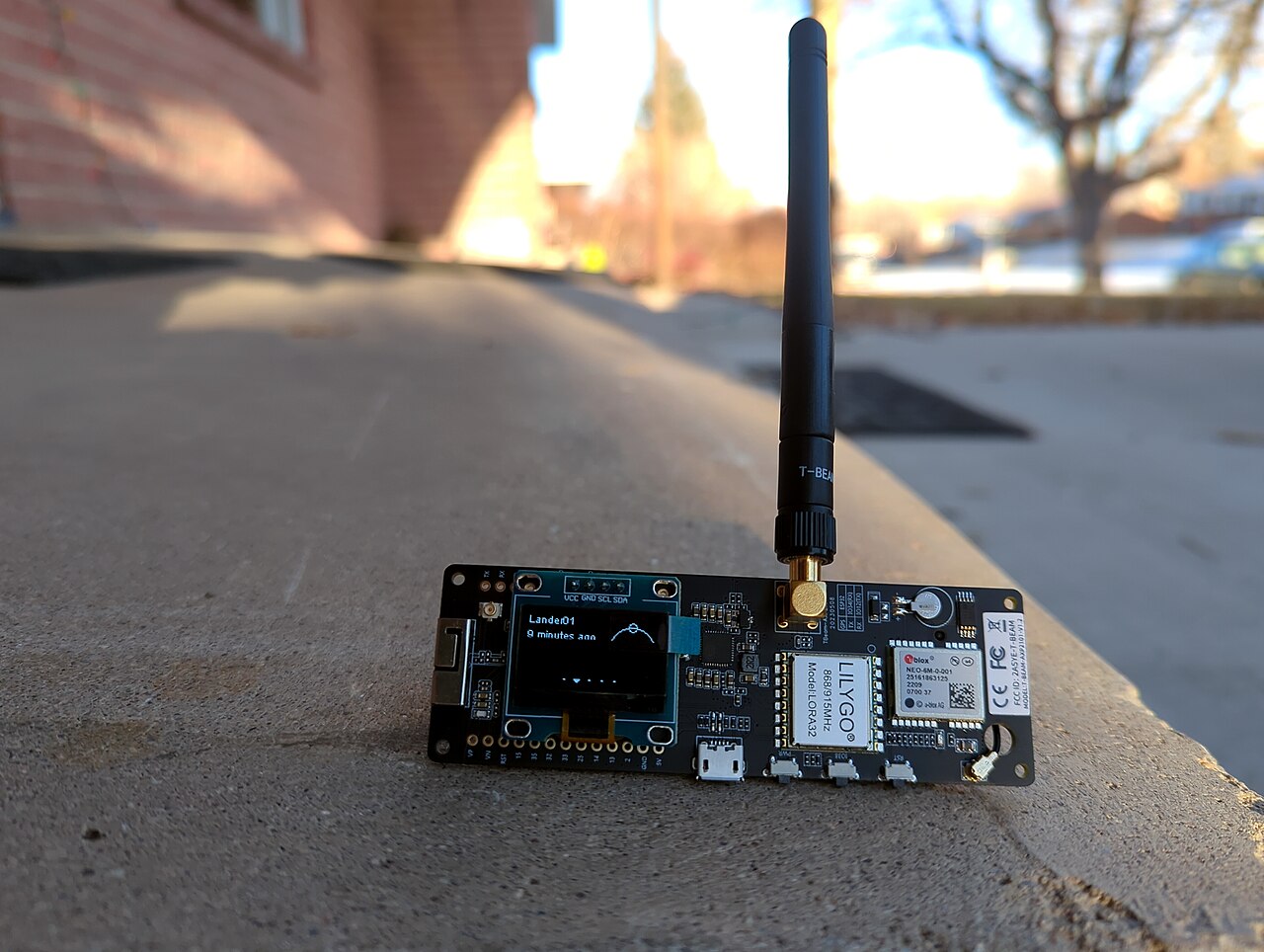
Meshtastic is easy to misread if you approach it as a chat app that happens to use radio. The more useful framing is stricter: it is an open-source firmware, client, and protocol ecosystem for small LoRa devices whose hardest engineering limit is not interface polish but shared airtime. Its official overview describes a message path that begins in a companion app, crosses Bluetooth, Wi-Fi, Ethernet, or serial to a radio, then moves outward by broadcast and selective rebroadcast across nearby nodes.[1]
That architecture is attractive because it works where ordinary infrastructure is weak: trails, rural properties, volunteer events, field teams, disaster-preparedness kits, and local hobby networks. Hackaday caught the early promise in 2020 as off-the-shelf ESP32 LoRa boards becoming affordable mesh communicators, while LWN's 2025 FOSDEM report placed the project in a more mature setting: open-source firmware running on low-power devices, with LoRa's proprietary radio layer as an explicit boundary rather than a hidden detail.[5][6][7]
The key adoption mistake is to treat Meshtastic like a low-speed internet substitute. It is not that. It is a radio mesh where every convenience feature has to be measured against range, congestion, legal region settings, and rebroadcast behavior.
The physical mesh is the modem contract
At the lowest useful level, a Meshtastic mesh is not defined by a room name. It is defined by LoRa parameters. The overview says radios must share the same spreading factor, center frequency, and bandwidth to participate in the same radio mesh, and the LoRa configuration page makes the operational contract concrete: devices must have matching Region and Modem Preset, or identical custom modem settings, to communicate fully.[1][2]
That means the first architecture decision is regulatory and physical before it is social. The lora.region setting must be set so the device operates inside the legal limits for its area; the docs list different frequency ranges, duty-cycle limits, and power limits by region.[2] In the United States, the listed range is 902.0-928.0 MHz with a 30 dBm power limit; in EU 868, the page lists 869.4-869.65 MHz, 10% duty cycle, and 27 dBm.[2] Those numbers do not just decorate a settings page. They decide how much airtime the mesh can spend before reliability and compliance collide.
The modem presets make the trade more visible. SHORT_TURBO is fastest but has shorter range and may not be legal everywhere because of its bandwidth, while VERY_LONG_SLOW maximizes range but is not recommended for regular use because it does not form meshes well and is unreliable.[2] The default LONG_FAST sits in the middle as a practical compromise.[2] Meshtastic therefore rewards conservative radio planning: pick the slowest and longest mode only when the network shape truly needs it, because every extra second on air is time other packets cannot use.
Channels are readability boundaries, not separate air
Meshtastic channels are easy to overinterpret. The channel docs draw the distinction clearly: modem settings define the LoRa radio behavior and are identical for all channels, while channel settings segregate message groups, encryption, and internet-gateway behavior.[3] A node can have channels indexed from 0 to 7, with one required PRIMARY channel and optional SECONDARY channels.[3]
This gives users a familiar group model without pretending that each group owns separate spectrum. The overview says nodes can belong to as many as eight channels, and only nodes with the same channel name and encryption key can read and display messages for that channel.[1] But the same section adds the crucial operational caveat: all nodes in the radio mesh may still receive and retransmit messages depending on role, regardless of whether they can decrypt the application content.[1]
That is the architecture note in one sentence: encryption and channel names protect meaning; they do not create new airtime. A private secondary channel can make the text unreadable to outsiders, but it still consumes the same constrained local radio medium. For teams deploying Meshtastic at an event, campsite, neighborhood, or work site, this means channel design is partly social governance. More groups are not free if they encourage more traffic.
Hop limits are congestion control in plain sight
Meshtastic's flood behavior is deliberately bounded. The overview says a node ignores packets it has already heard, rebroadcasts new packets, decrements the hop limit on each rebroadcast, and stops forwarding when that value reaches zero.[1] The LoRa configuration page caps Max Hops at 7 and says the default is 3, adding the blunt guidance that 3 is fine for most applications.[2]
That bluntness is useful. A higher hop limit can make a network feel larger, but it also multiplies airtime pressure. In a sparse mesh, rebroadcasting is the feature that makes the system useful. In a dense mesh, careless rebroadcasting is one of the easiest ways to turn a local channel into noise. Meshtastic's design gives users enough rope to extend range, but the defaults are trying to keep the mesh from rewarding maximum reach as a reflex.
The packet format reinforces the same point. The overview describes unencrypted routing metadata around an encrypted application payload, including destination, sender, packet ID, hop limit, original hop start, channel hash, next-hop hints, relay node, and a payload capped at 239 bytes over the air.[1] That is not a generous transport. It is a tiny, purpose-built envelope for text, position, telemetry, node info, administration, and routing messages.[1] The best applications respect that envelope instead of treating it like a poor person's TCP link.
MQTT is a bridge, not an escape hatch
MQTT is where the internet temptation returns. Meshtastic's public MQTT service can bridge devices over the internet and provide global connectivity for remote networks, but the docs immediately wrap that convenience in restrictions.[4] Public MQTT traffic uses a zero-hop policy: directly connected nodes can receive the data, but it does not fully propagate through local mesh networks.[4] The service also prioritizes specific message portnums and limits default-PSK location precision to protect privacy and reduce unnecessary traffic.[4]
The warning around private brokers is even more important. The docs say using the default key on a private broker is not recommended because it can create security problems and flood the mesh with traffic when the public server's zero-hop protections are absent.[4] That turns MQTT from a simple checkbox into an architectural boundary. A gateway can be valuable when it links isolated groups, feeds dashboards, or bridges a private channel deliberately. It becomes harmful when it lets internet-scale expectations spill into a radio network whose real scarce resource is airtime.
This is where Meshtastic's open-source character matters most. The firmware repository identifies the project as an open-source LoRa mesh networking system for long-range, low-power communication without internet or cellular infrastructure, with support across ESP32, nRF52, RP2040/RP2350, and Linux-based devices.[7] That hardware breadth is a strength, but it also means deployments will vary widely in antennas, batteries, enclosures, terrain, and operator skill. The architecture has to stay legible enough for people to make good local decisions.
Meshtastic is strongest when the deployment goal is modest and clear: short text, position, telemetry, and local coordination across a constrained radio mesh. It is weakest when users expect it to behave like a resilient miniature internet. The right mental model is not "chat, but off-grid." It is "shared low-bandwidth radio, with encryption, routing hints, and careful bridges." Once that model is in place, the project becomes much easier to evaluate and much harder to abuse.
Sources
- Meshtastic docs, "Overview" - message flow, mesh definition, hop behavior, channel model, packet fields, payload limits, and radio-condition metadata.
- Meshtastic docs, "LoRa Configuration" - region settings, modem presets, max hops, duty-cycle notes, power limits, and physical radio tradeoffs.
- Meshtastic docs, "Channel Configuration" - channel roles/settings, active channel indexes, primary-channel frequency-slot behavior, and channel-vs-modem boundary.
- Meshtastic docs, "MQTT | Integrations Overview" - public MQTT bridge behavior, prioritized portnums, location-precision filtering, and private-broker caveats.
- Tom Nardi, "LoRa Mesh Network With Off-The-Shelf Hardware," Hackaday, February 26, 2020 - early independent coverage of the project's off-grid hardware premise.
- Koen Vervloesem, "Meshtastic: decentralized communication with low-power devices," LWN.net, February 19, 2025 - FOSDEM context, LoRa boundary, hop-count explanation, and project framing.
- GitHub,
meshtastic/firmwareREADME - official firmware repository, hardware platform support, license, and project-maintenance surface. - Wikimedia Commons, "File:Meshtastic T-Beam.jpg" - real photograph of a LILYGO TTGO T-Beam running Meshtastic on battery power, used as the article image.