The easiest way to misread Grafana Loki is to think of it as "logs in object storage." That description is directionally true, but it hides the part that actually decides whether a deployment stays pleasant after the first growth spurt. Loki's architecture works only when three constraints line up: labels stay disciplined, ingesters keep chunk creation under control, and the read path has a way to stop one heavy actor from turning a shared tenant into a traffic jam.[1][2][3][4]
As of 2026-03-29 UTC, the GitHub API reports 27,891 stars, 3,965 forks, 2,117 open issues, and push activity as recent as 2026-03-29T01:09:46Z for grafana/loki; the releases feed shows v3.7.1 published on 2026-03-27, only one day after v3.7.0.[5][6] Those numbers do not prove that every team should run Loki, though they do show a project still shipping quickly enough that architectural defaults matter more than abandoned-project anxiety.
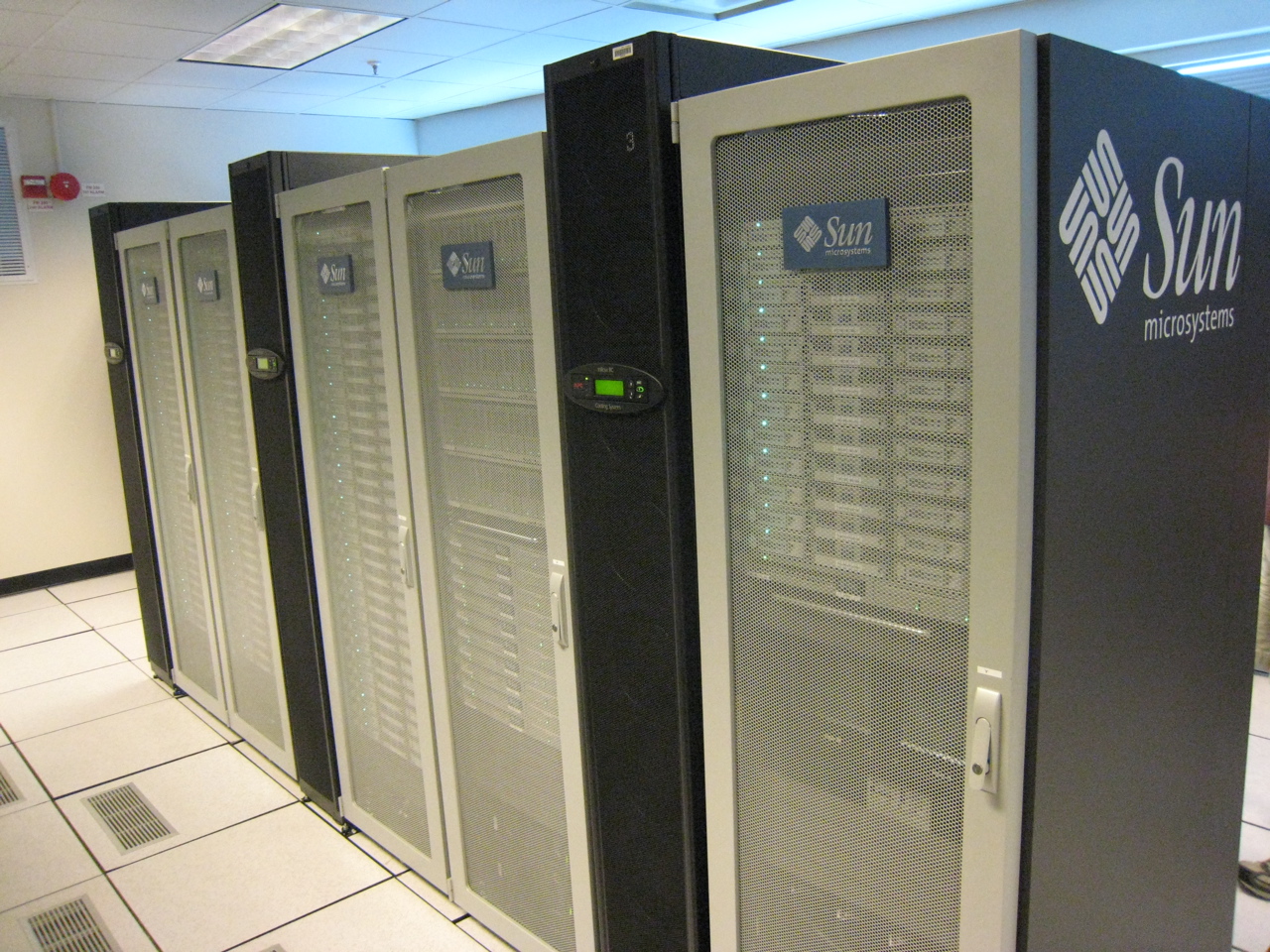
Image context: the cover image shows a real Solaris server cluster because Loki's real subject is cluster behavior under shared load, not a pretty query UI. The system stays calm only when write replication, object storage, and query scheduling keep reinforcing each other instead of fighting each other.[7]
1. The minimal index is the product
Loki's labels design document makes the project's position unusually explicit: Loki is not meant to recreate open-ended log search by indexing everything.[2] The recommended pattern is narrower and more structural. Labels should describe durable, low-cardinality characteristics of a stream, while the actual log body still carries the high-cardinality details that operators grep or filter later.[2]
That distinction is easy to wave away during a small pilot. It becomes central in production. A label is not just a metadata convenience. In Loki it influences stream identity, write fanout, index size, and query selectivity at the same time.[1][2] The design document even uses a concrete warning: labeling by something like order number is a bad fit, while labeling by a smaller category and then filtering within a time range is the intended pattern.[2]
So the first architectural boundary is straightforward: if a team wants ad hoc full-text indexing semantics, Loki is the wrong center of gravity. If the team can keep labels few, stable, and meaningful, Loki's storage economics start to work in its favor.[2][4]
2. The write path is really a chunk factory with strict failure boundaries
The components documentation describes Loki as a modular system that can run in a single binary or as separated services.[1] That deployment flexibility matters less than the behavior of the write path. A distributor validates incoming streams, hashes each label set, and forwards writes to multiple ingesters according to the replication factor. The same docs describe the default mental model clearly: a replication factor of 3 means the distributor wants a quorum of 2 successful writes before the request is considered durable enough to acknowledge.[1]
From there the ingester becomes the real cost center. It is responsible for persisting incoming data, returning recent in-memory data on the read path, and building each stream into chunks in memory before flushing them to long-term storage.[1] Those chunks get compressed and rotated when they hit configured capacity, sit idle for too long, or are forced out by a flush event.[1]
This is why label discipline and storage discipline are the same conversation. Over-fragment streams with noisy labels, and you force more small chunks, more object-store references, and more work on the querier later. Keep streams structurally useful, and chunking stays denser and cheaper.[1][2]
The same components guide also says ingesters now include a write-ahead log so data survives abrupt process loss as long as the disk itself is intact.[1] That does not remove the need for replication. It explains the intended pairing: WAL reduces single-node loss risk, while quorum replication keeps writes flowing across restarts and rollouts.[1] Loki's durability story lives in that combination, not in any single switch.
3. Query fairness is not a UI feature; it is a cluster survival feature
Most operators intuitively understand multi-tenant fairness across customers or business units. Loki's query-fairness guide focuses on the harder case: multiple actors inside the same tenant sharing the same backend budget.[3] This is exactly where many internal observability stacks get noisy. One dashboard author, one batch user, or one aggressive CLI loop can monopolize the same tenant queue and make everybody else feel like the cluster suddenly slowed down for no obvious reason.[3]
Loki's answer is architectural, not social. The query frontend can split large queries into smaller ones and queue them for workers, while the optional query scheduler adds more advanced queuing with one queue per tenant.[1] On top of that, Loki introduced hierarchical scheduler queues in version 2.9, and the query-fairness docs say they are enabled by default.[3] Operators can then use the X-Loki-Actor-Path header to push subqueries into actor-specific subqueues inside the tenant tree.[3]
That matters because read amplification in Loki is structural. The more data a query has to fan across chunks and object storage, the more important it becomes to keep one actor from flooding the shared work queue. Fairness is therefore part of the storage model. It is how a cluster turns shared hardware into a predictable service instead of a winner-take-all queue.[1][3]
4. TSDB made the index smaller and the read path sharper
Loki's TSDB storage document says that, starting with v2.8, TSDB is the recommended index type.[4] The same page frames the payoff in practical terms: the format is more efficient, faster, more scalable, and still lives in object storage.[4] That is a meaningful architectural shift because it keeps Loki's "cheap long-term logs" story while tightening the read path around a more compact index surface.
The trade is that smaller and more numerous internal queries now matter more. The TSDB docs explain that Loki added tsdb_max_query_parallelism as a separate per-tenant limit, with a default of 128, precisely because TSDB produces many smaller queries compared with older index types.[4] The same page also notes that TSDB does not currently use an index cache, which changes how teams should think about query performance tuning once older data ages out.[4]
In other words, TSDB did not remove the need for operating judgment. It moved that judgment. Instead of spending as much time on cache folklore, operators spend more time on parallelism budgets, object-store throughput, and whether their label model keeps the query fanout sane.[3][4]
5. Where Loki fits best
Loki is strongest when the team wants a shared log system with object-storage economics, can keep labels low-cardinality, and is willing to treat query scheduling as a first-class control surface.[1][2][3][4] It is a weaker fit when the cultural expectation is unrestricted full-text search over every field, or when nobody is prepared to govern who gets to consume the read path inside a shared tenant.[2][3]
That is the practical reason Loki keeps surviving "just use search" objections. It is solving a narrower problem with more discipline: durable log storage, selective indexing, and a queue-aware read path that assumes cluster resources are finite.[1][2][3][4] Teams that understand those boundaries usually get a cheaper and calmer system. Teams that ignore them often discover that their "logging problem" was really a cardinality problem plus a fairness problem.
Sources
- Grafana Loki documentation, "Loki components" (modular deployment modes, distributor quorum, ingester lifecycle, chunk flushing, query frontend, and scheduler roles).
- Grafana Loki design document, "Labels" (why Loki discourages full-text indexing via labels and why high-cardinality labels are easy to abuse).
- Grafana Loki documentation, "Ensure query fairness within tenants using actors" (hierarchical scheduler queues,
X-Loki-Actor-Path, and default enablement). - Grafana Loki documentation, "Single Store TSDB (tsdb)" (TSDB as the recommended index since v2.8, compact index behavior, and
tsdb_max_query_parallelism). - GitHub API,
grafana/lokirepository metadata snapshot used for stars, forks, open issues, and recent push activity. - GitHub API,
grafana/lokireleases feed used for recent release cadence, includingv3.7.1andv3.7.0. - Wikimedia Commons file page for the Sun Microsystems Solaris server-cluster photograph used as the article image.