An atom near the edge of a processor's territory still feels its neighbors on the other side. That small inconvenience explains much of LAMMPS's architecture. The open-source molecular-dynamics program divides a simulated volume among processes, gives each process nearby copies called ghost atoms, and exchanges the information needed to advance the whole system. Following those copies reveals both why the calculation can grow and why adding processors eventually becomes expensive.[1][2][3]
LAMMPS models interacting particles, from atoms in a solid to coarser representations of material. It can run on a laptop as well as a parallel machine. The account here follows the project's 2 September 2026 release documentation, concentrating on spatial decomposition and the conventional velocity-Verlet timestep. Accelerator packages and specialized models can alter the details.[1][5]
A territory and its borrowed neighbors
For distributed computation, LAMMPS uses MPI, the Message Passing Interface. Each MPI process receives a spatial subdomain. With the default comm_style brick, those subdomains form a regular grid. The division works well when particles are spread reasonably evenly; a dense droplet surrounded by empty space gives some processes much more work than others. The processors and balance commands, and a tiled decomposition, offer ways to change that arrangement.[2]
The particles assigned to a process are its owned atoms. To calculate short-range interactions near an edge, it also needs selected data about atoms assigned elsewhere. Ghost atoms supply those copies within a communication cutoff. They also represent neighbors across periodic boundaries, where the simulation treats opposite faces of the box as connected.[3]
This is selective duplication: a process can work on its patch without storing the entire system. But the copies must stay useful. In LAMMPS terminology, forward communication sends information such as coordinates from owners to the processes holding ghosts. Reverse communication returns calculated contributions, such as forces, to the owners, where they are added together. The distinction is between distributing the inputs and collecting the results.[3]
Remembering whom to check
Knowing which particles are nearby is itself work. LAMMPS keeps neighbor lists so a force calculation need not reconsider every possible pair in the simulation. A list includes candidates out to the force cutoff plus an extra distance called the skin. Spatial bins help build these lists efficiently, and the lists are reused over subsequent steps.[4]
Imagine a hypothetical force cutoff of 10 distance units and a skin of 2. The candidate list reaches 12. Particles between 10 and 12 are candidates for later interactions; extending the list does not extend the physical force cutoff. The extra room buys time before rebuilding becomes necessary. The developer guide describes a typical rebuild trigger when any atom has moved half the skin distance since the previous build.[4]
That spare room has a cost. A larger skin includes more candidates to inspect and can increase communication, while a smaller one can require more frequent rebuilding. Neighbor lists also occupy substantial memory—the project identifies them as typically its largest data structure. Tuning therefore trades repeated search work against extra storage and checking. There is no universally fastest skin setting.[4][6]
Two routes through a timestep
Inside Verlet::run(), after integration updates positions, neighbor->decide() determines whether to rebuild neighbor lists. Otherwise, comm->forward_comm() refreshes ghost coordinates.[5]
A rebuild step remaps periodic coordinates, migrates atoms to new owners, establishes ghosts with comm->borders(), and calls neighbor->build(). Ownership transfers accompany rebuilding; crossing a dividing line does not require an immediate transfer on every step.[5]
After force calculation, with Newton handling enabled, reverse communication returns ghost-force contributions. Integration finishes the velocity update. Reusing a neighbor list does not mean reusing old positions: candidates persist while their coordinates change.[5]
For someone extending LAMMPS, that sequence matters as much as the force formula. A new operation must obtain the data it needs at the appropriate stage and return contributions before the owning process uses them.
Why a bigger allocation can disappoint
Consider the geometry before considering a benchmark. For an approximately cubic subdomain of side length L, owned volume grows as L³, while surface area grows as 6L². For a thin communication halo of fixed thickness, shrinking the subdomain increases the halo's size relative to the owned volume. That is a geometric explanation, rather than a measured speedup claim: splitting the same box ever more finely leaves less local work to justify each exchange.[2][3]
The performance guide identifies the corresponding practical limit: communication can dominate when there are too few work units per MPI process. It also warns that long-range electrostatics bring additional costs. PPPM, a particle-mesh solver, uses parallel three-dimensional Fourier transforms whose scaling differs from the nearby-particle exchanges described above.[6]
The useful experiment is consequently modest: hold the physical problem fixed, run a representative equilibrated configuration at several process counts, and read the timing breakdown. A rise in communication time can reflect load imbalance and waiting, so atom-count distributions matter too. Faster completion and efficient use of an allocation are related goals, but they need separate measurements.[6]
The shared work behind the local calculation
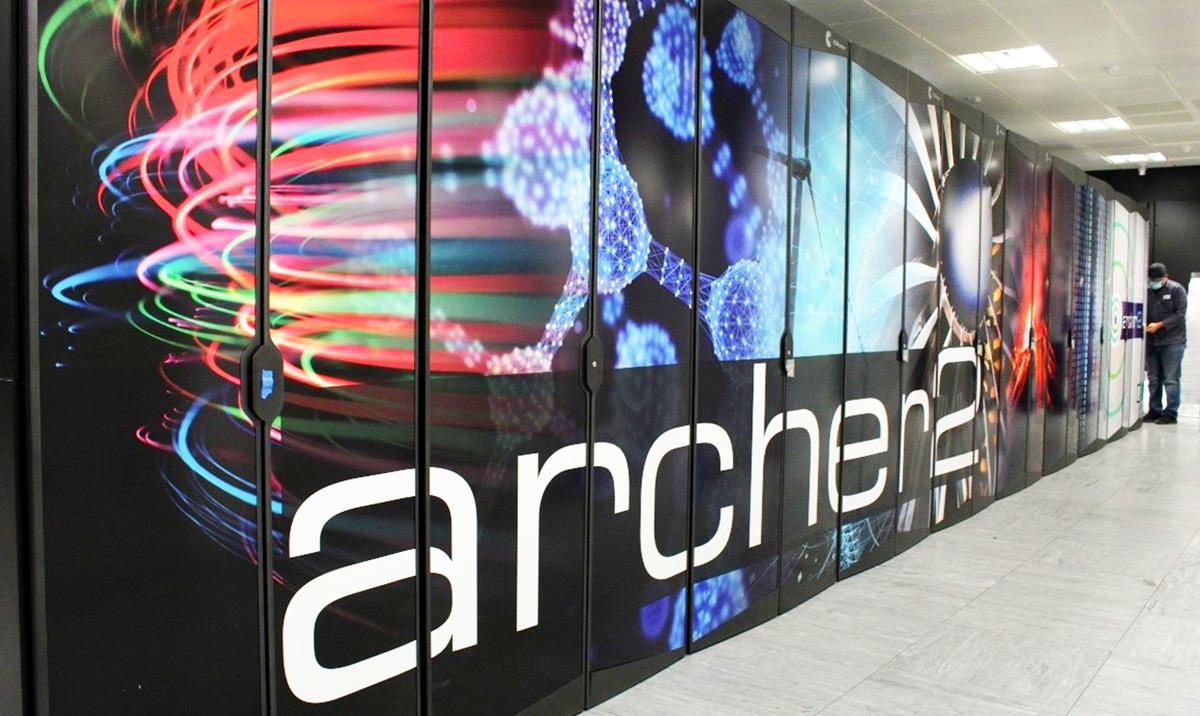
ARCHER2's operator documentation provides a concrete deployment example: LAMMPS is offered as installed research software, with instructions for parallel jobs.[7] Access to that machinery lets researchers use an implementation whose communication and integration routines already exist.
An older independent report gives the organizational point some texture. Covering a 2015 GPU Technology Conference presentation, The Next Platform reported P&G scientist Russell Devane's explanation that his small computational-chemistry group could not have undertaken the GPU modifications to LAMMPS and NAMD itself. It benefited from work already done in those packages.[8]
My reading is that this is the durable value of the architecture: a research group can change its model while sharing the engineering that distributes the calculation. That still calls for someone who understands the model and can inspect a scaling run. Ghost atoms make neighboring data available; they cannot decide whether a chosen interaction model represents the material well.
Sources
- LAMMPS, “Overview of LAMMPS,” release documentation dated 2 September 2026 — particle models, MPI, acceleration, and extensibility.
- LAMMPS, “Partitioning” — spatial subdomains, brick and tiled layouts, and load balancing.
- LAMMPS, “Communication” — ghost atoms, periodic boundaries, and forward and reverse exchanges.
- LAMMPS, “Neighbor lists” — force cutoff plus skin, rebuilding, spatial bins, and memory use.
- LAMMPS, “How a timestep works” — the Verlet integration loop, atom migration, communication, and force evaluation.
- LAMMPS, “Measuring performance” — neighbor-list tradeoffs, parallel efficiency, PPPM, and interpretation of timings.
- ARCHER2 User Documentation, “LAMMPS” — installed software and parallel job guidance from the computing service.
- Nicole Hemsoth Prickett, “Procter and Gamble Moves Closer to GPU Computing,” The Next Platform, 18 March 2015 — independent reporting on a small research group's use of existing molecular-dynamics software.
- EPCC, “ARCHER2” — official system page and source of the photograph identified as “ARCHER2 full system 2021.”