GNU Radio is easy to undersell as a drag-and-drop tool for software-defined radio. The graphical editor is important, but it is not the architecture. The deeper idea is that radio work can be represented as a signal-processing graph: sources create streams, blocks transform them, metadata rides alongside samples, and sinks hand the result to files, displays, networks, or real RF hardware.[8]
That distinction matters because radio systems fail at boundaries. A demodulator may look correct until the sample rate changes. A packet detector may work in a recording but lose boundaries when attached to live hardware. A hardware source may promise a nominal rate that the USB path or host CPU cannot sustain. A prototype may be clear in one developer's notebook and opaque to everyone else. GNU Radio's value is that it gives those decisions names, edges, and runtime contracts before the antenna turns them into a harder debugging problem.
As of 2026, the project is also in a useful transition window. The GitHub repository describes GNU Radio as "the Free and Open Software Radio Ecosystem," and its public metadata on 2026-06-27 showed a C++ GPL-3.0 project with thousands of stars, thousands of forks, hundreds of open issues, and recent activity on the main branch.[9] GNU Radio 3.10 remains the current stable release line, with v3.10.12.0 published in February 2025.[10] At the same time, GNU Radio 4 work is visible in a separate FAIR/GSI-led repository and release surface, where the project is described as a modern C++ rewrite while the README still points production users back to GNU Radio 3.x.[11][12] That does not make every existing flowgraph obsolete. It does make the architecture worth re-reading: GNU Radio is not only a library of DSP blocks; it is a way to turn RF assumptions into an inspectable system.
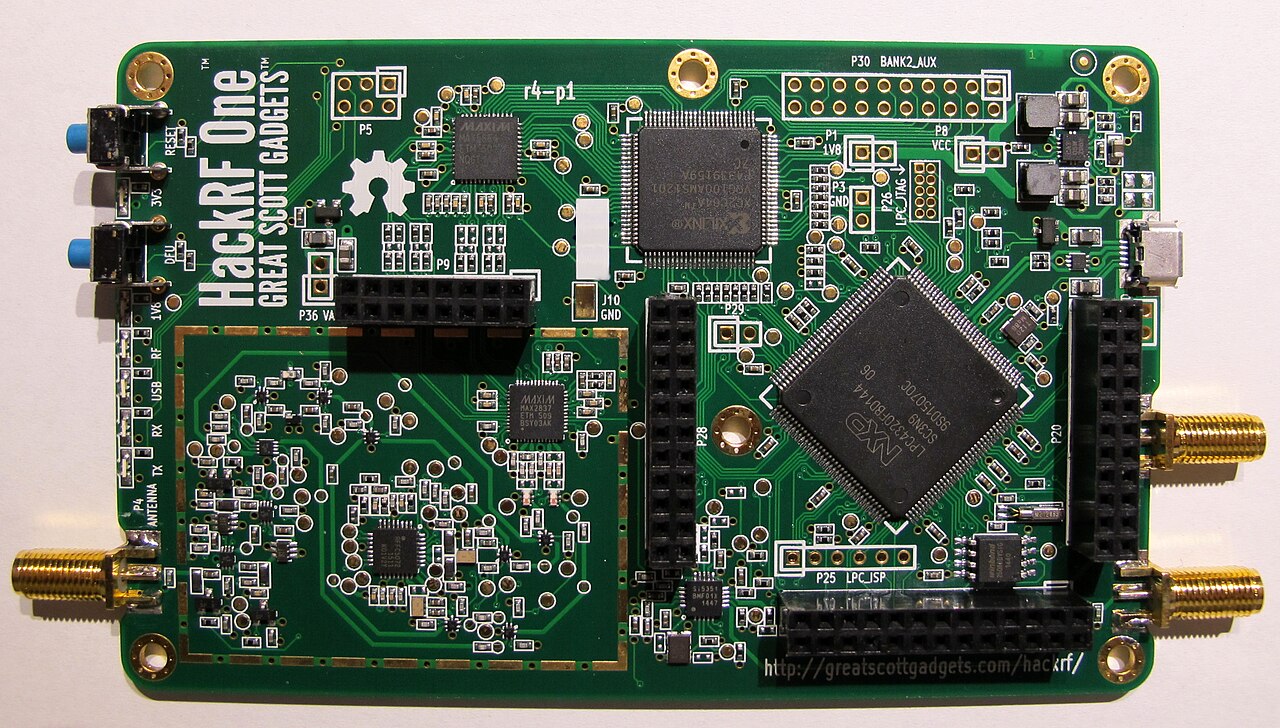
Image context: the cover photograph shows a HackRF One board, not a spectrum plot or block diagram. That choice is deliberate. GNU Radio lets engineers reason in software, but the end of the graph is often a real radio front end with physical bandwidth, clocking, gain, and transport constraints.[1]
Flowgraphs Make RF Work Reviewable
The central unit of GNU Radio work is the flowgraph. In GNU Radio Companion, a user connects blocks into a graph; in Python or C++, the same idea appears as a top block that wires sources, processing blocks, and sinks. Introductory GNU Radio teaching material tends to start with blocks, variables, sample rates, and graphical flowgraphs because the graph is the shared object of design, review, execution, and debugging.[2]
That is the first architectural advantage. A radio receiver is no longer a private sequence of callbacks hidden in one file. It becomes a visible pipeline: source, filter, frequency translation, resampler, demodulator, timing recovery, decoder, visualization, storage, or hardware sink. Each block owns a narrower job. Each edge implies a stream contract. The graph can be inspected, copied, altered, or reduced to a minimal failing case.
GNU Radio's runtime reinforces that model. The scheduler moves items through blocks in chunks, and the exact chunk size can vary as the runtime balances buffers, downstream demand, and block behavior.[3] A good flowgraph therefore is not a single-sample mental model. It is a streaming system. Blocks should be written and configured as components that can process ranges of items, tolerate scheduler choices, and communicate important boundaries through the mechanisms GNU Radio gives them.
That is why the flowgraph is more than visual convenience. It is a design review artifact. If a team cannot point to where tuning happens, where filtering narrows bandwidth, where clock recovery starts, where packet boundaries appear, or where hardware enters the loop, the problem is not that the diagram is ugly. The problem is that the radio system has not been made explicit enough to operate.
Sample Rate Is The First Contract
In ordinary software, throughput is often a performance attribute. In software radio, sample rate is closer to a contract. It decides how much spectrum is represented, how much data every downstream block must process, and what assumptions a filter, demodulator, or display is allowed to make. GNU Radio teaching material treats rate as a concept users should see and manipulate directly, not as a hidden setting inside a device dialog.[2][4]
This is where many flowgraphs become honest. A low-pass filter's cutoff only makes sense relative to a sample rate. A waterfall display can be visually persuasive while showing the wrong interpretation if the rate is wrong. A hardware source might be configured for a rate that the device accepts but the downstream graph cannot process in real time. A resampler can solve one mismatch while introducing CPU cost and latency elsewhere.
The important lesson is not "choose the fastest rate." The correct rate is the one that satisfies the signal's bandwidth, the hardware's supported settings, the host's processing budget, and the downstream algorithm's assumptions. If the goal is to inspect a narrow signal, a high-rate capture may create unnecessary pressure. If the goal is to preserve a wider channel, a low-rate shortcut can destroy information before the demodulator has any chance.
GNU Radio makes that tradeoff visible because rates live in block parameters, hardware source settings, resamplers, and displays. The architecture does not remove DSP responsibility. It moves the responsibility to places that can be reviewed. A healthy flowgraph tells a reader why each major rate transition exists. An unhealthy one leaves the rate budget as folklore.
Tags Keep Metadata Attached To Samples
Radio streams often need more than raw samples. A detector may identify where a burst begins. A synchronizer may estimate timing or frequency offset. A packet decoder may need to preserve length. A downstream sink may need to know that a range of samples has a particular meaning. GNU Radio's stream tags exist for that reason: they are metadata that travel alongside the sample stream at specific offsets.[5]
That design is subtle but important. Without tags, metadata is easily pushed into side channels, global variables, or assumptions about buffer shape. Those approaches work until scheduler chunking, buffering, or block reuse changes the timing. Tags let a block say, in effect, "this fact belongs to this point in the stream." Downstream blocks can then react without relying on a separate timeline.
Tagged stream blocks extend the idea for packetized work. The tagged-stream documentation frames the problem directly: a stream of bytes alone does not reveal packet boundaries, so the boundary needs to be represented in-band with the stream contract.[6] That is a radio architecture issue, not just a GNU Radio API detail. Packetized systems depend on knowing where one unit ends and another begins. If the boundary lives only in the developer's head, the flowgraph is fragile.
The practical rule is simple: use stream tags when sample-aligned facts matter, and use tagged streams when packet length or frame boundaries are part of the computation. That keeps metadata inside the same reviewable graph as the samples themselves.
Hardware Is A Boundary, Not A Checkbox
GNU Radio can simulate signals, process recordings, generate files, and run entirely without a radio attached. But its cultural center is software-defined radio, where hardware sources and sinks make the graph meet the physical world. The HackRF One photograph in the cover image is a useful reminder: an SDR board is not an abstract input. It has an RF path, converters, oscillator behavior, gain stages, USB transport, and supported operating ranges.[1]
That boundary changes the engineering posture. A flowgraph that works on a captured file may still fail live because the input level is wrong, the antenna is unsuitable, the host cannot process the selected rate, or the device's actual tuning and filtering behavior are not what the algorithm assumed. Conversely, a flowgraph that is hard to debug live can often be made tractable by recording samples at the hardware boundary and replaying them through the same downstream blocks.
GNU Radio's architecture supports that discipline because source and sink blocks are ordinary graph components. A file source can stand in for a hardware source. A null sink can replace a transmitter while a processing chain is tested. A GUI sink can reveal a spectrum before a decoder is trusted. That does not make RF easy. It makes the boundary movable, which is often the difference between debugging and guessing.
This is also where regulatory and operational reality enter. GNU Radio can build transmitters, but it does not make a signal legal, clean, or safe by itself. Gain settings, modulation correctness, filtering, frequency choice, and hardware behavior still matter. The architecture helps expose those responsibilities; it does not absolve them.
Extension Is How Experiments Graduate
GNU Radio's block library is broad, but its long-term value depends on extension. The wider ecosystem's Out-Of-Tree module index shows how blocks, hardware integrations, and research components can live outside the core source tree while still participating in the GNU Radio model.[7] In practice, that mechanism is how local experiments become reusable blocks, how hardware integrations live independently, and how research code avoids becoming a one-off script with no clear interface.
Out-of-tree modules are more than packaging convenience. They force a question: what is the stable boundary of this new capability? If the answer is "a block with clear inputs, outputs, parameters, tags, and tests," the experiment has a chance to become part of a larger graph. If the answer is "some custom Python around a half-known buffer," the result may still be useful, but it is harder to share, review, or maintain.
Independent packaging also matters. GNU Radio is visible in distribution ecosystems such as Debian's package tracker, which is a modest but real signal that the project is not only a source checkout for specialists.[13] For teams adopting it, that means the extension decision has two sides: use packaged core components when stability matters, and isolate custom work in modules that can be versioned and tested instead of letting local flowgraphs become undocumented infrastructure.
The healthy adoption path is therefore not to drag every custom idea into one graph forever. Build the simplest flowgraph that proves the signal path. Promote repeated logic into a block. Move reusable blocks into an out-of-tree module. Record test vectors. Keep hardware assumptions visible. That is how a lab prototype starts to look like an engineering asset.
GNU Radio 4 Makes Runtime Choices More Explicit
The GNU Radio 4 work is worth watching because it focuses on the machinery that experienced users already care about: execution strategy, scheduling, modern C++ APIs, and performance. The GR4 release page describes the work as the first release candidate of a ground-up GNU Radio 4.0 rewrite in modern C++23, while the repository README still labels the line as a beta/prototype and advises production users to use GNU Radio 3.x.[11][12]
That tension is useful rather than confusing. It says the project is treating runtime structure as a first-order problem, but it also says users should be honest about maturity. A signal graph describes what computation should happen. A scheduler decides how that computation should run on available resources. The more complex the workload, the more that difference matters.
That distinction fits GNU Radio's broader philosophy. If sample rates, tags, and hardware boundaries should be explicit in the graph, execution choices should be explicit too. A low-latency receiver, an offline batch processor, and an accelerated pipeline may share high-level signal structure while needing different runtime behavior. Making that difference first-class is the right direction for a framework whose users span education, research, instrumentation, amateur radio, security labs, satellite work, and industrial signal processing.
For current users, the cautious reading is best. GNU Radio 3.10 remains the stable line to evaluate for ordinary production use today.[10][12] GNU Radio 4 is the architecture signal: it shows where the project thinks the hidden runtime should become more inspectable. The migration question is not only "when is the next major version ready?" It is "which of my flowgraphs depend on runtime behavior I have never made explicit?"
Where GNU Radio Fits
GNU Radio is strongest when a team needs to make signal-processing assumptions inspectable. It fits education, SDR prototyping, RF measurement, modem experiments, packet decoding, receiver design, hardware bring-up, and research workflows where changing one block should not require rewriting the whole system. It is also useful when teams need to move between recordings, simulations, visual inspection, and hardware runs without losing the structure of the pipeline.
It is weaker when the goal is a turnkey radio appliance. GNU Radio exposes blocks, rates, buffers, tags, scheduler behavior, and hardware settings; it does not hide the need to understand them. A team adopting it should expect to learn enough DSP to defend its parameter choices, enough systems engineering to respect throughput and latency, and enough RF practice to treat hardware as a physical constraint.
The best pilot is narrow and testable. Choose one signal path. Draw the flowgraph. Write down the expected sample rate at each major edge. Identify where metadata should travel as tags. Decide where the hardware boundary can be replaced by a file for repeatable testing. If custom logic appears twice, turn it into a block. If the graph cannot be explained from left to right, simplify it before adding more hardware.
GNU Radio's enduring contribution is not that it makes radio graphical. It makes radio work legible. Flowgraphs, sample rates, stream tags, hardware boundaries, and extension modules turn RF experiments into systems that other engineers can inspect before the spectrum gets involved.
Sources
- Wikimedia Commons, "SDR HackRF one PCB.jpg" - real HackRF One software-defined radio board photograph by wdwd used as the article cover image source.
- University of Victoria ECE Communications Labs, "Tutorial 1" - GNU Radio Companion material on flowgraphs, decimation, interpolation, and sample-rate configuration.
- GNU Radio repository usage manual, "Handling Flowgraphs" - scheduler behavior, buffer movement, and chunked work calls in GNU Radio flowgraphs.
- Ettus Research, "GNU Radio Tutorials: Labs 1-5" - tutorial material explaining GRC flowgraphs, sample-rate settings, throttle behavior, and hardware-clock boundaries.
- GNU Radio repository usage manual, "Stream Tags" - metadata attached to sample offsets and propagated through GNU Radio streams.
- GNU Radio repository usage manual, "Tagged Stream Blocks" - packetized stream handling and length tags for frame boundaries.
- CGRAN, "GNU Radio Out-Of-Tree Module List" - community index of GNU Radio modules outside the core source tree.
- GNU Radio GitHub repository - public project repository, README, license, installation pointers, and source tree.
- GitHub API,
gnuradio/gnuradiorepository metadata sampled on 2026-06-27 - license, repository activity, language, stars, forks, and issue counts. - GitHub releases,
gnuradio/gnuradiov3.10.12.0 - stable release tag published on 2025-02-20. - FAIR/GSI
gnuradio4GitHub releases - GNU Radio 4 release surface, including RC material and modern C++23 rewrite context. - FAIR/GSI
gnuradio4GitHub repository - GNU Radio 4 prototype README, beta status, and production-use caveat pointing users to GNU Radio 3.x. - Debian Package Tracker,
gnuradio- independent distribution packaging surface for GNU Radio.