OpenCV 5 should not be treated as the kind of upgrade where a team bumps a package and waits for compile errors. The public release notes make it clear that OpenCV 5 is now a stable branch, but one that deliberately sheds old surfaces, moves modules, and turns deep-learning inference into a runtime choice.[2][3] The migration question is therefore less "does my old code still build?" and more "which assumptions did OpenCV 4 quietly absorb for us?"
That matters because OpenCV sits in awkward real systems. A production pipeline may begin with a cheap camera, pass through undistortion, feature extraction, contour logic, resize behavior, model inference, post-processing, and measurement, then end in a robot, inspection line, app, or edge device. A mismatch in any layer can look like a model problem even when the real cause is a build flag, a moved module, an interpolation change, or a different inference engine.
As of 2026-06-28T02:33:41Z UTC, the public opencv/opencv repository showed OpenCV as a C++ Apache-2.0 project with about 89,423 stars, 56,659 forks, 2,734 open issues, a 4.x default branch, and push activity on 2026-06-27.[5] The latest GitHub release endpoint returned OpenCV 5.0.0, published on 2026-06-06 and updated on 2026-06-26.[4] Those are not adoption proof by themselves. They are a useful signal that 5.0 is current enough to pilot, while 4.x remains visible enough that migration can be staged instead of forced overnight.
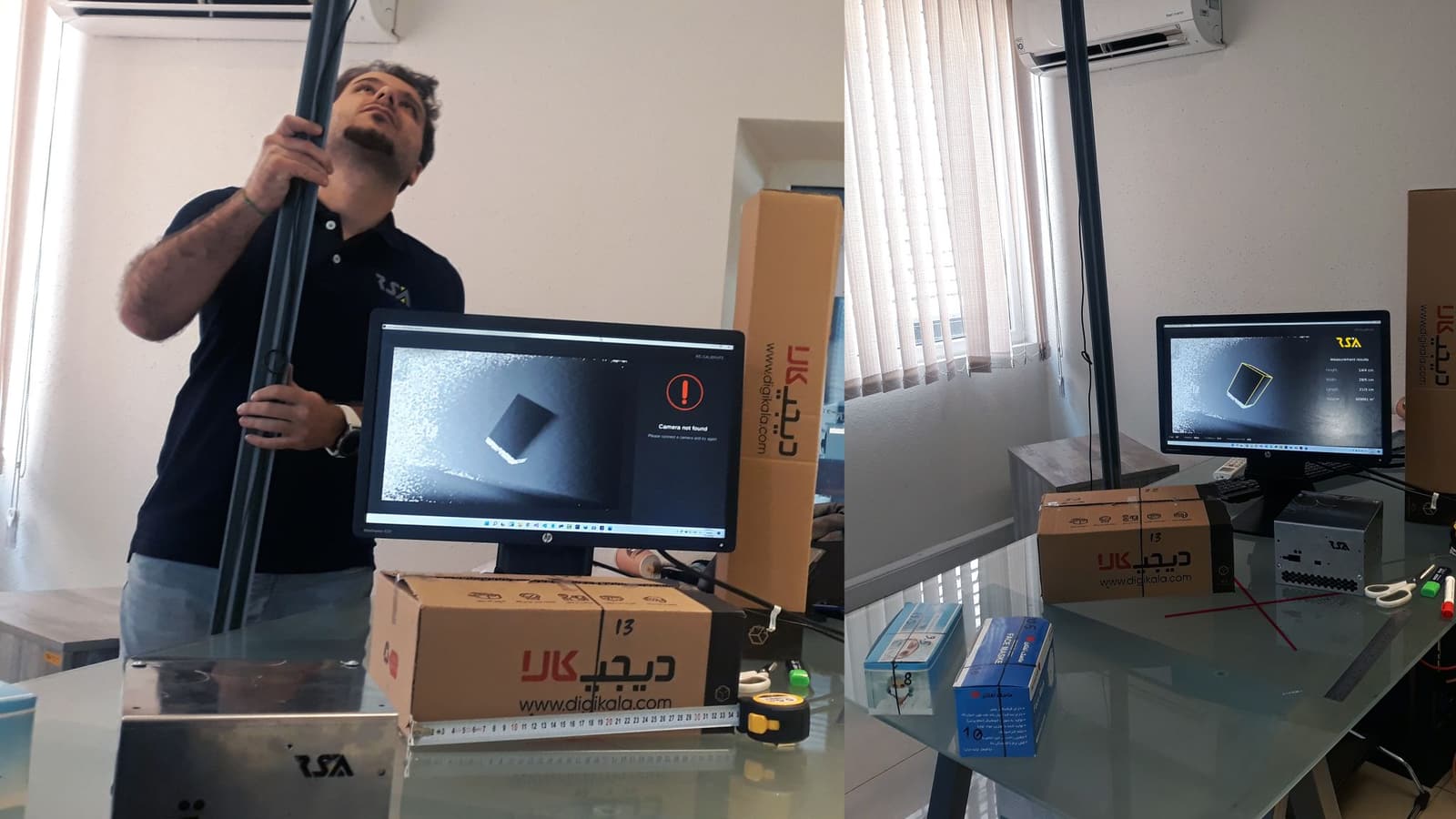
Image context: the cover uses Peyman Majidi's real photograph of a dimensioning prototype using image processing. It is not a diagram or generated visual. It shows why OpenCV migrations are practical rather than cosmetic: the library becomes part of a physical measurement loop where cameras, boxes, calibration, display output, and deployment code all have to agree.[1]
First, raise the floor deliberately
The cleanest hard gate in OpenCV 5 is the build floor. C++17 is now required, Python 2 support is gone, and Python 3.6 or later is required for bindings.[2][3] That is good technical hygiene, but it is not free. Any product still carrying old compiler images, pinned CI containers, old Android build environments, or Python 2-era scripts should discover that before the OpenCV package is changed in the main branch.
The C API removal is the other obvious cut. OpenCV 5 removes old C functions such as cvCreateMat() and cvFindContours() and old structures such as CvMat and related 1.x-era types, while keeping common CV_ type macros.[2][3] For most active codebases, this will be a minor archaeology exercise. For long-lived industrial, robotics, or academic code, it can be the difference between a quiet upgrade and a week of excavation.
The migration plan should start with a compatibility branch that does nothing but answer four questions: can the compiler build C++17 cleanly, do bindings run on a supported Python, does any C API usage remain, and can CI produce the same deployable artifacts the product currently ships? Until those are true, DNN benchmarks and module reshuffling are premature.
The module map changed where old demos used to hide
OpenCV 5's module reshaping is best read as maintainers moving the library away from "everything old stays in the main box." The migration guide says calib3d is split into geometry, calib, stereo, and ptcloud; features2d is renamed to features; ml and gapi move to opencv_contrib; and Haar/HOG object-detection paths move to xobjdetect in contrib.[3]
That can be less disruptive than it sounds, but only if the team checks by language and build shape. C++ users can keep the legacy opencv2/calib3d.hpp include for the split calibration and geometry functionality, though new code should include narrower headers. Python users see many functions remain under cv2.<name>(). Java users may need import changes.[3] The same migration can therefore be trivial in a Python notebook, modest in C++, and noisy in Java or custom CMake packaging.
The sharper point is about intent. SIFT, ORB, FAST, GoodFeaturesToTrack, and MSER remain in the main repository, while older feature detectors and descriptors such as SURF, BRIEF, FREAK, LUCID, and DAISY move into contrib.[2][3] That is a signal for teams with old feature pipelines: if an algorithm has been surviving mainly because a sample from 2012 still worked, OpenCV 5 is forcing a product decision. Either keep contrib as an explicit dependency, or update the pipeline to a maintained mainline path.
DNN is the real migration center
The biggest OpenCV 5 adoption question is the revised dnn module. The official OpenCV 5 notes describe a new inference engine that coexists with the classic engine, adds much better support for dynamic shapes, subgraphs, and modern ONNX features, and covers more than 80% of the ONNX specification compared with less than 23% in OpenCV 4.x.[2] Independent coverage framed the same release as a major modernization driven by the new DNN engine rather than by a narrow API polish pass.[6]
That improvement comes with a new control surface. cv::dnn::readNet(), cv::dnn::readNetFromONNX(), and related loaders now accept an engine parameter with ENGINE_AUTO as the default. The engine can also be forced with OPENCV_FORCE_DNN_ENGINE: classic engine, new engine, automatic mode, or ONNX Runtime.[2][3] The notes also warn that the engine cannot be switched after the model has loaded because the engines use different internal representations.[2]
That single sentence should drive the adoption test. Model loading is no longer just "can OpenCV parse this file?" It is "which engine parsed it, which fallback happened, and which hardware path will production actually use?" The new engine currently runs on CPU only. Teams that need GPU acceleration must either force the classic engine or build OpenCV with ONNX Runtime and the appropriate execution providers.[2] Darknet and Caffe parsers are removed, TFLite remains on the classic engine, and the new engine adds pieces needed for vision-language model execution, including tokenizers, attention layers, decoding blocks, post-processing, and KV-cache.[2][3]
The practical migration sequence is simple but strict. Inventory every deployed model by format, expected input shape, dynamic-shape behavior, custom layer usage, target hardware, and latency budget. Test ENGINE_AUTO, then force the new engine and classic engine separately so fallback does not hide the result. If ORT is part of the plan, build with -DWITH_ONNXRUNTIME=ON; for NVIDIA execution providers, test the GPU-specific ORT build path as well.[2][3] Record the chosen engine next to the model artifact. If nobody can say which engine is running in production, the upgrade is not controlled yet.
Pixel behavior needs regression fixtures
OpenCV 5 also changes lower-level behavior that can surface far from the code that caused it. The core module adds data types including CV_16BF, unsigned 32-bit and 64-bit integer types, signed 64-bit, and CV_Bool; it changes how 1D and 0D arrays are represented; and it replaces MatSize with MatShape to carry shape and data-layout information more directly, especially for DNN shape inference.[2][3]
The image-processing changes are just as adoption-relevant. warpAffine, warpPerspective, and remap have revised interpolation paths; nearest-neighbor resize now follows Pillow behavior; and findContours() can use the faster TRUCO contour extraction algorithm automatically where applicable.[2][6] These are good improvements, but computer-vision systems often encode assumptions in thresholds, bounding boxes, masks, calibration tolerances, and post-processing. A better warp or resize can still move a borderline decision.
So the migration should carry image fixtures, not only unit tests. Keep a small corpus of representative frames: bright, dark, blurred, rotated, low contrast, reflective, wide-angle, and camera-specific cases. For each major pipeline, save the expected intermediate outputs or tolerances: undistorted corners, masks, contour counts, keypoint counts, box coordinates, class scores, and final measurements. The goal is not pixel-perfect sameness everywhere. The goal is to know which differences are intended improvements and which are product regressions.
Distribution is part of the decision
OpenCV 5.0.0 ships through GitHub release assets such as Android SDK, docs, iOS framework, and Windows binaries, and the 5.0.0 files are also visible on SourceForge.[4][7] That distribution surface matters because OpenCV is often consumed in several incompatible ways: package manager, vendored source, custom CMake build, prebuilt mobile SDK, Python wheel, Docker image, or system package.
The adoption risk changes by route. A Python-only project may mainly care about wheel availability, cv2 behavior, and model-engine differences. A C++ robotics stack may care about headers, ABI boundaries, CUDA/ORT build flags, contrib modules, and cross-compilation. A mobile app may care less about old C APIs and more about binary size, platform assets, and whether the same model path exists on iOS, Android, and server-side validation.
This is why the upgrade owner should write down the exact consumption model. Are you using opencv_contrib? Are you relying on system packages? Are you building with ORT? Are old Haar cascades or HOG descriptors in the path? Is the project actually on OpenCV 4.x source, a distro-patched package, or a vendor SDK that only calls itself OpenCV-compatible? Without that inventory, a green local build proves very little.
Where OpenCV 5 fits now
OpenCV's original promise was broad: a reusable open-source computer-vision library rather than one-off algorithm code trapped in papers and demos.[8] OpenCV 5 keeps that promise, but modernizes the boundary. It is still a strong default for projects that mix classical vision, camera calibration, image transforms, feature work, video I/O, and deployable inference. It is especially useful when the pipeline needs to run outside a heavyweight research framework.
It is weaker when the team wants a pure deep-learning runtime, a fully managed model-serving stack, or a no-ops abstraction over hardware. OpenCV 5 can run modern ONNX and vision-language paths more credibly than before, but it is still a library whose performance and behavior depend on build options, engine selection, CPU/GPU paths, and input preprocessing discipline.[2][3]
The clean pilot is narrow. Pick one production-like pipeline, not the whole estate. Move the build to C++17 and supported Python. Decide whether contrib is in scope. Run the same images through OpenCV 4 and OpenCV 5. Test every model under explicit engine settings. Record latency and output drift on the actual target hardware. Only then promote the version bump.
OpenCV 5 is worth taking seriously because it is not just a cleanup release. It moves computer vision teams toward a clearer contract: old APIs are not immortal, modules have ownership boundaries, inference engines are explicit, and pixel-level changes deserve tests. Treating it as a header swap misses the point. The useful migration is the one that makes those boundaries visible before a camera, model, or measurement system finds them for you.
Sources
- Wikimedia Commons, "Peyman Majidi Prototyping a dimensioning system via image processing.jpg" - real photographic image used as the article cover.
- OpenCV GitHub wiki, "OpenCV 5" - official OpenCV 5.0 feature notes, cleanup list, DNN engine details, module changes, and performance notes.
- OpenCV GitHub wiki, "OpenCV 4 to 5 migration" - official migration guide covering build requirements, C API removal, module restructuring, DNN engine choices, and binding differences.
- GitHub API,
opencv/opencvlatest release metadata sampled on 2026-06-28 - OpenCV 5.0.0 tag, publication date, update date, and downloadable release assets. - GitHub API,
opencv/opencvrepository metadata sampled on 2026-06-28 - stars, forks, open issues, default branch, license, and repository activity. - Harry Fairhead, "OpenCV Introduces New DNN Inference Engine," I Programmer, 2026-06-08 - independent release coverage of OpenCV 5's DNN, core, and module changes.
- SourceForge, OpenCV Library 5.0.0 files - secondary distribution surface for OpenCV 5.0.0 release files.
- Gary Bradski, "The OpenCV Library," Dr. Dobb's Journal, 2000 - historical introduction to OpenCV as an open-source computer-vision library.