The easiest way to misread ESPHome is to treat it as a friendlier smart-home UI layer. That misses where the design really lives. ESPHome is better understood as a compile-time system that turns declarative YAML into generated firmware, then pushes that firmware onto small devices that must live within tight memory, connectivity, and recovery limits.[1][4][5] The user-facing syntax matters, but the architecture is downstream of code generation, device transport, and update safety.
As of 2026-05-06T03:04:35Z UTC, the public esphome/esphome repository reports 11,029 stars, 5,257 forks, 584 open issues, and a most recent push at 2026-05-06T01:37:40Z.[6] The current releases stream shows 2026.4.4 published on 2026-05-05.[7] Those numbers do not prove quality on their own, but they do show that ESPHome is an actively maintained platform surface rather than a static pile of example configs.
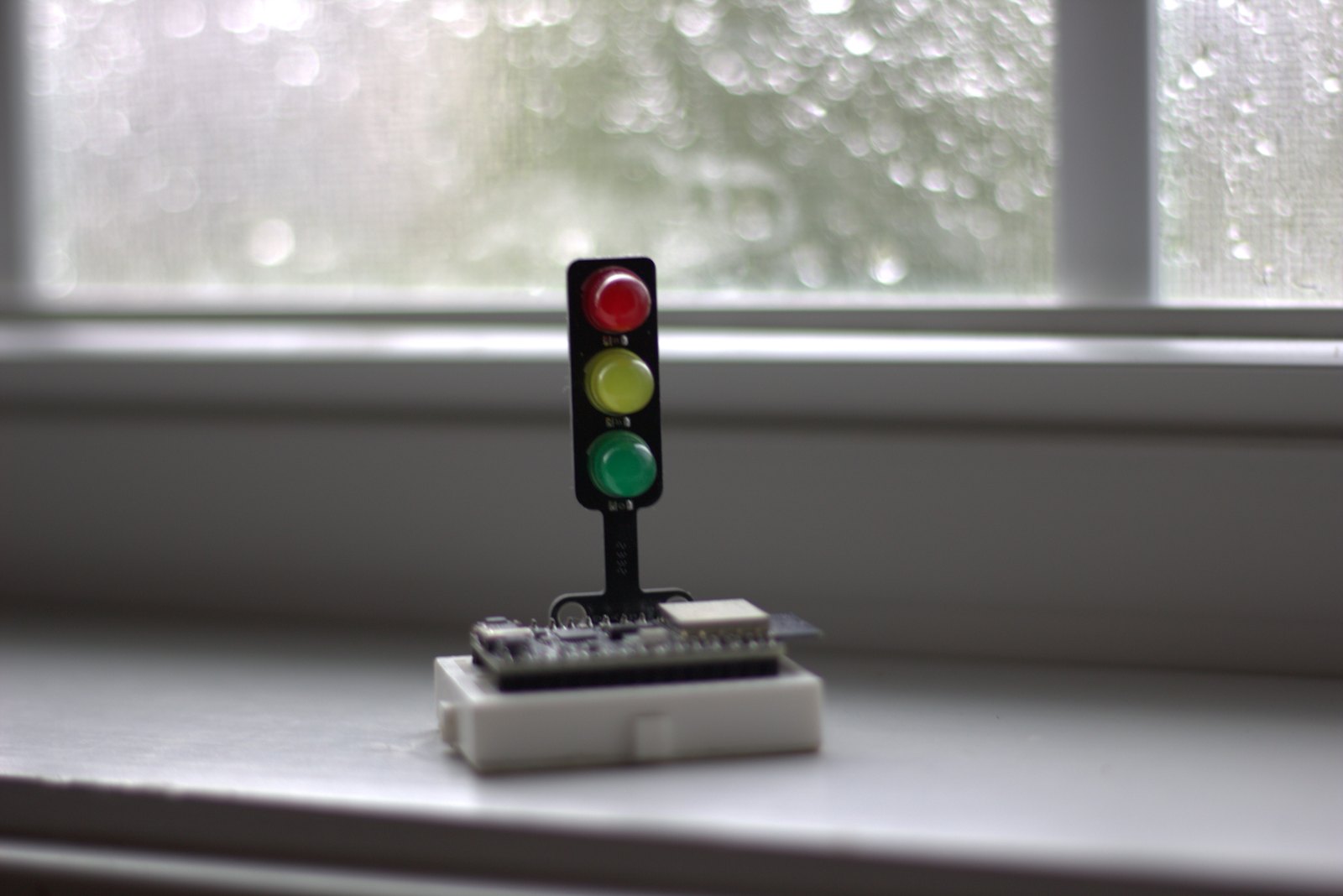
Image context: the cover uses a real ESP32-C3 device wired to a small traffic-light module rather than a flowchart, screenshot, or isolated product shot.[8] That is the right visual argument for this article. ESPHome's important boundary is not between YAML boxes on a whiteboard. It is between a high-level configuration language and the physical device that will have to boot, connect, expose entities, and survive updates in the field.
1. YAML is the interface, but code generation is the architecture
The core configuration docs describe ESPHome as the place where a node's name and base metadata are declared, but the more revealing details are the build-oriented ones.[1] build_path points to a generated PlatformIO project under .esphome/build/<NODE> by default, includes can copy local source files into that generated project, and compile-time environment variables can be supplied as part of the build process.[1] That is not the shape of a pure runtime interpreter. It is the shape of a system that uses YAML as a front-end language for producing device-specific firmware.
This distinction matters because it explains why ESPHome can feel simple at the top and opinionated underneath. A YAML entry is not just a preference knob. It becomes part of a compilation pipeline that validates configuration, expands substitutions, materializes component code, and emits a concrete firmware artifact.[1][3] The system is therefore closer to infrastructure-as-code for microcontrollers than to a thin configuration screen pasted over arbitrary binaries.
That compile-time bias is also why ESPHome scales better than its "home tinkering" reputation suggests. Once the configuration language is really a generator input, reuse stops being cosmetic. It becomes a way to keep many devices within one controlled build discipline.
2. Packages and substitutions are the fleet-management layer hiding in plain sight
The packages documentation is one of the clearest signals that ESPHome is not only for one-off boards on a hobbyist desk. Packages merge non-destructively with the main device config: dictionaries merge key by key, component lists merge by component ID when possible, other lists concatenate, and later values override earlier ones.[2] The substitutions system is applied before validation, supports templated expressions, and allows command-line values to override defaults.[3]
Taken together, those two features define ESPHome's real fleet boundary. A project can keep a shared base package for Wi-Fi, logging, OTA, API, or board defaults, then use substitutions to specialize names, pins, rooms, or hardware variants at build time.[2][3] That is an architectural move, not a convenience feature. It turns YAML from a device note into a layering system.
The design also sets limits. Because merge rules are explicit and ordered, maintainers have to think about where shared behavior belongs and where a single device should diverge.[2] That is healthier than a pile of copied files, but it still requires discipline. ESPHome helps most when a team recognizes that "just one more node" eventually becomes a configuration estate.
3. The native API keeps control local, but it makes memory a first-class budget
ESPHome's native API documentation is unusually candid about the hardware trade. The API uses a custom TCP protocol with protocol buffers, communicates directly with clients such as Home Assistant, and exposes several operational controls including batch_delay, listen_backlog, max_connections, max_send_queue, encryption, and reboot_timeout.[4] The crucial architectural detail is that some of these knobs are not abstract service settings. They are firmware-shaping constraints. The docs note that max_connections is compiled into the firmware, that connection slots are statically allocated, and that each active API connection consumes roughly 500 to 1000 bytes of RAM.[4]
That one paragraph explains a lot about ESPHome's worldview. The project is not hiding the device beneath a generic cloud transport. It is exposing a direct local protocol and asking the operator to respect the hardware envelope. On a larger ESP32 that can be a comfortable trade. On a smaller ESP8266-class board, it can become the difference between a stable node and a fragile one.[4]
This is why ESPHome should not be framed as "YAML instead of firmware engineering." It is firmware engineering with a more legible front end. The API layer proves it. The friendlier syntax does not repeal RAM accounting; it just moves more of that accounting into documented architecture choices.
4. OTA and safe mode define whether the system can recover from its own convenience
Remote updates are where configuration ergonomics either become operational leverage or operational debt. ESPHome's OTA docs state the basic promise directly: the ota component enables remote updating, exposes hooks like on_end and on_error, and automatically enables safe mode.[5] That last point matters most. A generated-firmware workflow becomes much riskier if every bad rollout requires physical recovery.
Safe mode is therefore not a side feature. It is the recovery contract that makes the compile-and-push model tolerable on real devices.[5] If YAML is the authoring surface and the native API is the local control plane, OTA is the maintenance path that keeps the whole system usable after deployment. Without that recovery story, ESPHome would be much closer to a lab tool than a platform for distributed hardware.
This also clarifies the adoption boundary. ESPHome is strongest when the operator wants locally controlled devices, accepts firmware-flash discipline, and can live within the explicit transport and memory budgets the project documents.[4][5] It is weaker when the problem demands broad dynamic reconfiguration without reflashing, or when the device estate is so heterogeneous that a shared YAML-and-package model no longer captures it cleanly.
Bottom line
The most useful way to read ESPHome in 2026 is not as a smart-home convenience layer that happens to emit firmware. It is as a compile-time architecture for small devices: YAML defines intent, substitutions and packages provide reusable layers, code generation produces the concrete project, the native API keeps communication local while making RAM costs visible, and OTA with safe mode keeps the resulting fleet recoverable.[1][2][3][4][5]
That design is why ESPHome remains compelling. It narrows the distance between high-level configuration and embedded deployment without pretending the hardware constraints disappeared. If you want local-first device control with an opinionated build pipeline, that is a strength. If you want the runtime flexibility of a thicker software platform, ESPHome's architecture will feel narrower by design.
Sources
- ESPHome Docs, "ESPHome Component" - core node configuration, generated
build_path,includes, and build-time environment variables. - ESPHome Docs, "Packages" - merge rules, package layering, and remote-package reuse patterns.
- ESPHome Docs, "Substitutions" - pre-validation substitution expansion, templated expressions, and command-line overrides.
- ESPHome Docs, "Native API Component" - direct TCP/protobuf transport, compile-time connection limits, queue settings, and per-connection RAM costs.
- ESPHome Docs, "OTA Updates" - remote-update flow, safe mode, and OTA lifecycle hooks.
- GitHub API,
esphome/esphomerepository metadata snapshot - stars, forks, open issues, and recent push activity at article creation time. - GitHub,
esphome/esphomereleases - current release stream including2026.4.4. - Wikimedia Commons, "File:ESP32-C3 with Traffic Light Module.jpg" - source page for the real ESP32-C3 device photograph used as the article image.