CPAN is easy to file as a period artifact: the 1990s archive that let Perl programmers share tarballs before "package registry" became a product category. That reading misses the part still worth studying. The Comprehensive Perl Archive Network has been online since October 1995, and the current front page reports tens of millions of indexed module entries across 47,386 distributions from 14,710 authors.[1] The important signal is not only age. It is that CPAN made a social archive behave like installable infrastructure.
That does not happen by letting everyone throw files into one large directory. CPAN's durable trick is a governance stack: PAUSE gives authors identities and upload directories; the indexer decides which package names point to which releases; metadata gives tools a machine-readable contract; CPAN Testers turns installation failure into public feedback; MetaCPAN makes the archive searchable and queryable beyond the raw mirror tree.[2][3][4][5][6] Read this way, CPAN is not nostalgia. It is an early, still-running answer to a modern package-ecosystem question: how much governance can be encoded in boring files, permissions, and volunteer-operated services before a registry needs a corporate control plane?
PAUSE Is The Gate, CPAN Is The Mirror
The first boundary is the one most outsiders blur. CPAN is the mirrored archive. PAUSE, the Perl Authors Upload Server, is where authors upload work and where package indexing authority is enforced. The PAUSE contributor guide describes author directories under authors/id/, password-protected upload access, registration through a PAUSE account, and a rule that code uploads need versioned filenames because identical code archive names cannot simply be overwritten.[2]
That upload rule sounds small until you treat it as operational governance. A release archive becomes a durable artifact, not a mutable blob. Documentation files have an overwrite exception, but ordinary code distributions are pushed toward versioned, append-only behavior.[2] That does not solve every supply-chain problem, and it does not make every CPAN distribution healthy. It does give the ecosystem a base invariant: package history is supposed to move forward by new releases, not by silently replacing a prior archive under the same name.
The second boundary is identity. The PAUSE operating model says a contributor gets a PAUSE account, an author directory, and a cpan.org email address, while PAUSE admins approve account requests and may revoke accounts for behavior that works against CPAN's interests.[3] That is a lightweight model compared with modern registry identity programs, but it is not identity-free. Uploads sit under accountable author IDs, and the administrative surface is explicit enough that disputes have a place to land.
The Index Is Where Ownership Becomes Real
The governance heart is not the file upload. It is the CPAN Index. PAUSE unwraps uploads, scans Perl package declarations in source files, and decides whether package names in a distribution should be indexed for the uploading author.[2] The operating model is even more direct: most users will not install a module unless it appears in the CPAN Index, and PAUSE has ultimate control over what goes into that index.[3]
That distinction matters because package ecosystems often confuse hosting with authority. PAUSE allows an author to upload files to an author directory, but indexing permissions decide whether those files become the current installable answer for a package name. The operating model describes indexing permissions as tuples of package name, PAUSE user ID, and permission type. It also names three permission types: first-come, co-maint, and admin.[3]
That is a compact governance system. The first uploader of a package can receive first-come indexing permission. Co-maintainers can be granted the ability to release indexed versions. Admin-level permissions can help manage ownership. If a package appears inside a release but the uploader lacks appropriate indexing permission, the upload can exist without becoming the indexed release for that namespace.[3] The result is not perfect safety, but it creates a sharper rule than "whoever uploaded most recently wins."
This is the CPAN lesson that still travels. The namespace is a shared commons, but the authority to update a namespace is not the same as the right to host files. Healthy registries need that split. Without it, abandoned-package rescue, accidental namespace collision, hostile takeover, and ordinary maintainer succession all collapse into one overloaded policy problem. CPAN's answer is old-fashioned, but the shape is modern: separate artifact storage from name-to-artifact authority.
Metadata Makes The Archive Toolable
The third layer is metadata. CPAN::Meta::Spec defines distribution metadata: the data a distribution publishes about itself so installers, search systems, dependency tools, and humans can reason about it in a consistent way.[4] This is where CPAN moves from archive to ecosystem. A pile of tarballs is storage. A pile of tarballs with dependency metadata, version declarations, license fields, resource links, and release structure becomes something tools can plan around.
The spec matters because Perl has historically tolerated many ways to build, test, and install software. That flexibility is powerful and exhausting. Metadata gives the toolchain a shared surface even when build systems and author habits vary. A client does not need to infer every relationship from prose. It can read the metadata contract, resolve dependencies, understand phases, and expose release details to the user.
The PAUSE guide also lists the old index files that CPAN clients consume, including modules/02packages.details.txt.gz, modules/03modlist.data.gz, and modules/06perms.txt.gz.[2] Those filenames are not glamorous, but they are the point. CPAN works because some of its core governance is legible as files that mirrors, clients, and search services can consume. The registry is not only a website. It is a set of stable data products.
That should sound familiar to anyone maintaining modern dependency infrastructure. The hard part is rarely one API endpoint. It is the compact between producers, indexers, mirrors, installers, security scanners, search tools, and users. CPAN's compact is less centralized and less polished than newer registries, but it demonstrates the same principle: once metadata and indexes become part of the public contract, operational behavior can grow around them.
Testers Turn Failure Into A Public Signal
CPAN Testers adds a different kind of governance. It is a network of contributors testing uploads to CPAN, and its front page points readers to report APIs for the data behind those tests.[5] That is not the same as a mandatory CI gate. CPAN does not make every release prove green across every Perl version, operating system, library stack, and architecture before publication. Instead, CPAN Testers creates a public after-market of compatibility evidence.
The distinction is useful. A strict pre-publish gate can become too slow or too centralized for a volunteer ecosystem. No gate at all leaves users alone with failures. CPAN Testers sits between those extremes. It lets a release enter the archive, then turns distributed installation attempts into reportable evidence. Maintainers get feedback they could not have generated alone. Users get a way to inspect whether a distribution seems healthy on the platforms they care about.
There is an honest limitation here. Volunteer test coverage is uneven, and a public report stream does not guarantee maintenance. The CPAN Testers site itself notes that some historical features are still missing after infrastructure changes.[5] But that imperfection is also the governance signal: CPAN's quality system is not a single corporate dashboard. It is a loose feedback loop that survives because the reporting surface is public, reusable, and useful enough for people to keep feeding it.
Search Is A Layer, Not The Archive
MetaCPAN completes the modern picture. Its API repository describes a free web service that provides metadata for CPAN modules, built around a RESTful interface and Elasticsearch-backed queries.[6] That makes MetaCPAN a discovery and data layer on top of CPAN, not a replacement for CPAN itself. The PAUSE guide makes the same separation: search engines such as MetaCPAN use PAUSE-generated indexes and other heuristics to help developers find modules.[2]
This separation is healthy. The archive can remain conservative. The search layer can iterate. The index can stay authoritative while discovery tools build richer ranking, author pages, release pages, documentation views, API responses, and metadata exploration. If a search system changes, the underlying upload and indexing model does not have to be reinvented. If the archive remains stable, discovery can improve without turning every improvement into a registry migration.
Modern ecosystems often bind these surfaces together too tightly. The hosting UI, download endpoint, trust policy, search algorithm, metadata API, and maintainer account system become one product. That can be convenient, but it also concentrates failure and governance. CPAN shows another shape: smaller pieces, old protocols, mirrored files, separately operated services, and enough shared contract for the pieces to cooperate.
The Durable Lesson
CPAN's governance signal is not that every decision was designed perfectly in 1995. It is that the ecosystem put authority in places where tools could see it. Author IDs are visible. Versioned uploads are visible. Package ownership and co-maintenance are visible through index permissions. Metadata is visible. Test reports are visible. Search and API services are allowed to grow from those surfaces.
For teams building or selecting internal registries, that is the useful lesson. Do not start with the prettiest portal. Ask where upload authority lives, whether files are mutable, how package names map to current releases, how co-maintenance and takeover work, what metadata clients can trust, whether compatibility failures become shared evidence, and whether search is coupled to the storage layer. CPAN's answers are not the only answers. They are durable enough to make the questions sharper.
The archive's age is therefore not the main story. The main story is that CPAN made a volunteer package commons installable by treating governance as a set of indexable facts. That is less romantic than Perl mythology, and much more useful.
Sources
- CPAN, "The Comprehensive Perl Archive Network" front page, used for archive age, current distribution/author counts, and CPAN's search entry point.
- CPAN, "PAUSE" contributor and indexing guide, covering author upload directories, versioned filenames, PAUSE-vs-CPAN roles, index files, and MetaCPAN as a search layer.
- PAUSE, "The PAUSE Operating Model," defining PAUSE principles, account approval, the CPAN Index, indexing permissions, and first-come/co-maint/admin roles.
- Perldoc,
CPAN::Meta::Spec, documenting the metadata specification for CPAN distributions. - CPAN Testers, front page, describing the contributor testing network for CPAN uploads and report APIs.
- MetaCPAN,
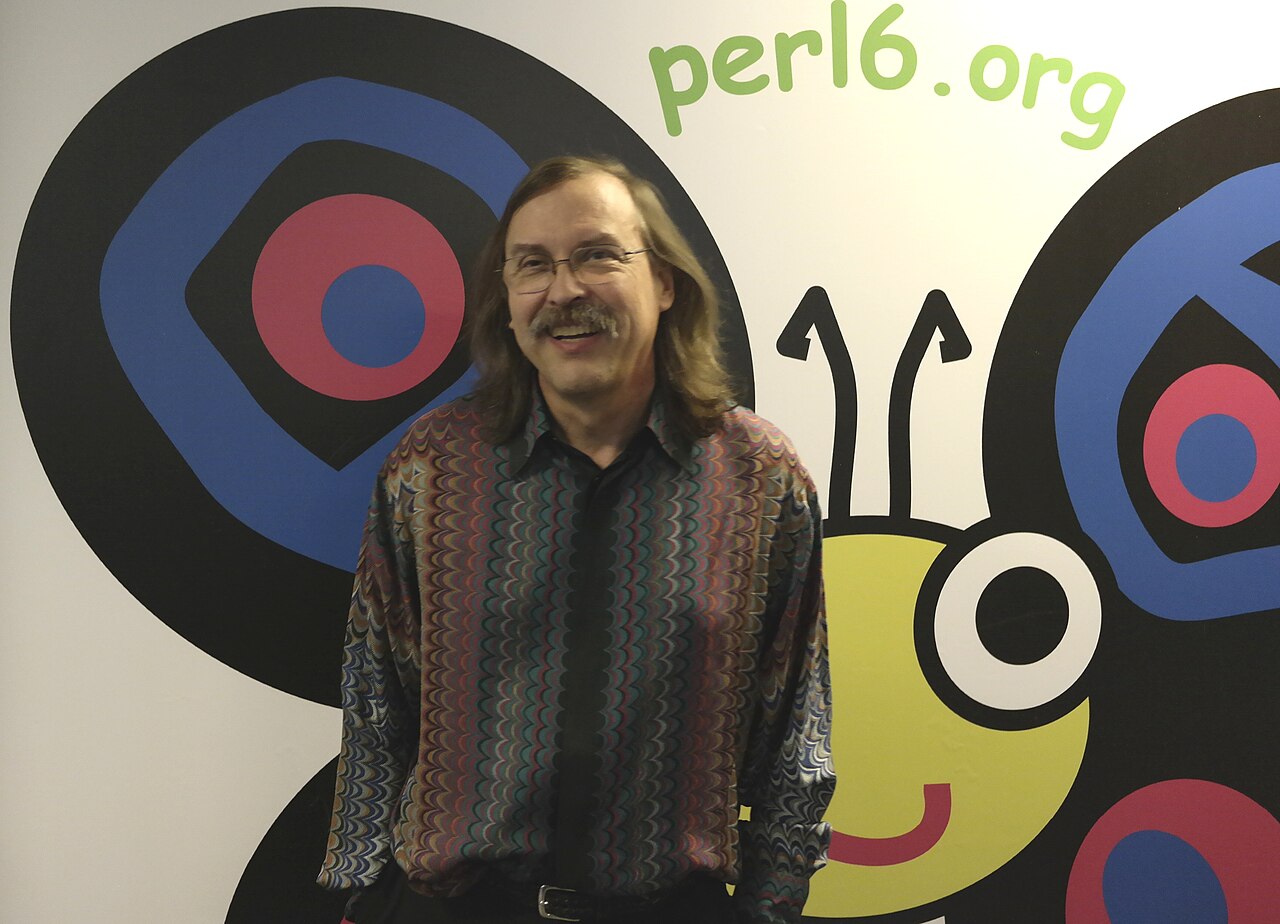
metacpan-apirepository README, describing MetaCPAN as a free web service for CPAN module metadata with REST and Elasticsearch-backed queries. - Wikimedia Commons, "FOSDEM 2015 Larry Wall and Camelia the Perl6 logo" photograph, used as the article image source.