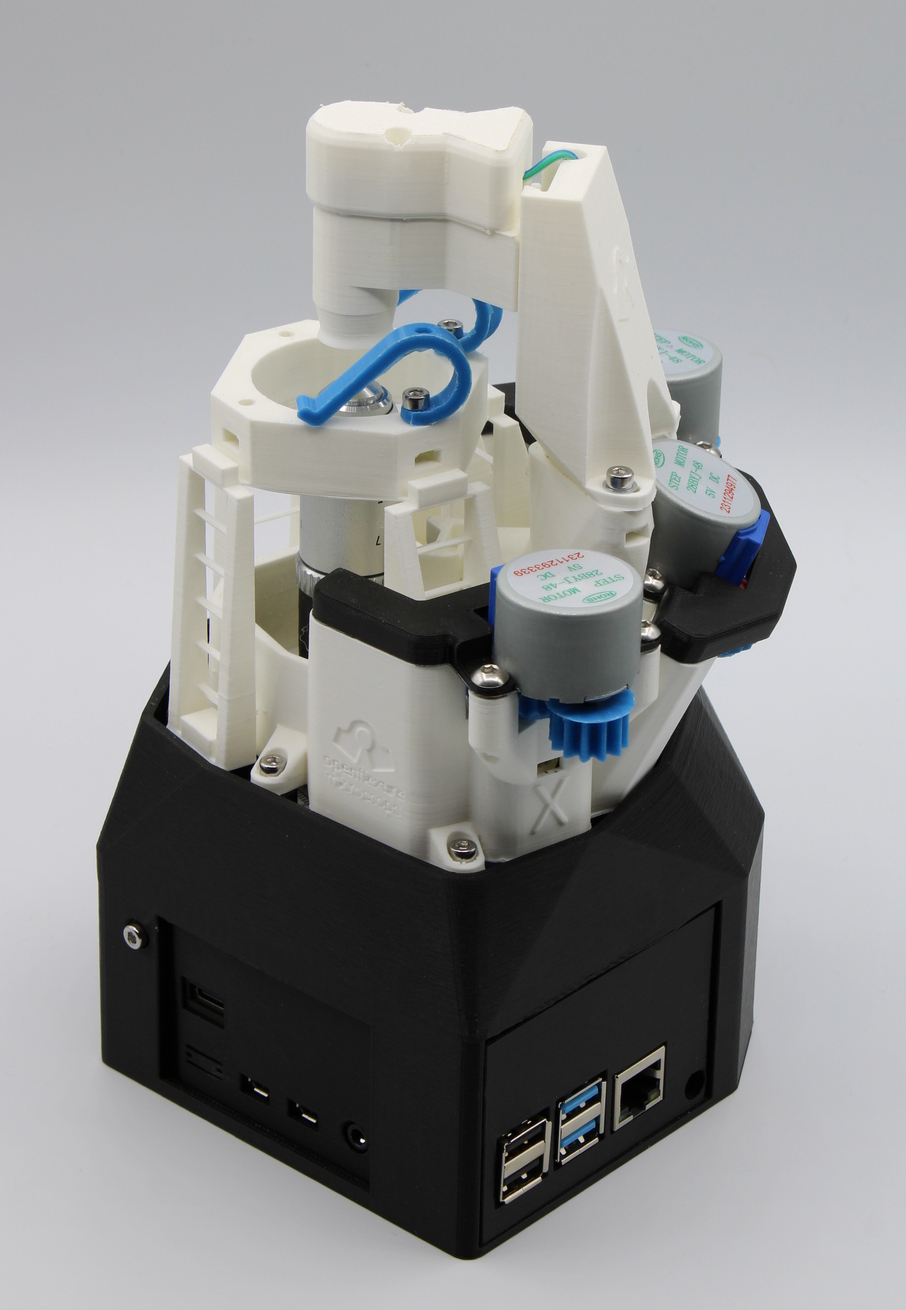
OpenFlexure is easiest to underrate if it is filed as "a 3D-printed microscope." The printed body is visible first, but the project is more interesting as an instrument stack: a flexure stage that turns plastic into precise motion, optics modules that let the same frame serve different imaging jobs, Raspberry Pi-based control software, assembly documentation, and public source repositories that make repair and modification part of the design rather than an afterthought.[1][2]
That makes OpenFlexure a useful open-source project even for people who will never print one. Most OSS infrastructure asks whether a team can inspect, run, and patch software. OpenFlexure asks the same question about a scientific instrument. Can the motion system be understood? Can the optics be swapped? Can the software be scripted? Can the build be repeated from public documentation? Can a lab fix the tool without waiting on a vendor supply chain? The project matters because it treats those questions as one system.
The Print Is Not The Product
The official overview describes the OpenFlexure Microscope as a customizable open-source optical microscope that can use either low-cost webcam optics or laboratory-grade RMS-threaded microscope objectives. It uses inverted optical geometry and a high-precision mechanical stage that can be motorized with inexpensive geared stepper motors.[1] That is the important boundary: the print is not a novelty enclosure around commodity parts. It is the mechanical logic of the instrument.
The flexure mechanism is the core trick. Instead of relying on sliding surfaces, bearings, or machined rails, the stage uses compliant plastic geometry. The overview says the design achieves steps well below 100 nanometers when driven by miniature steppers and remains stable within a few microns over several days.[1] The 2020 Biomedical Optics Express paper gives a more specific engineering frame: the mechanism provides three-axis positioning with low nanometer-scale step sizes, 12 x 12 x 4 mm travel, and a compact high-resolution automated configuration around 15 x 15 x 20 cm and roughly 500 g.[4]
Those numbers do not make OpenFlexure equivalent to every commercial microscope. They explain why it is not a toy. A microscope becomes useful when sample motion, focus, optics, illumination, and imaging can be trusted together. If the stage jitters or drifts unpredictably, the camera and lens cannot rescue the instrument. OpenFlexure puts the hardest part of low-cost microscopy into a public mechanical design that can be printed, inspected, and revised.
Optics Stay Swappable On Purpose
OpenFlexure's second useful design choice is refusing to pretend that one optical path is enough. The public build instructions split the microscope into configurations: a high-resolution motorized build using a traditional microscope objective, a motorized low-cost optics version using a Raspberry Pi camera module lens, an upright microscope for samples that cannot be inverted, and a manual version for education or low-cost digital use.[3]
That range is not just product-menu variety. It is the project acknowledging that "microscope" is not one workload. A classroom build, a field lab, a research prototype, and an automated slide-scanning experiment all have different constraints. The paper describes interchangeable optics modules, bright-field imaging, epi-illumination, polarization contrast, and fluorescence options.[4] The official site also notes printable filter cubes for reflection illumination, polarization contrast, and fluorescence.[1]
The practical adoption lesson is to choose the optical contract before choosing the print. If the goal is teaching, the low-cost optics path may be the right proof of value. If the goal is reliable laboratory imaging, the high-resolution RMS-objective path is the serious baseline. If the sample cannot be turned upside down, the upright configuration matters more than the elegance of the default geometry. Open hardware is useful only when the user can map the design to the actual experiment.
Software Turns It Into An Instrument
The most important correction to the "printed microscope" label is the software layer. The microscope server repository says the server is responsible for hardware control, data management, and local or network control. It also states that the simplest setup path is a pre-built Raspberry Pi SD card image with the server and dependencies installed, with a web interface normally reachable on port 5000.[6]
That shape is sensible. The Raspberry Pi sits close to the hardware. The server owns camera settings, stage movement, calibration state, and capture behavior. A user can then control the microscope through OpenFlexure Connect or a browser rather than treating the instrument as a pile of scripts.[6] The 2020 paper describes the software as split between a server running on the microscope and client applications over a network, with plugin-based functionality for things beyond stage movement, image capture, and hardware configuration.[4]
This is where OpenFlexure becomes more like serious OSS infrastructure. The server has configuration files, dependency choices, development instructions, tests, formatting tools, release tags, and extension points.[6] That may sound mundane compared with the hardware, but mundane is the point. A scientific instrument that cannot be configured, updated, debugged, or extended repeatably is fragile even if the mechanics are clever.
The arXiv paper on OpenFlexure Voice Control and OpenFlexure Blockly makes the same point from the user-interface side. It treats the OpenFlexure family as a smart-control system and explores hands-free control plus drag-and-drop scripting for laboratory hardware.[5] Whether or not those interfaces are the right fit for a given lab, they reveal the project direction: the microscope should be controllable by people who need repeatable experiments, not only by developers comfortable writing bespoke hardware scripts.
Build Docs Are Part Of The Architecture
For many open-source hardware projects, the weak link is not the license or the CAD files. It is the handoff from files to working object. OpenFlexure's build documentation is therefore part of the project architecture. The current assembly site offers separate paths for high-resolution, low-cost, upright, and manual microscopes; it also points users toward source files, STL artifacts, customization pages, and GitLab for ongoing development.[3]
The hardware repository reinforces that release discipline. Its README describes editable instructions, source files, OpenSCAD development, GitLab CI builds, generated STL files, and a release flow where tagged releases update the "latest" build server target only when semantic-version requirements are met.[2] That is a software-style release model applied to plastic, optics, and instructions.
This matters because physical reproducibility has more failure modes than software reproducibility. A package install can fail because a dependency changed. A printed instrument can fail because the printer, filament, tolerances, hardware sourcing, lens choice, motor controller, or assembly step drifted from the tested path. Good documentation does not remove those risks. It makes them visible enough that builders can know whether they are following a supported configuration or inventing a variant.
Local Maintenance Is The Point
The strongest social claim around OpenFlexure is local maintenance. The 2020 paper says the team produced more than 100 microscopes in Tanzania and Kenya for educational, scientific, and clinical applications, and argues that local manufacturing can be a viable alternative to costly and slow international supply chains.[4] The same paper describes design choices aimed at reducing assembly time, easing component sourcing, and allowing broken printed parts to be replaced locally.[4]
That is the open-source value proposition in its hardest form. It is not only "the files are public." It is "a community can understand enough of the instrument to build, maintain, and adapt it." The distinction is crucial. A public repository does not automatically create capacity. Capacity arrives when the project has readable documentation, realistic bills of material, repairable modules, community channels, release artifacts, and a design that tolerates the imperfect conditions of real labs.
OpenFlexure is not the right answer for every microscopy workflow. Commercial instruments still win when a lab needs certified service contracts, specialized objectives, automated pathology-scale throughput, regulatory packaging, or integration with existing clinical systems. A builder also needs access to decent 3D printing, suitable optics, calibration discipline, and time to validate results. The conservative pilot is not "replace the lab microscope." It is "build one supported configuration, image a known sample, compare results against a trusted instrument, and document every deviation."
That is exactly why the project is worth watching. OpenFlexure turns a microscope from a purchased black box into a set of reviewable boundaries: printed flexure mechanics, interchangeable optics, motorized stage control, camera pipeline, server API, build artifacts, and local repair practice. Read that way, the project is not only about cheaper microscopy. It is about making scientific instrumentation behave more like open infrastructure.
Sources
- OpenFlexure Project, "OpenFlexure Microscope" - official project overview covering the customizable microscope, inverted geometry, flexure stage, optics choices, motorization, and photo source context.
- OpenFlexure,
openflexure-microscopeGitLab repository - hardware design README, source files, release flow, license, related repositories, and build process. - OpenFlexure, "Assembly Instructions" - current build documentation for high-resolution, low-cost, upright, and manual microscope configurations.
- Joel T. Collins et al., "Robotic microscopy for everyone: the OpenFlexure microscope," Biomedical Optics Express 11(5), 2020 - open-access paper on design, positioning, imaging, software, distributed manufacturing, and local production.
- Samuel McDermott et al., "Controlling and scripting laboratory hardware with open-source, intuitive interfaces: OpenFlexure Voice Control and OpenFlexure Blockly," arXiv, 2022/2023 - interface and scripting paper for OpenFlexure laboratory hardware.
- OpenFlexure,
openflexure-microscope-serverGitLab repository - microscope server README covering hardware control, data management, web control, Raspberry Pi setup, configuration files, development workflow, and plugins. - OpenFlexure Project, "v7_complete.jpg" - official real photograph of the OpenFlexure Microscope used as the article image.