Many teams first meet Consul through one feature name: service discovery. That description is true and still too small. The official docs describe something more structural. Consul works by putting a local agent next to workloads, collecting registrations and health information there, then projecting a shared view of healthy services through a centrally queryable catalog exposed over DNS and HTTP API.[1][3] Read that way, Consul stops looking like a registry appliance and starts looking like a distributed control plane whose real trick is keeping node-local knowledge close to the workload while making cluster state legible everywhere else.
That framing matters in 2026 because the product surface has widened without changing the underlying wager. The introduction pages still describe service discovery, service mesh, traffic management, and network automation as features that can be used separately or together, but they all depend on the same architecture: local agents at the edge, servers holding durable cluster state, and a catalog that becomes the source of truth for service identity and health.[1][2] As of 2026-05-13T17:04:59Z UTC, the GitHub API reports 29,889 stars, 4,591 forks, 1,382 open issues, and a most recent push at 2026-05-13T14:44:10Z for hashicorp/consul; the tags API also shows an active line that includes v1.22.7 plus a visible v2.0.0-rc1 release candidate.[9][10] Mature project, still moving.
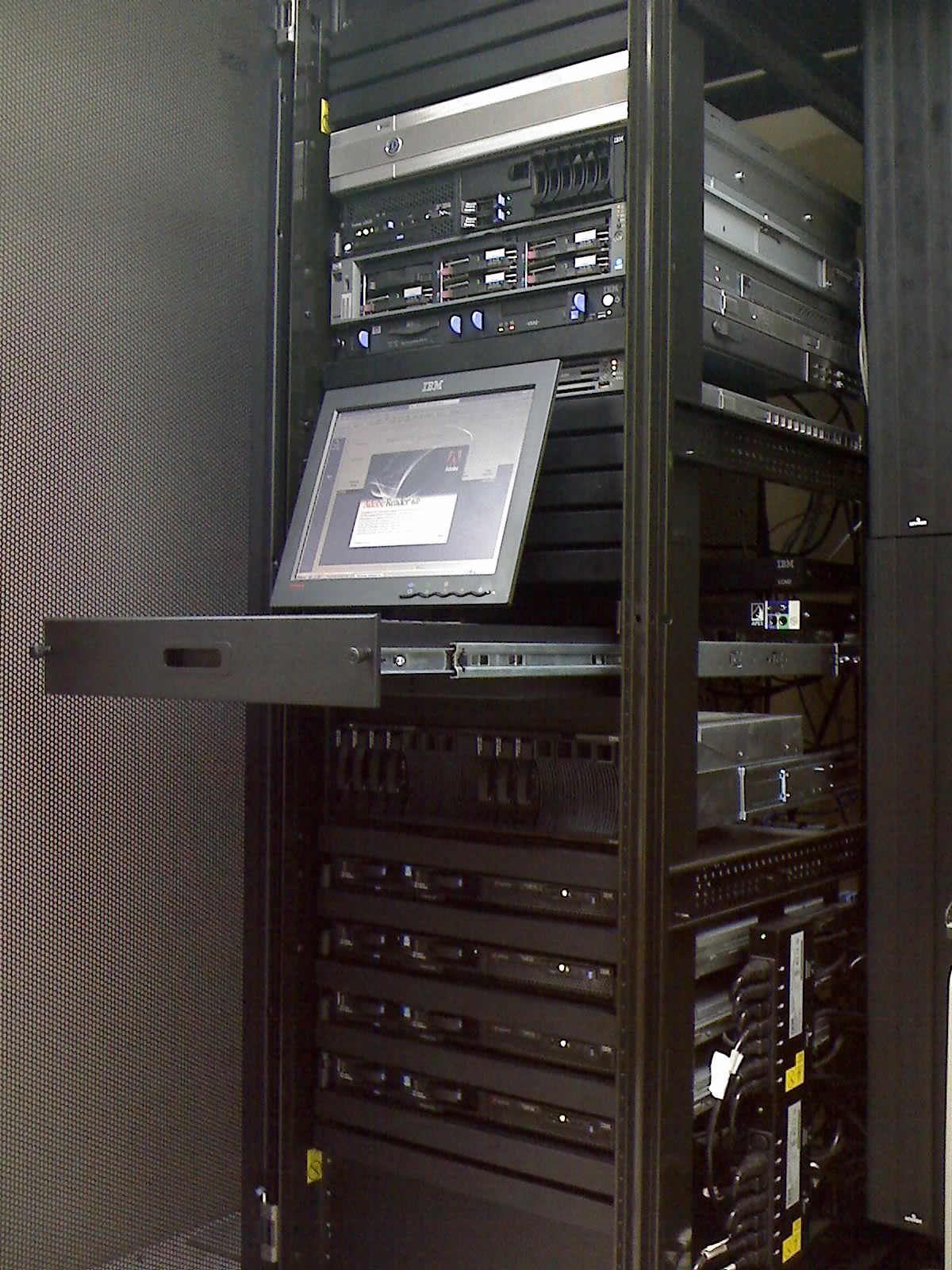
Image context: the cover uses a real server-rack photograph rather than a dashboard screenshot or network diagram.[8] That is the right visual choice because this article is about placement and boundaries: the control plane feels abstract only until you remember that every registration, cache, and failure signal starts on a machine somewhere.
The local agent is the product surface most operators actually live on
The easiest architectural mistake is to picture Consul as a set of servers that applications talk to directly. The docs push a different mental model. Service discovery begins with an identity-based service catalog, but the operational unit closest to the workload is the agent running on the same node.[1][3] Health checks, service definitions, DNS lookups, HTTP API calls, and proxy configuration all flow through that local process rather than requiring every workload to speak to a remote server first.[3][6][7]
That matters because it explains why Consul feels practical in mixed estates. The local agent is the adapter between whatever the workload is doing and whatever the cluster needs to know. A service can register locally, health can fail locally, and when the node dies the rest of the cluster marks the node failed and updates the catalog accordingly.[3] The control plane is distributed in an uneven but deliberate way: edge agents absorb local churn, while servers retain the durable shared record.
Once you see that split, several design choices make more sense. DNS and API queries against the catalog are simple for consumers because the catalog is centralized enough to answer consistently, but the burden of watching workloads is pushed outward to agents.[1][3] Consul does not try to erase host boundaries. It formalizes them.
Gossip decides who is present; Raft decides what is durable
The second key boundary is between liveness information and durable catalog state. Consul's gossip documentation says it uses the Serf gossip protocol to manage membership and broadcast messages within cluster operations, with separate LAN and WAN gossip pools available to the system.[4] Gossip is fast, weakly consistent, and well suited to telling the cluster which agents appear alive, which datacenters are reachable, and when failure suspicion should begin propagating.[4]
That is not the same job as storing the canonical catalog. The architecture docs are explicit that Consul servers keep the record of agent and service state using the Raft protocol, which generates a Raft index that must persist across reboots, and the current backend logs that index with a write-ahead log LogStore implementation.[2] In other words, gossip answers the question "who seems to be here right now?" while Raft answers "what cluster state are we willing to commit and recover later?" Mixing those questions is where many mental models of Consul go soft.
This division is why Consul can stay responsive without pretending every read has identical semantics. Membership can move quickly through gossip, but the catalog ultimately becomes authoritative only when the server side commits state durably.[2][4] The architecture is not one flat consistency plane. It is layered on purpose.
The catalog is central, but Consistency Modes make that centrality negotiable
Consul's own API docs are unusually candid about the tradeoff surface. Every HTTP read uses a consistency mode, and operators can choose among modes that shift the balance between freshness and performance.[5] The API even exposes the effective choice through the X-Consul-Effective-Consistency header so callers can see whether a query was served in leader/default/stale form.[5]
That is an important architectural tell. A system that documents consistency modes this plainly is telling you that the catalog is central, but not magical. You are allowed to pay less for some reads when absolute freshness is not required. The service catalog remains the source of truth, yet the path to that truth can be tuned.[1][5] For day-to-day engineering, this means Consul is strongest when teams know which reads are on the critical correctness path and which ones are allowed to trade a little freshness for lower cost or lower latency.
It also means the real operational boundary is not "Do we have a catalog?" The harder question is "What semantics do our clients assume when they query it?" Consul gives you a coherent answer, but not a free one.[5]
Service mesh keeps the data path off the servers and close to the workload
The same edge-first pattern shows up again in Connect. Consul's service-mesh docs describe sidecar proxies running on the same node as the service instance they represent, while the local agent can expose a gRPC xDS API that feeds Envoy configuration to those proxies.[6][7] The control plane therefore stays close to the workload twice: once through the regular agent used for service discovery, and again through local proxy configuration for mesh traffic.
This is why the Consul process does not need to sit inline in application traffic. The broader architecture docs say the Consul process itself does not run directly in the data plane; sidecars and gateways do that work when mesh features are enabled.[2] The deeper data-plane architecture page adds another useful detail: service-mesh-related data such as CA roots, leaf certificates, service intentions, and upstream discovery results are cached on demand in the local agent, partitioned by ACL token and datacenter.[6] That is a practical design, not just a security one. It keeps repeated mesh lookups off the servers and makes the local agent a short-distance control surface rather than a dumb forwarder.
The built-in CA and mTLS story often get the headline, and they matter.[6] Architecturally, the more interesting point is that Consul keeps reusing the same placement logic: local agent near workload, durable coordination on servers, specialized proxies in the actual traffic path.[2][6][7]
The hard boundary is operational discipline, not feature count
So the cleanest way to understand Consul in 2026 is not as "a registry plus some mesh features." It is a distributed system that asks you to accept three constraints in exchange for a clean control surface:
- You run a local agent wherever you want service discovery and mesh control to feel close to the workload.[3][6][7]
- You keep server quorum and persistent state healthy because the durable catalog still lives behind Raft and WAL-backed storage.[2]
- You choose consistency modes deliberately because some reads are allowed to be cheaper than others, and Consul will not hide that tradeoff from you.[5]
That boundary is narrower than marketing language sometimes suggests, and that is exactly why the design still holds together. Consul works best when teams want one control plane for healthy-service discovery, policy-aware connectivity, and multi-runtime placement, while remaining willing to operate agents everywhere and maintain a disciplined server core. If what you want is pure remote registry simplicity with no local process model, Consul will feel heavier than it first looks. If you accept the agent-first contract, the architecture becomes much easier to reason about.
Sources
- HashiCorp Developer, "What is Consul?" - service networking overview, identity-based service catalog, and DNS/API query surface.
- HashiCorp Developer, "Consul architecture" - control-plane/data-plane split, Raft-backed state, WAL LogStore backend, and network tomography overview.
- HashiCorp Developer, "Configure a Consul agent" - local agent responsibilities, graceful leave behavior, and catalog updates after node failure.
- HashiCorp Developer, "Gossip" - Serf-based cluster membership, message broadcast, and LAN/WAN gossip pools.
- HashiCorp Developer, "Consistency Modes" - leader/default/stale tradeoffs and the
X-Consul-Effective-Consistencyresponse header. - HashiCorp Developer, "Consul service mesh" - built-in CA and mTLS model, on-demand local-agent caching, and partitioning by ACL token and datacenter.
- HashiCorp Developer, "Service mesh proxy overview" - local-agent xDS configuration for Envoy and the role of sidecar and gateway proxies in the mesh.
- Wikimedia Commons, "Rack001.jpg" - source page for the server-rack photograph used as the article image.
- GitHub API,
hashicorp/consulrepository metadata - stars, forks, open issues, and recent push/update activity at article creation time. - GitHub API,
hashicorp/consultags list - current release/tag visibility includingv1.22.7andv2.0.0-rc1at article creation time.