Most teams do not actually need a giant search platform. They need a search bar that stays fast while people type, forgives small spelling mistakes, filters cleanly on structured fields, and does not force the application team to become part-time information-retrieval specialists. Typesense is worth reading in that narrower frame. Its own positioning is blunt: an open-source, typo-tolerant search engine optimized for instant sub-50ms searches with an intuitive developer experience.[1] The useful project-introduction question in 2026 is not whether that sounds attractive. It is whether the project's query model, hybrid-search additions, and clustering story make it a realistic middle ground between "simple search bar" and "full analytics/search platform."
As of 2026-05-12T20:36:17Z UTC, the GitHub API reports that typesense/typesense has 25,813 stars, 885 forks, 798 open issues, and a most recent push timestamp of 2026-05-12T06:51:36Z.[6] The latest tagged release is v30.2, published on 2026-04-19; the release feed also shows v29.1 published the same day, which is a useful signal that multiple release lines are still being maintained in public.[7] Those numbers do not prove fit on their own. They do show that Typesense is not a sleepy side project. It is an active engine with a live operational and release surface.
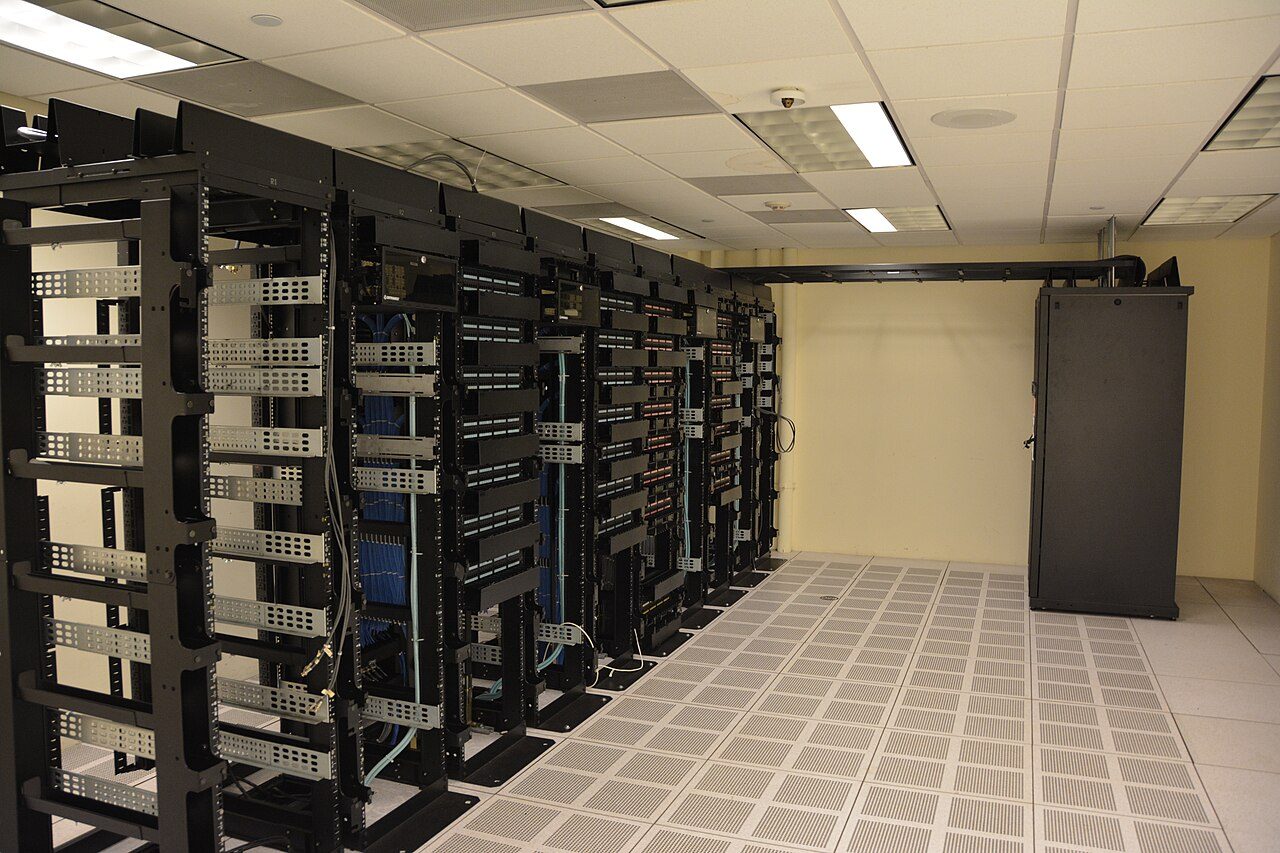
Image context: the cover uses a real data-center rack photograph rather than a portrait or search-box mockup. That choice fits the article because Typesense is interesting as operating infrastructure: fast keyword search, typo tolerance, facets, vector retrieval, and clustering all held inside one engine rather than split across several systems.[10]
One search request can hold more of the product surface than most teams expect
The strongest immediate signal appears in the search API itself. Typesense describes search as a query against one or more text fields plus a list of filters against numerical or facet fields, with sorting and faceting available in the same request surface.[2] In practice that means the core verbs are explicit and legible: query_by decides which text fields matter, filter_by narrows on structured values, facet_by returns counts for navigation, and sort_by decides how business ordering should coexist with textual relevance.[2]
That explicitness is a bigger advantage than it first sounds. Many search engines feel simple only until relevance tuning, category filtering, and ranking policy start leaking into separate subsystems. Typesense keeps those concerns in one request grammar. The special _text_match field is even exposed for sorting and tie-breaking, which makes it easier to decide when raw relevance should win and when a product rule should step in.[2]
Read together, the docs suggest a search engine built for user-facing applications rather than for general data spelunking. Typesense wants the application team to declare its searchable fields, filterable fields, facet fields, and ranking behavior upfront. That is opinionated in a good way. It prevents the system from pretending every field should be queryable, sortable, and aggregatable by default.
Typo tolerance is the headline, but the real story is where the engine refuses magic
The project's public identity starts with typo tolerance, and the docs explain why. Prefix search is enabled by default, so search-as-you-type behavior works naturally as users enter partial terms.[3] Typo correction is also built in, but not as an unbounded fuzziness machine. The FAQ says Typesense limits typo tolerance to 2 typos, and its infix-search guidance is even more revealing: if you want matches in the middle of strings, you must explicitly enable infix behavior per field because it is CPU intensive and requires additional memory.[3]
That boundary matters. Typesense is trying to make ordinary product search forgiving without pretending arbitrary substring search is free. This is the right trade for most user-facing search boxes. Product names, people, songs, docs, and articles benefit from prefix matching and typo correction. They do not usually need every field to behave like a generic grep surface over millions of records.
The filtering and sorting docs make the same engineering temperament visible elsewhere. Faceting has to be enabled in the collection schema before it can be used in facet_by, and sorting on string fields is only allowed when that field has sort enabled. The docs explicitly warn that string sorting requires a separate index and can consume a lot of memory for long strings or large datasets, so only relevant string fields should be made sortable.[2] That is not a glamorous feature note. It is the kind of boundary that keeps an application-search engine honest.
Hybrid retrieval is now first-class, but it still behaves like an extension of search, not a separate product
The 2026 Typesense story would be incomplete if it stopped at keyword search. The semantic-search guide shows that the engine now supports built-in machine-learning models and external services such as OpenAI, PaLM API, and Vertex AI for embedding generation.[4] More important than semantic search alone is the hybrid path. Typesense lets teams combine keyword fields and embedding fields in the same query_by clause, returning both text matches and semantic matches in one result set.[4]
That is the most interesting architectural move in the project right now. Typesense is not merely bolting on a vector sidecar and calling it modern. It is treating semantic retrieval as an extension of the same search engine contract. The guide even exposes rerank_hybrid_matches: true for teams that want both text and vector scores computed across all matches, at the cost of more computation.[4]
The boundary is equally important to preserve. The docs note that built-in models are computationally intensive, and that even a few thousand records can take tens of minutes to embed and index without GPU acceleration.[4] If a team uses remote embedding services, that pressure moves to the external provider; if it uses built-in models, hardware planning comes back into scope.[4] So the project is not promising free AI search. It is promising that keyword search and semantic retrieval can live behind one query and indexing surface when a team is willing to pay the compute bill.
The cluster story is real infrastructure, not marketing decoration
Typesense becomes more than a single-node developer tool once you read the high-availability guide. The docs say the engine uses the Raft consensus algorithm, replicates the entire dataset to all nodes in a cluster, and allows both read and write API calls to be sent to any node, with writes forwarded internally to the leader when necessary.[5] The quorum math is clear: a minimum of 3 nodes is required to tolerate a 1-node failure, while 5 nodes tolerates failures of up to 2 nodes at the cost of somewhat higher write latency.[5]
This is exactly the kind of operator-facing clarity a serious project should offer. The engine is not hand-waving its way through "enterprise readiness." It tells you how replication works, where consensus lives, and what failure tolerance costs.[5] That does not make Typesense a universal answer for every distributed-search workload. It does make the project more credible for teams that want user-facing search with real uptime requirements, without immediately adopting a much larger cluster-oriented stack.
Best-fit boundary
My inference from the official docs is that Typesense is strongest for teams that need application search, not general search infrastructure. It fits e-commerce catalogs, SaaS admin search, documentation search, internal knowledge surfaces, and recommendation or discovery flows where typo tolerance, faceting, filtering, and hybrid retrieval need to coexist behind one API.[1][2][4][5] An external 2026 review from MakerStack lands in roughly the same place, describing Typesense as a middle ground that is richer than Meilisearch and easier to operate than Elasticsearch, especially when vector search matters.[9]
The weaker fit is just as important. If the workload centers on very complex aggregations, log analytics, or extremely large-scale search across tens of billions of records, Typesense is the wrong mental model.[9] If the organization cannot tolerate the project's GPL-3.0 license, that boundary must be handled before any technical evaluation goes further.[8] And if schema choices are made carelessly, memory pressure will show up quickly because sortable strings, infix search, and vector workflows all have real costs.[2][3][4]
That is why Typesense deserves a project introduction in 2026. It matters less as a generic "open-source Algolia alternative" slogan and more as a specific engineering package: typo-tolerant keyword search, explicit query structure, optional hybrid retrieval, and Raft-backed high availability, all inside one engine that still forces teams to think clearly about schema, hardware, and operational boundaries.[1][2][4][5][9]
Sources
- Typesense, "About Us" - open-source positioning, typo-tolerant instant search, sub-50ms performance goal, and customer-funded mission.
- Typesense Docs, "Search" - the core request surface using
query_by,filter_by,facet_by,sort_by,_text_match, and the memory caveat on string sorting. - Typesense Docs, "Frequently Asked Questions" - prefix search enabled by default, infix-search boundary, and typo-tolerance limits.
- Typesense Docs, "Semantic Search" - built-in and external embedding models, hybrid search,
rerank_hybrid_matches, and compute/GPU boundaries. - Typesense Docs, "High Availability" - Raft-based clustering, full-dataset replication, leader-forwarded writes, and quorum requirements for 3-node and 5-node clusters.
- GitHub API snapshot for
typesense/typesense- stars, forks, open issues, default branch, and recent push activity at article creation time. - GitHub releases for
typesense/typesense- latest tagged releasesv30.2andv29.1, both published on 2026-04-19. - Typesense
LICENSE.txt- GPL-3.0 licensing terms for the self-hosted project. - MakerStack, "Typesense Review (2026)" - external fit judgment on Typesense as a middle ground between simpler open-source search and heavier distributed search stacks.
- Wikimedia Commons, "File:Datacenter Server Racks (22370909788).jpg" - real server-rack photograph used as the replacement cover image after rejecting a cutout-style portrait under the post-publish immersive-photo gate.