At a sample rate of 48 kHz and a buffer size of 64 frames, an audio workstation receives only about 1.3 milliseconds to finish the next block of work. Ardour must find the right pieces of every take, move their samples through tracks, plugins and buses, and return the result before the audio interface asks again. A late web page can paint on the next refresh. Late audio announces itself as a click, a pop or an xrun.[8][9]
That deadline makes Ardour's architecture more interesting than its mixer window suggests. The project has to support a leisurely human activity—trying an edit, changing a fade, auditioning another take, undoing the choice—without turning the real-time path into a leisurely computer program. Its answer is a separation of representations. Source files preserve captured media. Regions describe views into those sources. Playlists arrange regions. Tracks and buses turn the arrangement into signal flow. An audio backend gives the engine a clock, and latency compensation keeps paths aligned.[1][2][3]
This is no longer a niche proof of concept. In a 2025 survey of Linux music tools, MusicRadar described Ardour as a professional-grade workstation spanning recording, editing, routing, mixing, effects, instruments and automation.[12] The useful question, then, is not whether open-source software can draw a DAW timeline. It is how that timeline remains revisable while playback remains punctual.
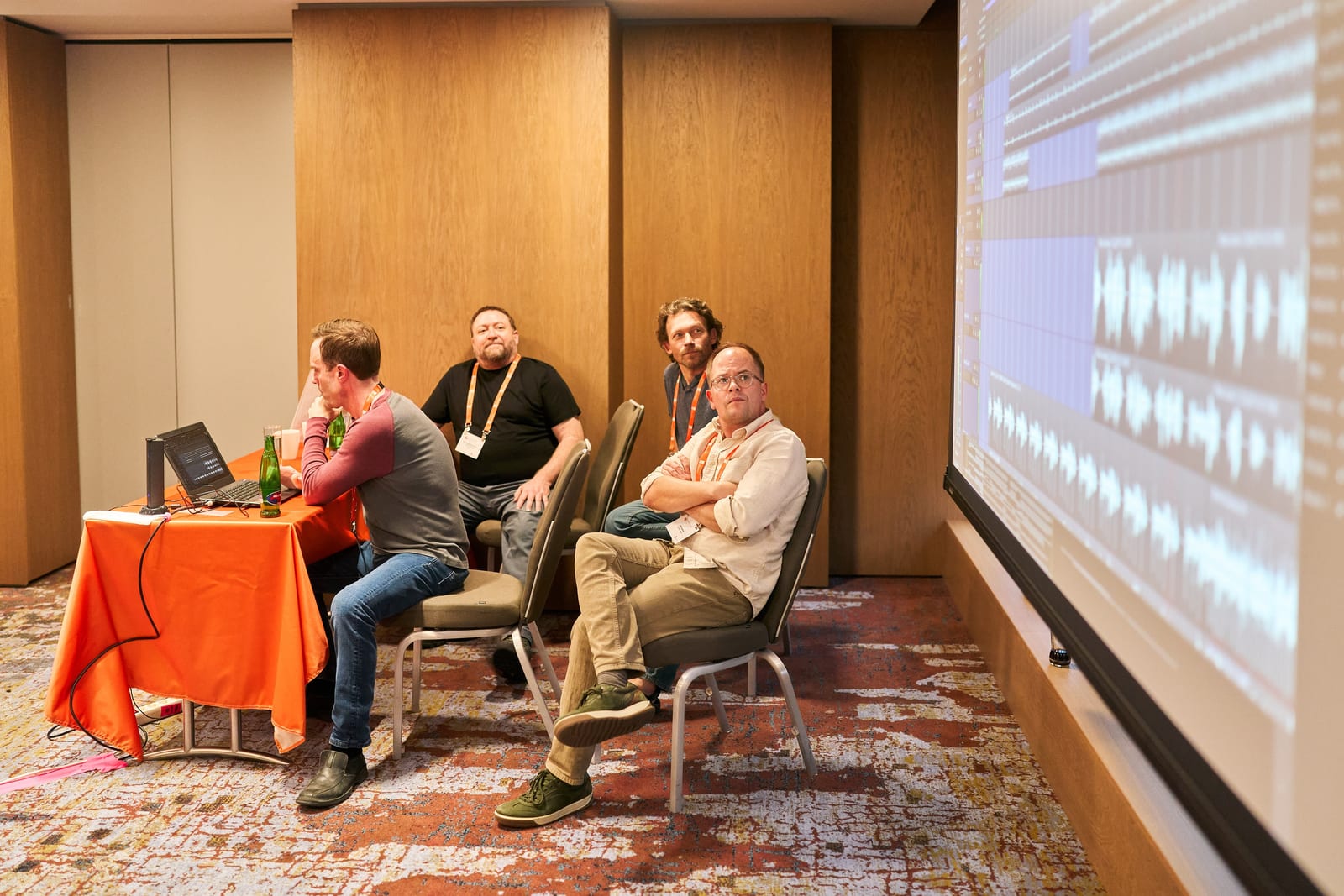
The cover photograph catches that split during an Ardour workshop at the 2022 Ubuntu Summit: collaborators gather around a laptop while a session's waveforms occupy the projection screen. The screen is an editable description of the work. The loudspeakers, out of frame, would still demand the next block on time.[13]
The session is a ledger, not a flattened recording
An Ardour session is a directory rather than one opaque media blob. Its main .ardour snapshot sits alongside an undo-history file, backups, waveform peaks, analysis data, exports and an interchange/ directory containing recorded or imported audio and MIDI. The snapshot records the arrangement and processing state; the captured media has its own durable place.[1]
That file layout supports the first important indirection. A region is not an audio file. For ordinary audio, it identifies source media, an offset into that media and a length. Once the region is placed in a playlist, it also acquires a position on the session timeline and a layer. Trimming, splitting, copying or moving the region changes those instructions without rewriting the underlying samples. New media is created only by operations that actually render or capture it, such as recording, exporting, bouncing or reversing.[2]
The practical consequence is larger than “non-destructive editing” as a feature label. Ten candidate vocal edits can refer to the same set of recorded takes. A cut can be shortened, restored and moved without accumulating ten rewritten WAV files or generation loss. Deleting a region from the arrangement does not delete its source. Physical removal is a separate cleanup action with a wastebasket step, precisely because arrangement state and media ownership are different concerns.[1][2]
Playlists add another level. A playlist is a time-ordered list of regions: which portion of which source should sound, and when. A track is not identical to that playlist; the track is the mechanism that turns the selected playlist into an audio stream. Alternate playlists can therefore hold different comp edits or takes while retaining the same mixer channel and processing context.[3]
This is the calm side of the system. A producer may reconsider the order for an hour. The stored session can represent every resulting edit with cheap metadata. Only when playback advances does that description become a recurring execution plan.
The backend turns the arrangement into a clocked obligation
Before Ardour can play anything, its Audio/MIDI Setup establishes the hardware contract: audio system, capture and playback devices, sample rate, buffer size, period count, MIDI system and measured hardware latency. Linux can expose ALSA, JACK or PulseAudio choices; macOS normally exposes CoreAudio; other platforms supply their own backends. Smaller buffers reduce the delay between input and output, but they also make processing blocks arrive more frequently.[4]
The source tree makes this boundary explicit in the abstract AudioBackend interface. Backend implementations report capabilities such as available sample rates and buffer sizes, expose physical ports, and provide create_process_thread() so work can run with the scheduling and stack conditions expected for a process cycle. Ardour's engine is not allowed to assume that JACK, ALSA, CoreAudio and PortAudio present identical device machinery. It asks them for the same kind of clocked service through one module boundary.[5]
The arithmetic is severe but simple. A 64-frame block at 48,000 frames per second spans 64 / 48,000, or roughly 1.33 milliseconds. Moving to 128 frames gives the engine about 2.67 milliseconds per block, but adds buffer delay. Neither figure is total round-trip latency: capture buffering, playback buffering, converters, drivers, buses and plugins contribute their own delays. The buffer is both a resource allocation and a responsiveness choice.[4][8]
This also explains why the graphical interface cannot be the engine's center of gravity. A waveform repaint may be deferred. A file browser may wait for storage. The audio cycle must complete with bounded work. Real-time audio is less about making every operation “fast” than about keeping unbounded operations away from the thread whose next deadline is already scheduled.
A playlist becomes routes, processors and dependencies
During playback, a track reads the regions active at the current timeline position and emits a block of samples. From there, Ardour's channel strip is executable order: trim, a processor box containing plugins or redirects, fader, panner and output ports. Tracks can feed buses; sends can tap a route; sidechains can bring a signal into a processor; hardware inserts can leave the application and return.[6]
Channel width is part of the computation, not merely a label on the strip. In Ardour's Flexible I/O mode, the outputs of one processor determine the inputs presented to the next. A mono source passed through a mono-to-stereo plugin can make the downstream path stereo. Strict I/O instead constrains processor pins to preserve the route's input/output count unless the user explicitly customizes the pin configuration.[6]
Across the session, those connections form dependencies. Ardour's documented Session class retains a current route graph, a process graph and graph-chain structures, and its cycle reaches a process_routes() stage.[7] The names matter because a session cannot safely treat every strip as an isolated loop. If several tracks feed a drum bus and that bus feeds the master, the bus needs the upstream results before the master can consume its result. Independent branches may offer parallel work; a serial plugin chain does not.
This is the point where editable state becomes a schedule. Changing a region boundary changes which samples enter a track. Moving a plugin changes processor order. Adding a send changes dependencies. Changing a plugin's pin layout can change channel width. Ardour can let the user make those edits because the source media remains stable, but the engine must translate the settled state into a valid plan before the next relevant cycles run.
Plugin speed and plugin isolation pull in opposite directions
Ardour normally loads plugins into its own process. That keeps the audio data and plugin call close, avoiding a compulsory trip through another process for every plugin or track on every buffer. It also means a faulty plugin can corrupt or crash the host. The design reduces deadline overhead by accepting a larger failure domain.[9]
The project makes this tradeoff unusually explicit. Its technical explanation considers a 128-track session with three plugins per track. At 48 kHz and 64 frames, hundreds of cross-process handoffs could consume far more than the 1.3-millisecond cycle even before useful signal processing began. The exact cost depends on grouping, operating system and hardware, so the example is an argument about Ardour's target workload rather than a universal proof against sandboxing.[9]
That distinction is important. A small session at a generous buffer size may reasonably favor plugin isolation and crash recovery. A large tracking session with software monitoring may favor minimal scheduling overhead. Other workstations can choose another point on that curve. Ardour's architecture says that low-latency scale is the primary constraint—and leaves plugin selection and stability inside the operator's trust boundary.
Compensation aligns sound; it does not create more time
Even a cycle that finishes on schedule can produce misaligned audio. An analog-to-digital converter delays capture. A plugin may need to look ahead. An external insert adds a trip through hardware. Different routes can therefore reach the master with different accumulated latency.[8]
Ardour uses read-ahead for latency compensation: material on a slower path is read early enough that its audible result can line up with faster paths at the output. The displayed playhead corresponds to what is heard, not simply to the earlier disk position from which compensated audio may be fetched. Hardware input and output latency can be measured and entered because the workstation cannot infer every delay beyond its software ports.[4][8]
Compensation preserves alignment, but it cannot stretch a processing deadline. A look-ahead limiter may report enough latency for Ardour to align other tracks with it; the limiter still has to process each block reliably. Likewise, making the device buffer smaller can improve software-monitoring response while increasing the probability of a missed cycle. Alignment, responsiveness and reliability are related, but they are not interchangeable controls.
Disk I/O gets a horizon instead of a deadline
Session media may be gigabytes long, and storage timing is bursty. Ardour's preferences therefore express disk I/O buffering in seconds for playback and recording. Longer buffers consume more memory but reduce the risk that a brief storage delay becomes an audio underrun.[10]
The architectural effect is to give storage a horizon. The engine does not need a disk read to complete inside every tiny device period if enough forthcoming audio has already been buffered. A machine can launch the application yet still fail to sustain a demanding session because track count pressures disk bandwidth, plugins pressure CPU time, and buffered media pressures RAM. The right capacity question is not “How many tracks does Ardour allow?” but “Can this machine keep the next required blocks ready under the chosen latency?”
Diagnose the layer that broke its promise
This architecture produces different signatures for different failures:
- A trimmed clip that reveals the original take again is normal region behavior; the source was never rewritten.[2]
- A click accompanied by an
xrunpoints to a missed cycle—possibly a buffer that is too aggressive, an expensive plugin, a driver stall or disk starvation—not automatically to a damaged source file.[8][10] - Correct audio arriving at the wrong destination points toward route ports, sends, bus assignments or plugin pin configuration.[6]
- Tracks that sound individually correct but lose alignment point toward reported plugin latency, external I/O measurement or compensation state.[8]
- A host crash triggered by one plugin is consistent with the in-process fault domain, even if the session file and recorded sources remain intact.[1][9]
Ardour's Plugin DSP Load view helps narrow one of those cases by showing minimum, maximum, average and variation in processing time for each plugin. Worst-case load matters more than a comforting average when one late block is enough to become audible.[11] For tracking, the operator can combine a small stable buffer with hardware monitoring when the interface supports it. For editing and mixing, where immediate input response matters less, a larger buffer can buy execution margin.
The deepest architecture lesson is the asymmetry between changing a session and performing it. Ardour makes an edit cheap by storing references, offsets, lengths, positions and processor state. It makes playback dependable by turning that state into bounded blocks, explicit routes, measured delays and prefetched media. The producer is free to hesitate because the audio engine is not.
Sources
- Ardour Manual, “What's in a Session?” — session snapshots, undo history, media directories, exports, analysis files and cleanup behavior.
- Ardour Manual, “Working With Regions” — source/offset/length semantics, playlist position and layer, and the boundary between region edits and source files.
- Ardour Manual, “Understanding Playlists” — playlists as time-ordered region lists and tracks as generators of their represented streams.
- Ardour Manual, “Audio/MIDI Setup” — backends, devices, sample rate, buffer size, periods, monitoring and hardware-latency calibration.
- Ardour Doxygen,
ARDOUR::AudioBackendclass reference — backend capability and process-thread interface implemented across supported audio systems. - Ardour Manual, “Track/Bus Signal Flow” — processor order, Flexible and Strict I/O, pin configuration, sidechains and latency-compensated thru paths.
- Ardour Doxygen,
ARDOUR::Sessionclass reference — route/process graph state, graph chains and route-processing entry points. - Ardour Manual, “Latency and Latency-Compensation” — the additive latency chain, buffer tradeoffs, xruns, read-ahead compensation and I/O calibration.
- Ardour, “Why doesn't Ardour offer plugin crash protection?” — the project's in-process plugin rationale, workload example and context-switch tradeoff.
- Ardour Manual, “Preferences” — playback and recording disk-buffer horizons, memory use and performance controls.
- Ardour Manual, “Plugin DSP Load” — per-plugin worst-case, average and variation measurements for locating deadline pressure.
- Stuart Adams, “14 of the best plugins and DAWs you can use on Linux,” MusicRadar, July 4, 2025 — independent assessment of Ardour's current production scope.
- Lorenzo's Music, “Talking about using Ubuntu Studio, Ardour and GitHub for music at the Ubuntu Summit in Prague,” December 2022 — context and credit for Stanislav Milata's workshop photograph.