On July 20, 2026, the Open Source Geospatial Foundation signed the founding documents for a new Dutch entity, Stichting Open Source Geospatial. The announcement arrived the next day with an unusually important constraint: OSGeo now has legal homes in the United States and the European Union, but both are governed by the same board, elected through the same Charter Member process.[1]
That makes this more than nonprofit paperwork and less than a fork. The operating surface has widened while the authority graph has stayed deliberately narrow. OSGeo can pursue kinds of European funding and donor recognition that its US entity could not reach directly, yet it has not created a European electorate, a second technical roadmap, or a rival chain of project control.[1]
For engineers who depend on GDAL, QGIS, PostGIS, GeoServer, PROJ, or the other projects under OSGeo’s umbrella, that separation is the governance signal worth reading. A foundation can add contracting capacity without taking release authority away from maintainers. Whether the design remains healthy will depend on something code cannot enforce by itself: money, votes, and project autonomy must continue to cross the two jurisdictions without becoming three competing centers of power.
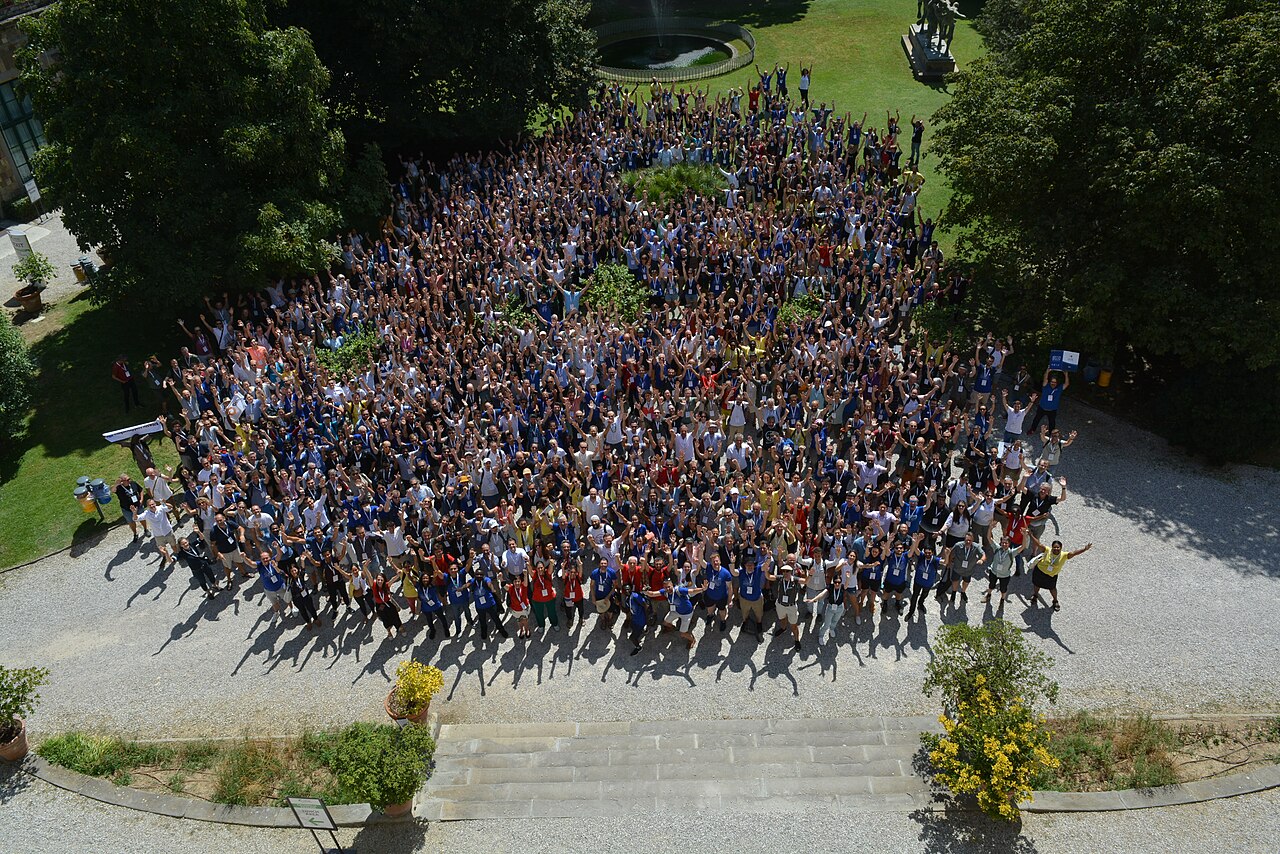
Image context: the cover photograph shows the FOSS4G 2022 community assembled in Florence. It belongs here because OSGeo’s institutional design is meant to serve a network of projects, local communities, users, and contributors. The crowd is not decorative; it is the human system that the legal entities are supposed to support.[7]
The new capability is jurisdictional, not technical
OSGeo says the Dutch foundation gives it a legal presence inside the EU and allows it to apply directly for European research and innovation funding, including calls that require an EU-based entity. It also plans to request Dutch ANBI public-benefit status. If granted, that status could make donations tax-advantaged for many European donors and exempt gifts and bequests from tax.[1]
The tense matters. The EU entity exists; ANBI status was still an application plan at publication. Eligibility to submit a funding proposal is not the same as winning one, and a tax structure is not a maintenance budget until money reaches a project with a transparent purpose. The announcement establishes new routes for resources. It does not establish that those routes are already carrying them.
Nor does the change alter an API, a release train, or a project’s merge permissions. Its immediate value is administrative impedance reduction: OSGeo can contract, apply, receive, and represent itself where an EU legal person is useful. That can matter enormously to a volunteer software ecosystem, but it should be evaluated through grants obtained, project work funded, and obligations reported—not through the mere existence of a second registration.
The single-board design prevents the most obvious split. OSGeo’s current governance page says Charter Members elect a nine-person Board of Directors, which appoints officers and empowers committees and volunteers. The July announcement says that same board governs both legal entities.[1][2] A funding opportunity may now enter through a different door, but it reaches the same top-level decision body.
That is clean on paper and demanding in practice. One board must understand two legal regimes, keep liabilities and accounts legible, and resist allowing whichever entity attracts more money to acquire informal policy dominance. Shared directors remove a handoff between institutions; they do not remove the need to document which institution signed, received, owed, or allocated what.
One electorate sits above both entities
OSGeo’s membership rules separate participation from foundation-level voting. Anyone may participate. A regular Member self-registers and may work through the foundation’s activities. A Charter Member, however, must be nominated and elected, and Charter Members vote for both new Charter Members and directors.[3]
This is an anti-capture design with a renewal dependency. A sudden wave of paid memberships cannot buy a board election: the rules explicitly separate financial support from voting power and do not impose membership fees as a condition of participation. At the same time, the electorate reproduces itself. Existing Charter Members must keep recognizing active contributors across regions, projects, and interests or the defense against capture can harden into an insider loop. The rules name geographic, project, and professional diversity as selection criteria, but criteria become evidence only through nominations and election outcomes.[3]
The European foundation does not reset that bargain. There is no new class of EU voter in the announcement, and no sponsor vote attached to a European donation. The same community-selected board serves both entities.[1] That continuity is valuable precisely because OSGeo also says it wants to build stronger membership, sponsorship, and donation programs. New ways to contribute money should remain visibly separate from the way contributors acquire governing authority.
This gives reviewers a concrete test for future proposals. Recognition, event access, or donor services may be sensible benefits. A proposal that quietly turns sponsorship into electoral leverage would change the governance model even if the bylaws’ nouns stayed the same.
The foundation supports projects without becoming their product manager
Top-level continuity would be much less reassuring if the board controlled every technical decision. OSGeo documents a different boundary. Its project governance FAQ says projects usually operate through their own Project Steering Committees, select a chair or liaison, and work autonomously and largely by consensus. The foundation does not require a project to hand over control or copyright merely to join; it sets legal and accountability expectations around contributions, funding, and open operation.[4]
Incubation makes that boundary inspectable. A project can be listed, recognized as an OSGeo Community project, or complete the fuller process for OSGeo Project status. The last path includes a source-code audit, transparent decision making, contribution rules, documentation, a release and testing process, and evidence of a healthy community supported by more than one organization. Recognized projects gain access to foundation support, including budget and liability-insurance benefits.[5]
This is governance as a protocol, not governance as centralized feature planning. The foundation checks whether a project has a credible way to accept code, make decisions, publish releases, and survive organizational change. The project’s steering body still decides what the software should become. For adopters, that division is more useful than a generic foundation badge: it identifies who can answer a legal or funding question and who can answer a compatibility or release question.
It also reveals the limit of institutional endorsement. An independent 2026 study of incubator projects across Apache, Eclipse, and OSGeo argues that foundations differ in policy, funding, and support, while projects arrive with different sociotechnical profiles. Its models use activity traces and project-specific triage rather than treating foundation membership as a universal sustainability guarantee.[6] OSGeo’s process can require visible governance and still cannot manufacture review capacity, contributor succession, or user demand.
Four signals will show whether the design works
The first signal is resource conversion. ANBI approval, an eligible Horizon Europe application, or a new sponsorship route is only the input. The meaningful output is funded maintenance, documentation, security work, infrastructure, or community work attached to a public decision and a responsible project body.[1][5]
The second is accounting clarity. With one board and two entities, minutes and financial reports should make the legal counterparty visible. A reader should be able to tell which foundation received a grant, which one carries an obligation, and how a project budget was approved. “Same board” should simplify direction, not blur records.
The third is electorate renewal. Charter Member nominations and board elections should continue to bring in people from different projects, regions, and kinds of work. This is the pressure valve in a self-selecting electorate: continuity without replenishment becomes concentration.[2][3]
The fourth is project autonomy under funding. A grant may arrive through Stichting Open Source Geospatial, but technical milestones should still be owned by the relevant project’s documented governance. If the foundation begins choosing roadmaps because it controls a funding channel, the legal expansion will have altered the authority graph after all.[4][5]
The strongest reading of OSGeo’s move is therefore neither “Europe now owns the stack” nor “nothing changed.” A real capability changed: the foundation can act through an EU legal person. A real constraint remained: one community electorate chooses one board, and autonomous project committees retain technical authority. That is a sensible way to add jurisdiction without adding a fork.
Now the paperwork has to become observable maintenance. The new entity earns its place when it lowers the distance between European resources and project work while keeping every vote, allocation, and release boundary as legible as it was before.
Sources
- Open Source Geospatial Foundation, “OSGeo establishes a European legal foundation,” July 21, 2026 — formation of Stichting Open Source Geospatial, EU funding and ANBI plans, and the shared-board continuity rule.
- Open Source Geospatial Foundation, “Board and Officers” — current nine-member board, Charter Member election boundary, officers, committees, and project liaisons.
- Open Source Geospatial Foundation, “Membership rules” — Participant, Member, Charter Member, supporter, nomination, voting, diversity, and anti-capture boundaries.
- Open Source Geospatial Foundation, “FAQ” — board, Project Steering Committee, project-autonomy, copyright, contribution, and accountability boundaries.
- Open Source Geospatial Foundation Incubation Committee, “Incubation Committee” — listing, Community, and Project tiers; audit, governance, release, documentation, and multi-organization requirements.
- Arjun Ashok et al., “Multi-Ecosystem Modeling of OSS Project Sustainability,” arXiv:2602.17112, February 2026 — independent empirical study of foundation-specific incubation and sociotechnical sustainability across Apache, Eclipse, and OSGeo.
- Alessio Ferroni, “FOSS4G 2022 Firenze Group Photo,” Wikimedia Commons, August 25, 2022 — provenance page for the documentary conference photograph used as the article image.