As of 2026-06-11 07:34 UTC, the news is not simply that Europe is hot. The practical change is that WHO/Europe has released a second edition of its heat-health action-plan guidance, replacing a 2008 baseline with a much more operational framework for national, regional, and city authorities [1][2].
That matters because heat is now one of the most predictable public-health emergencies in Europe and one of the easiest to under-manage. The new guidance arrives with a sharper premise: warning people to drink water is not a plan unless somebody has already decided who receives alerts, which care homes and hospitals must change staffing or cooling routines, where vulnerable residents can go, and how deaths and illness will be tracked afterward [2][3].
Verified Facts
| Point | What is verified | Confidence |
|---|---|---|
| Release | WHO/Europe presented the new guidance in Berlin on 11 June 2026, during Germany's nationwide Heat Action Day [1]. | High: primary WHO/Europe release. |
| Scope | The second edition is a 272-page report and says it is organized around eight core elements: governance, warning systems, at-risk populations, communication, health-system resilience, reducing exposure, surveillance, and monitoring/evaluation/learning [2]. | High: publication page. |
| Regional risk | WHO/Europe says the European Region is warming faster than the other WHO regions and that heat stress is the leading cause of climate-related death in the region [3]. | High: WHO/Europe topic page. |
| Readiness gap | The European Environment Agency found 21 of 38 EEA countries had heat-health action plans in place, with four more developing them; 20 of 38 monitored heat impacts on health [4]. | High: EEA briefing, 2024 survey basis. |
| Recent burden | The 2026 Lancet Countdown Europe report says 99.6% of sub-country regions are seeing rising heat-attributable deaths, with an estimated 62,000 deaths in 2024 [5]. | Medium-high: modelled burden, not a real-time death registry. |
What Changed
The guidance changes the center of gravity from public messaging to public administration. Older heat plans often read like seasonal advice: avoid midday exertion, drink fluids, check on neighbors. Those messages still matter, but the updated WHO framework treats them as one part of a chain. A heat warning has to be tied to decisions by meteorological services, health ministries, municipalities, hospitals, care providers, employers, schools, and civil-society groups [2].
The eight-part structure is important because heat deaths do not usually happen in one dramatic scene. They accumulate across apartments, workplaces, care homes, emergency rooms, and streets. A city can publish good advice and still fail if the warning threshold is wrong, if social-care teams do not know which residents live alone, if a hospital loses cooling capacity, or if post-event surveillance arrives too late to improve the next response [2][4].
Berlin is the example WHO/Europe chose to make that machinery visible. The release says the State of Berlin adopted a heat-health action plan in 2025 with 72 measures, including communication, a heat-protection portal, a map of cool places, and a health-and-care-sector network [1]. That does not prove Berlin's plan will perform under every future heatwave. It does show the direction of travel: the benchmark is moving from "does the city warn people?" to "does the city know which institutions must act, and can residents find help before emergency rooms fill?"
Who Should Care
Public-health agencies have the most immediate work. The EEA's 2024 briefing shows that Europe still lacks consistent near-real-time heat mortality and morbidity surveillance; only part of the region can forecast or monitor heat-related health impacts quickly enough to guide emergency decisions [4]. That creates a policy blind spot. If a health ministry cannot tell whether ambulance calls, emergency visits, dehydration diagnoses, or excess deaths are moving during a heatwave, it is left managing by weather maps and anecdote.
Hospitals and care systems should care because heat is a capacity problem. WHO's heat-and-health fact sheet warns that prolonged high day and night temperatures can raise acute illness and mortality and can disrupt health facilities, transport, water, and power infrastructure [3]. The new guidance's emphasis on health-system resilience is therefore not decorative. It asks managers to think through staffing, cooling, triage, medication risks, backup power, and care-home routines before the warning is issued [2].
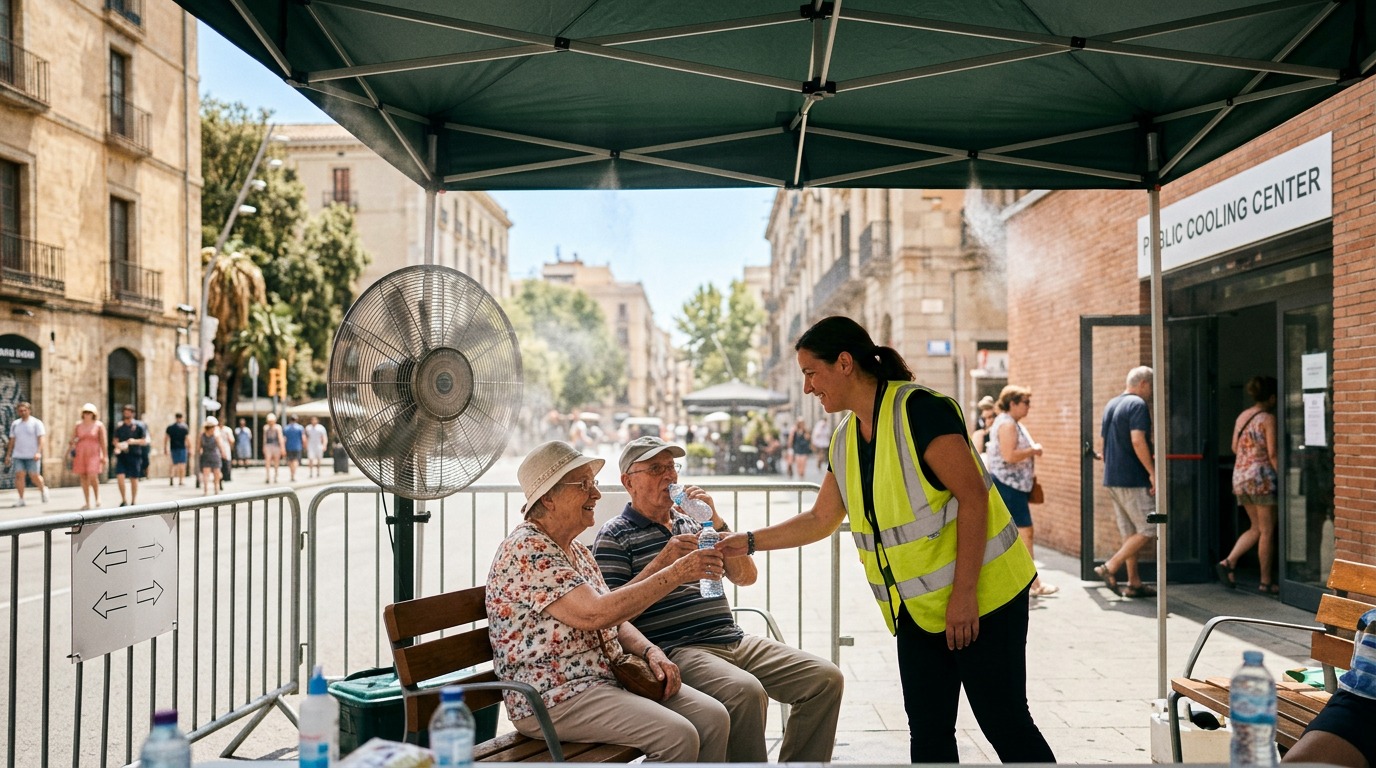
Cities and local governments should care because they control many of the practical levers. Heat exposure is shaped by shade, tree cover, public buildings, cooling centers, pavement, housing quality, water access, and whether residents trust official information. WHO/Europe's release frames heat protection as both climate adaptation and social policy: people in overheated apartments, dense districts, or isolated care situations cannot solve the problem by willpower alone [1].
The public should care, too, but the public is not the whole plan. Individual behavior can reduce risk, especially for older people, infants, outdoor workers, pregnant people, and people with chronic disease [3]. The point of the updated guidance is that individual behavior works best when supported by a system that gives timely warnings, names safe options, and reaches people who will not see a press conference.
What Changes In The Next 24 Hours, 7 Days, And 30 Days
In the next 24 hours, the useful question for authorities is whether existing heat alerts, vulnerable-population lists, care-home procedures, and hospital escalation plans line up with the eight WHO elements. The answer is likely uneven. The EEA found that heat-health action plans exist across parts of Europe, but not everywhere, and the surveillance layer remains patchy [4].
In the next seven days, the pressure moves to translation: national health bodies, city administrations, and emergency managers need to compare their local plans against the new WHO framework. That means checking not only whether a plan exists, but whether it has named owners, warning thresholds, communication scripts, outreach routes, health-system triggers, surveillance metrics, and a review process after the event [2].
In the next 30 days, the test becomes seasonal execution. The Lancet Countdown's 2026 Europe report says extreme heat warnings have risen sharply in recent decades, with daily heat-health warnings of extreme heat up 318% in 2015-2024 compared with 1991-2000 [5]. If the summer brings a major heatwave, the credibility of the new guidance will depend on whether governments can turn the document into staffing rosters, call lists, cooling access, public transport adjustments, and post-heatwave evaluation.
Scenarios
Base case: agencies use the WHO document as a checklist for strengthening existing plans. This improves coordination in cities and countries that already have heat-health action plans, but leaves gaps where surveillance, local funding, or cross-agency ownership is weak [2][4].
Upside case: the guidance becomes a common operating language across Europe. National public-health institutes, meteorological agencies, hospitals, municipalities, and social-care networks start using comparable triggers and evaluation methods. That would make it easier to learn which interventions actually reduce deaths and illness, especially for older people and people with chronic conditions [3][4].
Downside case: the document is treated as a publication milestone rather than an implementation tool. In that scenario, the region still enters heatwaves with fragmented monitoring, late outreach, overloaded care systems, and little ability to compare what worked afterward. The warning sign would be another severe summer where officials can describe the meteorology in detail but cannot quickly measure the health burden [4][5].
Action Checklist
Authorities should audit plans against the eight WHO elements and name an owner for each element before the next extreme-heat alert [2].
Health systems should test whether hospitals, clinics, pharmacies, home-care providers, and long-term-care facilities know what changes when a heat warning moves from advisory to emergency [2][3].
Cities should publish plain-language cooling options, not just generic heat advice, and verify that vulnerable residents can physically reach or request help from those options [1][3].
Public-health institutes should prioritize near-real-time morbidity and mortality indicators, because delayed estimates are useful for research but weak for operational response [4].
The main invalidation condition is simple: if the next major heatwave shows no improvement in warning activation, vulnerable-population outreach, health-system readiness, or post-event measurement, the new guidance will have changed the paperwork more than the protection.
Sources
- WHO/Europe, "Heat Action Day: New WHO guidance helps authorities better protect people from the effects of heat" (11 June 2026).
- WHO Regional Office for Europe, Heat-health action plans: guidance, second edition (11 June 2026).
- WHO/Europe, "Heatwaves" topic page, regional risk and public-health response overview.
- European Environment Agency, "The impacts of heat on health: surveillance and preparedness in Europe" (27 November 2024).
- Lancet Countdown Europe, "2026 Report (Europe)," heat mortality and warning indicators.