As of 2026-06-11 09:33 UTC, Honda's new U.S. recall should be read less as a panic notice than as a targeted corrosion-screening program. The recall covers 880,514 vehicles across certain 2016-2022 Honda Pilot, 2017-2023 Honda Ridgeline, 2019-2023 Honda Passport, and 2014-2020 Acura MDX vehicles sold in road-salt states and the District of Columbia.[1][2]
The risk is specific: the rear subframe can corrode around suspension mounting points, and in a severe case that can lead to rear suspension component failure and loss of vehicle control.[1][4] Honda estimates the defect rate at about 1% of the listed population, and AP reports no warranty claims, injuries, or deaths tied to the issue as of the recall announcement.[1] That means the practical story is not "every affected Honda is unsafe today." It is "the vehicles most exposed to winter de-icing chemistry need a structured underside inspection before corrosion turns invisible risk into handling risk."
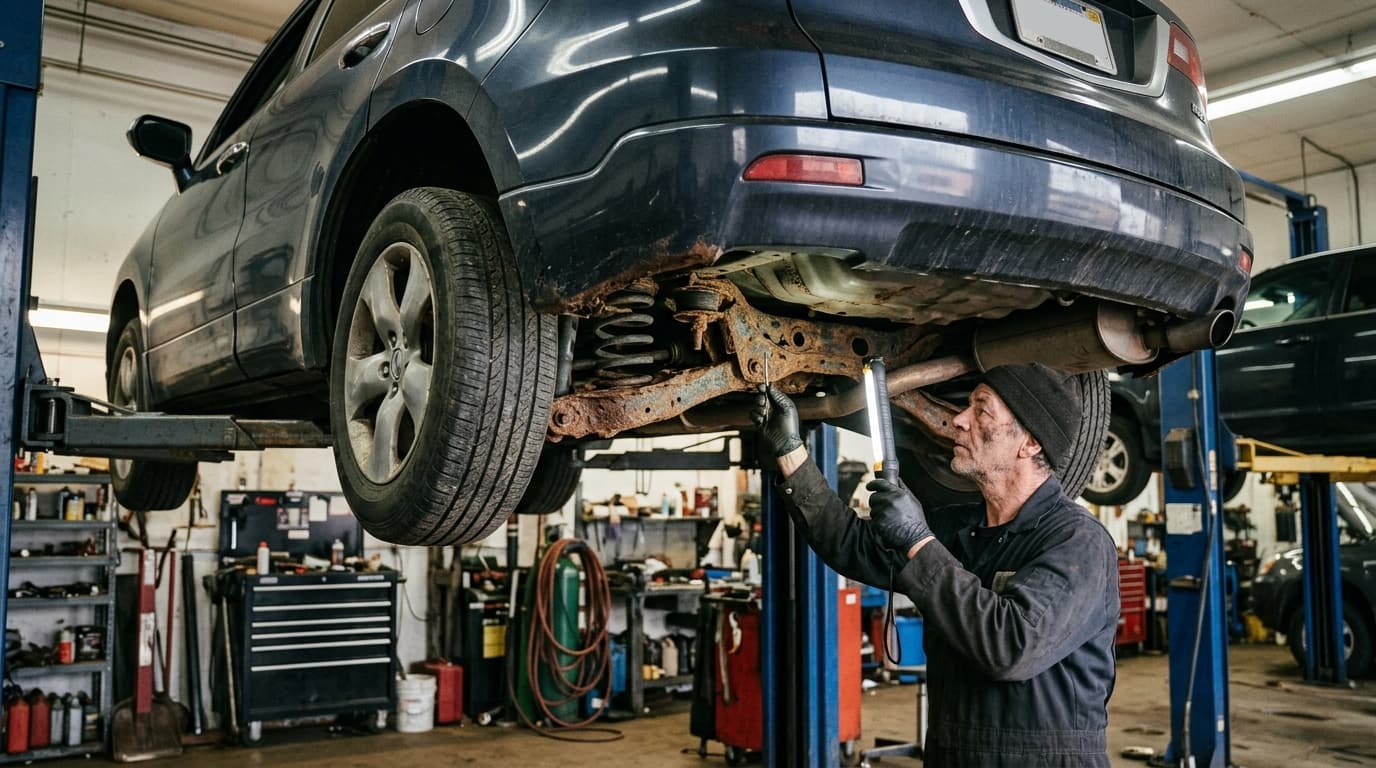
Image context: the cover uses an underbody inspection scene because this recall is about corrosion near rear subframe and suspension mounting points. The risk is structural and usually invisible from a normal street-level exterior view.
Fact file
| Item | Verified now | Confidence |
|---|---|---|
| Recall size | 880,514 vehicles are included in the U.S. recall.[1][2] | High; repeated in AP and CBS summaries. |
| Affected lines | Certain Honda Pilot, Ridgeline, Passport, and Acura MDX model years are covered.[1][2] | High; repeated across recall coverage. |
| Largest model count | Car and Driver reports 464,253 Pilot, 217,517 MDX, 110,070 Ridgeline, and 89,674 Passport vehicles in the affected population.[3] | Medium-high; useful secondary breakdown. |
| Geography | AP lists the recall as covering vehicles sold in 23 states plus Washington, D.C., concentrated in places where de-icing agents are used.[1] | High for listed geography; actual VIN status still controls. |
| Failure mechanism | Corrosion at rear subframe suspension mounting points can thin or fracture the structure and allow rear suspension failure.[1][3][4] | High; consistent across multiple reports citing NHTSA/Honda filings. |
| Defect estimate | Honda estimates about 1% of listed vehicles have the defect.[1] | High for company estimate; actual inspection results may differ. |
| Remedy | Dealers will inspect the rear subframe and install a reinforcement kit if needed, or repair or replace components at no cost.[1][4] | High; repeated across reports. |
| Owner timing | Owner letters are expected starting July 7, while VIN lookup is the faster path for owners who do not want to wait.[1][5] | High for timing; VIN systems can lag during rollout. |
What actually failed in the chain
This recall is about the boundary between manufacturing protection and winter-road reality. The recalled vehicles can experience premature corrosion in the rear subframe area, especially where the suspension mounts to the structure.[1][3] Car and Driver describes the problem as tied to improper coating specifications that can lead to weak paint adhesion and early paint peeling near arm-bracket weld areas.[3] Once the coating no longer protects the metal, salt, water, vibration, and time do the rest.
That makes this different from a software recall or a single broken switch. Corrosion is cumulative. A vehicle may look normal from above while the relevant risk grows underneath, especially in regions where brine and salt are repeatedly sprayed onto winter roads. The concern is not cosmetic rust. The concern is material thinning or fracture at a suspension load point.[3][4]
The uncertainty is also important. The public reports do not say that every vehicle in the listed model-year range has the defect. They say Honda identified a safety risk in a defined population, estimates a low defect share, and is using dealer inspection to sort vehicles into "reinforce," "repair," or "replace" outcomes.[1][4] That is why VIN lookup and inspection matter more than guessing from model year alone.
Why the salt-belt geography matters
The state list is not random. AP reports the affected vehicles were sold in Connecticut, Delaware, the District of Columbia, Illinois, Indiana, Iowa, Kentucky, Maine, Maryland, Massachusetts, Michigan, Minnesota, Missouri, New Hampshire, New Jersey, New York, Ohio, Pennsylvania, Rhode Island, Vermont, Virginia, West Virginia, and Wisconsin.[1] Those are places where winter de-icing practices can create a harsher underbody environment.
That does not mean a vehicle is safe merely because it now lives elsewhere. Used vehicles move. A Pilot bought in Pennsylvania can later be registered in North Carolina. An Acura MDX that spent ten winters in New Jersey may be on a lot in Georgia. The recall geography describes the sales population and exposure logic; the VIN is the controlling check for an individual owner.[1][5]
It also explains the article's main interpretation. This is an inspection race, not a broad stop-driving order. Owners should not infer that the driveway is immediately dangerous, but they also should not wait for visible rust to become obvious. The part that matters is underneath the vehicle and near load-bearing suspension geometry.
Decision impact
Next 24 hours: owners of the listed model lines should run a VIN check through Honda's recall search and save a screenshot or confirmation result. If the lookup is not yet populated, check again after the notification process begins rather than assuming non-coverage.[1][5]
Next 7 days: drivers should pay attention to abnormal rear suspension noise, vibration, or handling changes. Fox Business, citing the agency warning, notes that drivers may notice noises, vibration, or handling changes as the issue progresses.[4] Those symptoms are not a diagnosis, but they are a reason to call a dealer sooner.
Next 30 days: dealers and owners should expect a parts-and-scheduling bottleneck if many vehicles in salt-belt states arrive for inspection around the same time. The remedy sounds simple in summary, but inspection, reinforcement, and possible repair or replacement are shop-time work, not an over-the-air fix.[1][4]
Scenario map
Base case: most vehicles pass inspection or receive the reinforcement kit without major disruption. Trigger: dealers can confirm VIN coverage quickly and complete inspection appointments within normal service windows.[1][5]
Upside case: the recall catches corrosion before owners notice symptoms, and the low estimated defect rate proves accurate. Trigger: inspection results cluster near Honda's roughly 1% defect estimate and few vehicles need deeper component replacement.[1]
Downside case: real-world exposure is messier than the sales-state list suggests, with used-vehicle migration and uneven road-salt history making appointments harder to prioritize. Trigger: owners outside the original salt-belt states discover covered VINs or dealers report longer repair queues for subframe work.[1][5]
Action checklist
- Check the VIN, not just the model year. The affected population is specific, and some vehicles in the broad years may not be covered.[1][5]
- If covered, schedule the inspection rather than waiting for visible rust. The risk is at suspension mounting points where a casual walkaround may not show the relevant condition.[1][3]
- Treat new rear-end noise, vibration, or handling changes as a service prompt. Do not use the low estimated defect rate as a reason to ignore symptoms.[1][4]
- Ask the dealer which remedy path applies after inspection: no action beyond inspection, reinforcement kit, repair, or component replacement.[1][4]
- Used-car buyers should run the VIN before purchase, especially on Pilot, Ridgeline, Passport, and MDX examples that spent winters in the listed states.[1][5]
The narrow conclusion is useful. Honda has not announced a universal stop-driving order. It has announced a large, salt-belt corrosion recall where the safety risk is serious but sorted through inspection. For owners, the right response is neither alarm nor delay: verify the VIN, watch for handling symptoms, and get the underside checked while the remedy is free.[1][4][5]
Sources
- Associated Press, "Honda recalls more than 880,000 cars due to a problem with rear suspension components" (June 10, 2026).
- CBS News, "Honda recalls more than 880,000 vehicles for suspension issue that could cause crashes" (June 10, 2026).
- Car and Driver, "Honda Recalls 880,000 Vehicles for Rapidly Rusting Subframes" (June 10, 2026).
- Fox Business, "Honda recalls 880,000 vehicles over rear suspension corrosion risk" (June 10, 2026).
- American Honda, "Recall Search - MyGarage" (owner VIN lookup page).