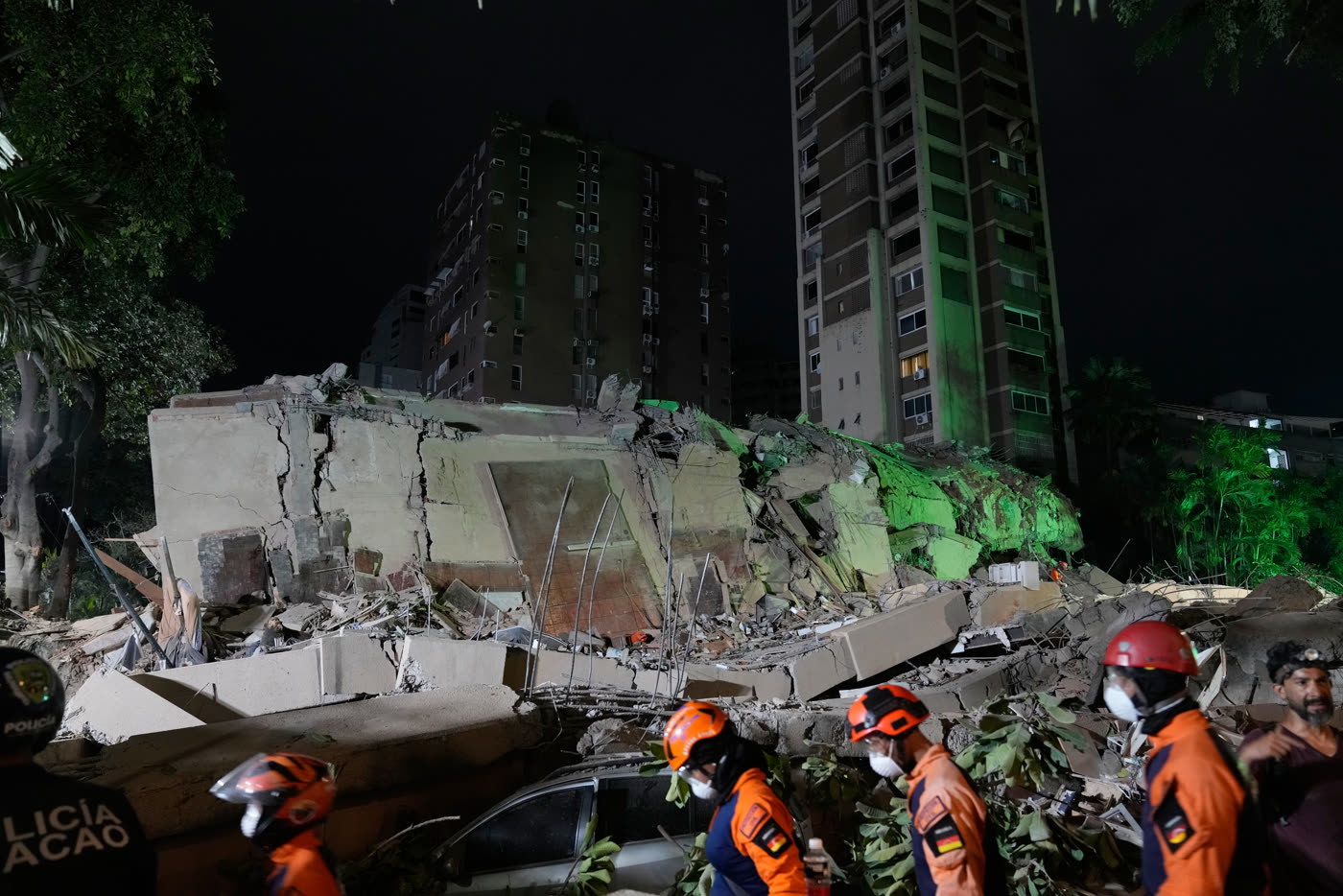
As of 2026-06-25 18:32 UTC, Venezuela's earthquake disaster is no longer just a magnitude story. It is a rescue-clock story. Reuters reported officials saying at least 164 people had been confirmed dead and nearly 1,000 injured after two powerful earthquakes struck northern Venezuela on the evening of June 24, while warning that many more people were feared trapped or unaccounted for as crews searched collapsed buildings.[1] AP's ground report describes widespread damage in Caracas, damage severe enough to close Simón Bolívar International Airport, suspended subway and natural gas services, and residents remaining outside because aftershocks could further weaken damaged structures.[2]
The technical outline explains why the first day is so hard. USGS lists a magnitude-7.2 earthquake at 2026-06-24 22:04:33 UTC, followed by a magnitude-7.5 event at 22:05:11 UTC: roughly 38 seconds apart, both shallow, both carrying red PAGER alerts.[3][4] GDACS classifies the larger event as a high-humanitarian-impact earthquake and estimates 2.4 million people exposed to intensity MMI VII or above, the level where poorly built structures can suffer heavy damage and even stronger buildings can be seriously stressed.[5]
That combination changes the practical reading. A single large quake can collapse weak structures, break lifelines, and send people into the street. A tight doublet can do that while also hitting buildings, stairs, roads, hospitals, and emergency communications before the first shaking has really become a finished event. The public question for the next hours is not whether the disaster is bad. It is whether rescue teams can convert the first daylight and night cycles into survivable access before void spaces close, injuries worsen, aftershocks interrupt work, and damaged infrastructure slows heavy equipment.
Facts Now
| Item | What is known now | Confidence note |
|---|---|---|
| Main sequence | USGS records a magnitude-7.2 quake followed about 38 seconds later by a magnitude-7.5 quake near Yumare/Morón in northern Venezuela.[3][4] | Strong for current USGS reviewed event pages; exact rupture interpretation may still evolve. |
| Casualties | Reuters reported officials saying at least 164 people were confirmed dead and nearly 1,000 injured; The Guardian live file separately cited 164 dead and 971 injured from Delcy Rodríguez.[1] | Strong for reported official figure, but unstable because active searches are ongoing. |
| Hardest-hit geography | Reuters and AP both point to severe damage in and around Caracas and La Guaira, with La Guaira described by officials as a disaster zone.[1][2] | Strong directionally; full municipal damage mapping is incomplete. |
| Humanitarian exposure | GDACS lists the magnitude-7.5 event as high humanitarian impact with 2.4 million people exposed to MMI VII or above.[5] | Model-based; useful for scale, not a casualty count. |
| Tsunami status | The U.S. Tsunami Warning Centers canceled the Puerto Rico/Virgin Islands advisory at 23:15 UTC and stated no warning, advisory, watch, or threat was in effect.[6] | Strong for tsunami risk status; does not reduce onshore earthquake risk. |
| Logistics posture | The Logistics Cluster has opened a Venezuela Earthquake June 2026 activity page, noting ongoing search and rescue, aftershocks, disrupted services, and continuing needs assessment.[7] | Strong signal that the event has entered international humanitarian coordination channels. |
Why The Doublet Matters
Earthquake magnitude is easy to read as one number, but this event is harder than that. USGS' event pages show two large shocks almost on top of each other in time and space: first magnitude 7.2, then magnitude 7.5, both shallow enough to transmit severe shaking into populated areas.[3][4] The difference between 7.2 and 7.5 is not cosmetic; the larger event releases substantially more energy. More important for emergency response, the second shock arrived while people and structures were still inside the first crisis.
That matters for collapse patterns. A building weakened by the first event may have had little margin left when the second arrived. A resident descending stairs, a patient moving inside a clinic, a driver near falling masonry, or a rescuer entering a damaged block could be exposed to a second severe pulse before normal decision-making had returned. AP reported residents describing buildings swaying, collapsed homes in Caracas neighborhoods, blocked streets, power and cellphone disruptions, and officials urging people to remain outside because aftershocks could worsen damage.[2]
It also matters for public information. Early reports can lag the actual damage map because communication outages, nighttime conditions, blocked roads, and panic slow verification. Reuters reported that relatives were searching for loved ones and that heavy machinery was being deployed to accelerate rescue work.[1] Those details are not secondary. In a collapsed-building disaster, the speed with which crews can move concrete, shore unstable slabs, locate voids, triage injuries, and keep routes open becomes part of the casualty curve.
The Immediate Bottleneck Is Access
The first bottleneck is not international sympathy. Offers of help are already being made, and Reuters reported that Venezuela's acting president thanked leaders including the United States and Russia as rescue crews from other countries were expected.[1] AP likewise described offers of aid and expressions of support from governments across the region.[2] The bottleneck is turning those offers into movement through a damaged transport and communications system.
Airport damage is therefore a critical fact, not a side note. AP reported that Simón Bolívar International Airport was damaged badly enough to close, while Reuters placed some of the worst damage in La Guaira, the state that includes the airport and sits north of Caracas.[1][2] If that hub is constrained, incoming rescue teams, medical supplies, field communications, generators, water equipment, and shelter materials may need alternate routing. Every extra transfer costs time.
Local access is just as important. GDACS' exposure estimate is wide enough to imply many neighborhoods where the question will be whether roads are passable, whether structures can be entered, whether ambulances can move, and whether people can charge phones or locate relatives.[5] The Logistics Cluster's early page emphasizes that aftershocks and disrupted services are complicating response and assessment.[7] That is the first-day reality: before recovery can be planned, responders need a working map of where people are trapped, where roads are open, which hospitals are functioning, and where shelters can safely operate.
What Changed Since The First Alerts
The tsunami alert is no longer the main regional risk. The U.S. Tsunami Warning Centers first issued advisories after the earthquake, then canceled them at 23:15:14 UTC on June 24, stating that no warning, advisory, watch, or threat was in effect.[6] That is good news for Puerto Rico, the Virgin Islands, and nearby Caribbean coasts, but it can also distract from the land emergency if readers treat cancellation as broad all-clear.
The active danger is onshore: unstable buildings, trapped people, aftershocks, disrupted utilities, and uneven access to rescue. Officials have urged residents to remain outdoors where structures may be unsafe.[2] Reuters reported collapsed houses near Morón, severe damage in La Guaira, and government work with businesses to deploy heavy machinery.[1] Those are the operational details that will matter more than headline magnitude in the next news cycle.
The casualty line is also likely to move. The reported official toll is a snapshot, not a ceiling. Reuters cited USGS predictive modeling as pointing to deaths most likely in the thousands, with a substantial probability of exceeding 10,000.[1] That is not a confirmed toll and should not be presented as one. It is a risk model, useful because it tells governments and aid groups to plan for a disaster that may be much larger than the first confirmed numbers show.
Decision Impact
Next 24 hours: the priority is live rescue. The useful public signals are not press-conference volume but whether heavy equipment reaches collapsed blocks, whether international urban-search-and-rescue teams can land or route around airport damage, whether hospitals can maintain power and water, and whether authorities publish usable shelter, missing-person, and road-status information.[1][2][7]
Next 7 days: the story shifts toward shelter, medical continuity, sanitation, and logistics. People sleeping outdoors after major shaking need safe water, toilets, medication access, battery charging, and protection from rain or heat. Damaged buildings need rapid inspection so residents are not forced to choose between unsafe reentry and open-air exposure.[2][7]
Next 30 days: the question becomes whether emergency response can turn into transparent reconstruction. The disaster has struck a country already under severe economic and political stress. That means aid access, local coordination, procurement, building inspection, debris removal, and public communication may decide whether the earthquake becomes a contained emergency or a longer humanitarian deterioration.[1][5][7]
Scenarios
Base case: confirmed deaths and injuries rise as crews reach La Guaira, Caracas neighborhoods, Morón, and other damaged areas, but transport corridors reopen enough for outside rescue teams, medical aid, and generators to reinforce the response. Airport limits remain a constraint, but not a blockade.[1][2][7]
Upside case: aftershocks remain manageable, missing-person reporting becomes more reliable, roads into the hardest-hit neighborhoods are cleared, and international teams arrive with search equipment before the most useful rescue window narrows. In this branch, the casualty count still rises but fewer people die because access improves quickly.[1][7]
Downside case: damaged structures continue to fail, power and cellular outages keep families and responders from locating people, rain or landslides complicate access, and airport or road constraints slow heavy equipment. GDACS' high-impact classification and USGS red alerts are the reason this branch has to be taken seriously.[3][4][5]
Action Checklist
- Treat the current death and injury count as provisional; cite a timestamp when sharing numbers because official figures are likely to change.[1]
- Do not treat the tsunami cancellation as a general safety clearance; it only resolves the tsunami advisory status, not damaged-building or aftershock risk.[6]
- If donating, prioritize established humanitarian channels that can coordinate logistics, medical support, shelter, water, and local partners rather than unverified individual appeals.[7]
- For Venezuelan diaspora readers, use official or well-established missing-person and consular channels where available, and avoid amplifying unverified casualty lists.
- Watch the airport and road-access status. The response will improve fastest if rescue teams, heavy machinery, field hospitals, power equipment, and water systems can move into La Guaira and Caracas without improvising every leg.[1][2][7]
The core uncertainty is no longer whether Venezuela experienced an unusually severe earthquake sequence. USGS has already made that clear.[3][4] The uncertainty is human and logistical: how many people are still reachable, how fast crews can reach them, and whether damaged systems can be patched quickly enough for the first day of rescue to become a bridge rather than another failure point.
Sources
- Vivian Sequera and Mayela Armas, Reuters via Al-Monitor, "Thousands feared dead in Venezuela after two major earthquakes" (June 25, 2026) - casualty reports, La Guaira damage, rescue operations, heavy machinery, and USGS fatality-model context.
- Regina Garcia Cano and Juan Pablo Arraez, Associated Press, "Back-to-back powerful earthquakes hit Venezuela, collapsing buildings in Caracas" (June 24, 2026; updated) - state of emergency, airport closure, service disruptions, aftershock warnings, and AP event photography.
- U.S. Geological Survey, "M 7.5 - 28 km SE of Yumare, Venezuela" - reviewed event page for the larger June 24, 2026 earthquake.
- U.S. Geological Survey, "M 7.2 - 23 km SE of Yumare, Venezuela" - reviewed event page for the preceding June 24, 2026 earthquake.
- Global Disaster Alert and Coordination System, "Overall Red Earthquake in Venezuela on 24 Jun 2026 22:05 UTC" - humanitarian-impact classification and exposed-population estimate.
- U.S. Tsunami Warning Centers, "Message: PR/Virgin Isl. Warn/Adv./Watch #3" (June 24, 2026) - cancellation stating no tsunami warning, advisory, watch, or threat was in effect.
- Logistics Cluster, "Venezuela Earthquake June 2026" - humanitarian logistics page noting ongoing search and rescue, aftershocks, disrupted services, and needs assessment.