As of 2026-06-26 00:31 UTC, the beach-safety message that matters most this week is a small but consequential shift in emphasis: do not try to beat a rip current head-on. The Associated Press, citing lifeguards and federal safety guidance, reported that U.S. rip currents have already killed at least 21 people in 2026, while rip currents remain responsible for the large majority of beach rescues and roughly 100 deaths in a typical U.S. year.[1]
The practical change is not that rip currents are new. It is that the advice has become more behavioral and less heroic. The old phrase many people remember - "swim parallel" - is still part of the picture, but it is not the first thing a tired or panicked swimmer may be able to do. The newer field language is flip, float, and follow: get on your back, keep your airway clear, conserve energy, let the current lose force, then signal or move out of the flow when possible.[1][3]
That distinction matters at the start of summer because rip currents are not storm-only hazards. The National Weather Service warns that good beach weather does not guarantee safe swimming, and NOAA's rip-current guidance says dangerous currents can occur with moderate surf, tides, and bottom shape rather than only with obvious severe weather.[2][3]
Fact File
| Item | What is known now | Confidence note |
|---|---|---|
| Current news trigger | AP reported at least 21 U.S. rip-current deaths so far in 2026 and renewed lifeguard advice to flip, float, follow, and signal for help.[1] | High for AP-reported current count; fatalities can be revised as agencies classify surf-zone deaths. |
| Scale of the hazard | AP, citing the United States Lifesaving Association, says rip currents account for more than 80% of beach rescues and about 100 U.S. deaths each year.[1] | High for public-safety scale; exact annual totals vary by reporting source and classification. |
| What a rip current does | NOAA describes a rip current as a narrow, fast-moving channel that starts near shore and moves offshore through breaking waves.[3] | High; core physical definition from NOAA safety material. |
| What it does not do | NOAA stresses that a rip current pulls swimmers away from shore, not under the water.[3] | High; this is central to the survival advice. |
| Why it forms | NWS science guidance explains that rip currents form where wave breaking varies along the beach, often around sandbar gaps, piers, jetties, groins, or other structures.[4] | High for mechanism; local shape and timing are site-specific. |
| Daily planning tool | NWS tells beachgoers to check local beach forecasts before going in the water and swim where lifeguards are present when possible.[2] | High; official operational guidance. |
What Actually Changed
The old mental model made the swimmer the engine of escape. If you were caught, you were told to swim sideways, parallel to shore, until you left the current. That is still useful when the swimmer is calm, buoyant, and strong enough to move deliberately. But it fails as first advice for someone already fighting water, swallowing spray, or discovering that the beach is not getting closer.
The newer emphasis starts one step earlier: do not spend the first minute exhausting yourself. Flip onto your back, float, keep breathing, and let the current carry you past its strongest neck. NOAA's Ocean Today guidance makes the same causal point: swimming straight back against the current burns energy while the current is doing exactly what it is built to do, moving water away from shore.[3]
This is not passivity. It is sequencing. Once the current weakens, a swimmer can signal, swim out of the flow, or follow breaking waves back at an angle. AP's report describes lifeguards urging swimmers to raise an arm after the current dissipates, because the swimmer may now be outside the break zone, tired, and hard for others to track from the beach.[1]
Why the Hazard Is Hard to Read
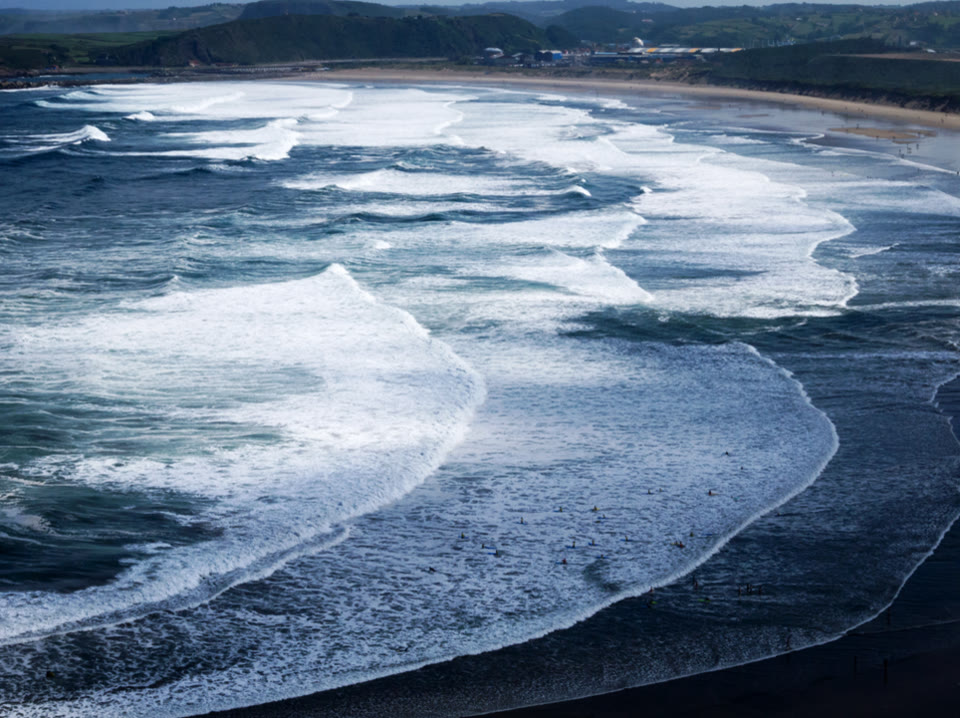
Rip currents look dangerous in safety posters, but in real water they can look like a break in the action. NWS science pages describe channelized rips as darker paths between areas of whitewater, places where waves are not breaking as much, sometimes with choppy texture, sediment plumes, or foam moving offshore.[4] The trap is that a calmer-looking gap can be the channel.
That is why the most useful beach decision happens before anyone is in trouble. Check the NWS beach forecast, read the flags, ask a lifeguard, and avoid swimming beside hard structures where currents can be concentrated.[2][4][5] The National Hurricane Center's rip-current page uses simple operational categories: high risk means life-threatening currents are likely and swimming is unsafe; moderate risk means dangerous rips can appear suddenly; low risk still does not mean no risk near structures.[5]
The uncertainty boundary is important. A national article cannot tell a family whether one specific beach access is safe at 3 p.m. today. Rip-current risk depends on swell, tide, wind, beach shape, sandbars, and structures. The useful national message is the behavior pattern and the habit of checking local conditions. The local call still belongs to lifeguards, beach patrols, and current forecasts.[2][5]
Decision Impact
Next 24 hours: anyone heading to an ocean or Great Lakes beach should check the local NWS beach forecast before entering the water, then treat warning flags and lifeguard instructions as the controlling source. The better decision is made on dry sand, not after a swimmer is already tired.[2][5]
Next 7 days: families and schools should update the simple script they teach children and visiting relatives. The sequence is: swim near lifeguards, do not enter during high-risk warnings, flip and float if caught, do not fight straight back, signal for help, and let trained rescuers handle rescues when possible.[1][2][3]
Next 30 days: beach towns, hotels, rental hosts, camp programs, and park operators should make the message visible at the point of decision: parking lots, beach accesses, lifeguard towers, hotel elevators, rental check-in notes, and weather pages. A warning that is only visible after someone reaches the surf line is late.
The Rescue Trap
The second danger is the bystander impulse. NOAA warns that people trying to rescue a swimmer can become the next victims, and recommends throwing flotation, calling for a lifeguard, or calling emergency services rather than entering the current unprepared.[3] This is not a moral argument against helping. It is a recognition that a rip current can defeat a strong swimmer who is emotionally committed, under-equipped, and now responsible for another struggling person.
For beachgoers, the high-value preparation is boring: know where the lifeguard tower is, identify flotation stations, keep a charged phone with someone on shore, and avoid swimming alone.[2][3] For local agencies, the high-value communication is concrete: today's risk level, what the flag means, where lifeguards are posted, and what swimmers should do if they feel themselves moving away from shore.
Scenarios
Base case: public-safety messaging continues to shift toward flip, float, follow, while beach agencies reinforce the same advice through forecasts, flags, and lifeguard contact. The risk remains seasonal and local, but more swimmers keep enough energy to survive the first minute.[1][2][3]
Upside case: more beaches make risk information easy to see before entry, and visitors learn to treat dark gaps and calm-looking channels with suspicion rather than curiosity. That would move prevention upstream from rescue.[4][5]
Downside case: people keep treating rip currents as something only weak swimmers need to worry about, or assume sunny weather means safe water. In that case, the advice may be correct but arrive too late.[2][3]
The headline lesson is narrow: a rip-current emergency is not a strength contest. It is a time-management problem in moving water. The swimmer who stops fighting first may be the swimmer who still has air, attention, and options when the current weakens.[1][3]
Sources
- Associated Press, "To survive rip currents, float and don't panic" (June 24, 2026) - current fatality count, lifeguard advice, rescue share, and public-safety framing.
- National Weather Service, "How to Avoid Getting Caught in a Rip Current" - beach forecast, lifeguard, and calm-weather safety guidance.
- NOAA Ocean Today, "Rip Current Survival Guide" - survival sequence, floating advice, rescue warning, and spotting guidance.
- National Weather Service, "Rip Current Science" - formation mechanisms, visual cues, flow behavior, and beach-shape context.
- NOAA National Hurricane Center, "Rip Currents" - risk-category definitions, hazard language, and public-facing map context.
- Wikimedia Commons, "File:Rip currents at Salina beach, Castrillon. Asturias. 01.png" - photographic image source and metadata.