As of 2026-06-08 16:02 UTC, the space-weather story is no longer just that the Sun had a noisy first week of June. NOAA's Space Weather Prediction Center has issued a G3 geomagnetic storm watch for June 8 and a G2 watch for June 9 for the anticipated arrival of a coronal mass ejection, or CME, that left the Sun on June 6.[1] That makes tonight operationally relevant for satellite, radio, navigation, and power-grid monitoring, while also raising the chance of auroras farther from the poles than usual.
The important word is "watch." NOAA is not saying a severe storm has already arrived everywhere, or that every mid-latitude observer will see northern lights. It is saying the solar wind disturbance expected from the June 6 CME could push Earth's magnetic environment into the G3, or strong, category today, then ease toward G2, or moderate, conditions on Tuesday.[1][4] CME timing, magnetic orientation, cloud cover, moonlight, and local darkness still decide what people actually experience.
Fact File
| Item | What is known now | Confidence note |
|---|---|---|
| Current watch | NOAA issued a G3 geomagnetic storm watch for June 8 and G2 watch for June 9.[1] | Strong; this is NOAA's posted watch language. |
| Trigger | The watches are tied to the expected arrival of a CME that left the Sun on June 6.[1] | Strong for the watch basis; arrival timing and magnetic orientation remain forecast variables. |
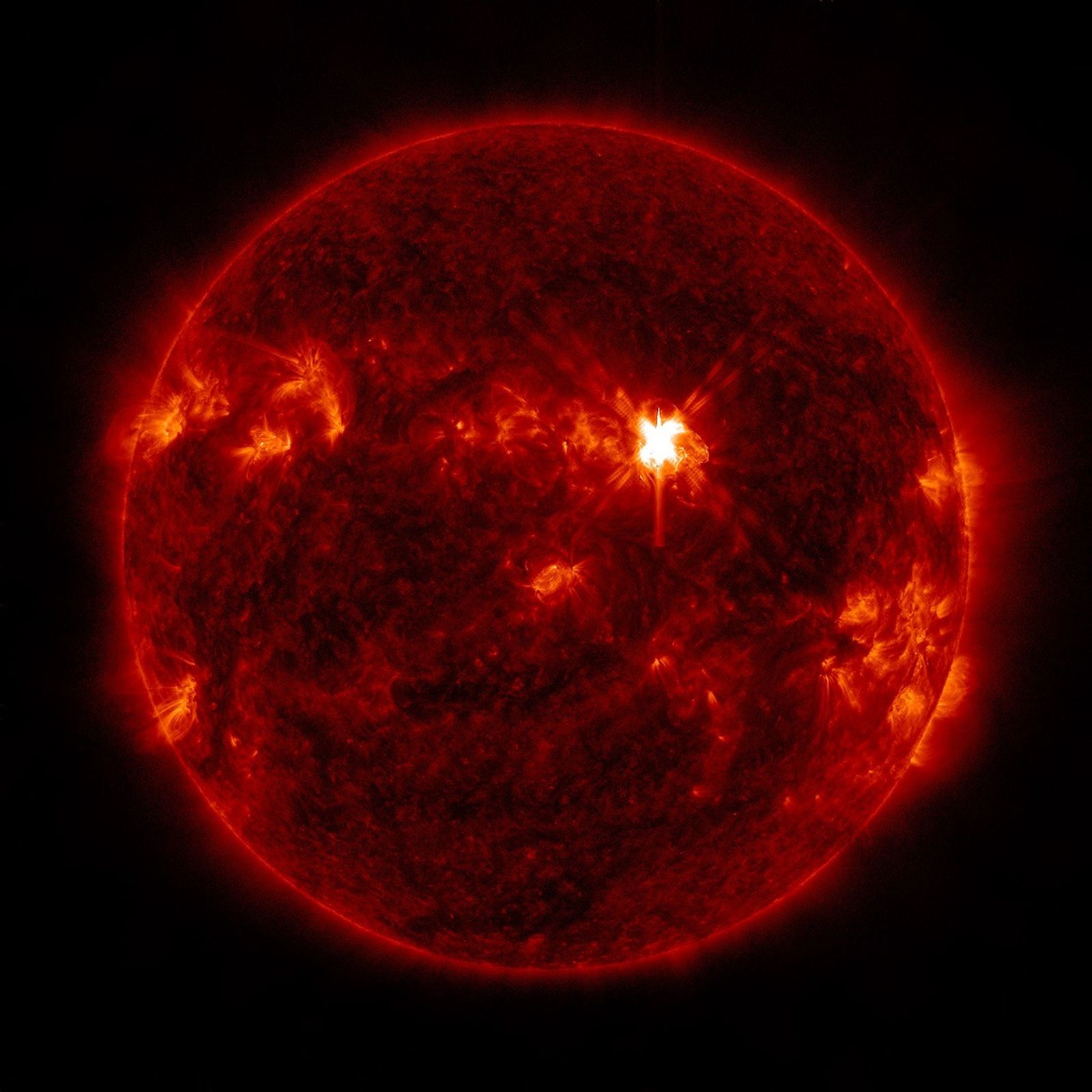
| Earlier solar activity | NASA reported an X1.0 solar flare peaking at 7:28 a.m. ET on June 3, captured by SDO.[2] | Strong; NASA/SDO source, but separate from the June 6 CME watch. |
| Radio-blackout context | NOAA reported R2 radio blackout conditions from an M9.5 flare at 01:36 UTC on June 3 and expected more M-class activity through June 5.[3] | Strong for the June 3 event; not proof of June 8 ground impact. |
| Practical G3 meaning | NOAA says G3 storms can require power-system voltage corrections, affect spacecraft charging or drag, cause intermittent satellite-navigation and low-frequency navigation problems, make HF radio intermittent, and bring aurora as low as roughly Illinois and Oregon in typical cases.[4] | Strong as a scale definition; local impact depends on storm structure and systems exposed. |
What Changed
The June 8 watch turns a solar-observation week into an Earth-impact forecast. NASA's June 3 report described a strong X-class flare, the top class of solar flare by intensity, and noted that flares and solar eruptions can affect radio communications, electric grids, navigation signals, spacecraft, and astronauts.[2] NOAA separately logged R2 radio-blackout conditions from a June 3 M9.5 flare near the center of the solar disk and warned at the time that additional M-class flare activity was likely through June 5.[3]
Those flare notices matter because they show an active Sun, but they do not by themselves equal a geomagnetic storm. Radio blackouts come from electromagnetic radiation that reaches Earth quickly, mostly affecting the sunlit side. Geomagnetic storms come from solar-wind and magnetic-field disturbances, often associated with CMEs, that arrive later and interact with Earth's magnetosphere.[2][4] The June 8-9 watch is therefore about the modeled arrival of material from the June 6 CME, not simply about the brightness of the earlier June 3 flare.
That distinction is the main public-service point. Aurora posts can make the event sound like a scheduled sky show. Operators hear something different: a forecast window in which the external magnetic field may become active enough to disturb vulnerable systems. NOAA's G3 definition includes possible false alarms on some power-protection devices, satellite surface charging and drag effects, intermittent HF radio, and navigation disruption.[4] None of that means a blackout is expected. It means the category is high enough that infrastructure teams should watch measurements, not headlines.
Who Should Care
For most people, the upside is visual. NOAA's short-term aurora product uses the OVATION model to estimate aurora location and intensity 30 to 90 minutes ahead, based on solar-wind travel time from the L1 observation point to Earth.[5] In the United States, that means people in northern and upper-midwestern areas may have a better reason than usual to check real-time aurora maps after dark, though clouds and light pollution can still defeat a technically favorable forecast.
For radio users, aviation planners, satellite operators, and utilities, the more useful habit is to separate the forecast clock from the measured storm. A G3 watch tells teams to prepare for strong conditions; real-time solar-wind speed, density, and the north-south direction of the interplanetary magnetic field decide how hard Earth's magnetosphere is actually coupled to the incoming disturbance. If the field turns strongly southward, the same CME can bite harder. If it arrives weakly coupled or off-schedule, the watch may produce little visible or operational effect.
The communications boundary is also worth keeping clean. A flare can produce radio blackout effects quickly; a CME-driven geomagnetic storm can arrive days later. NASA's June 3 X1.0 flare report is dramatic because it shows the Sun releasing energy earlier in the week. The June 8 watch matters because it asks whether Earth is now crossing the downstream disturbance from a later eruption.[1][2][5]
What To Watch
Next 12 hours: NOAA updates and real-time aurora products matter more than static screenshots. A G3 watch can be upgraded, downgraded, or refined as solar-wind measurements arrive upstream of Earth.[1][4]
Tonight after local dark: aurora watchers should treat the forecast as permission to look, not a promise. The best odds are away from city lights, with a clear northern horizon in the Northern Hemisphere, and with NOAA's short-term aurora forecast or trusted local reports confirming that the oval has expanded.[5]
Tuesday, June 9: the published watch steps down to G2. That still can matter for high-latitude power systems, satellite operations, HF radio at higher latitudes, and aurora visibility farther south than normal, but it is a lower category than Monday's G3 watch.[1][4]
Falsifier: this report's "watch, not guarantee" framing would be wrong if measured conditions already showed sustained strong storming and widespread verified mid-latitude auroras by the time readers act on it. As of the creation timestamp above, the more defensible posture is conditional: monitor official updates, distinguish flare effects from CME effects, and avoid treating a forecast category as a finished outcome.
Sources
- NOAA Space Weather Prediction Center, "G2/G3 Geomagnetic Storm Watches" (published June 6, 2026).
- NASA Science, "Strong Flare Erupts from Sun" (June 3, 2026; background on the earlier X1.0 flare during the active solar week).
- NOAA Space Weather Prediction Center, "R2 Conditions Reached on 03 June" (June 3, 2026).
- NOAA Space Weather Prediction Center, "NOAA Space Weather Scales" (scale definitions for G, S, and R events).
- NOAA Space Weather Prediction Center, "Aurora - 30 Minute Forecast" (OVATION model product and usage notes).
- Wikimedia Commons, "File:Aurora Borealis NO.JPG" - photographic source for the immersive aurora image used in this post-publish QA update.