As of 2026-06-08 16:33 UTC, the useful reading of Friday's International Space Station leak alert is narrow and serious at the same time. NASA did not lose the station. The crew returned to normal operations. But the event showed how little slack remains when a long-running structural problem, a proposed repair action, and crew-escape posture all meet in one morning.[1][2]
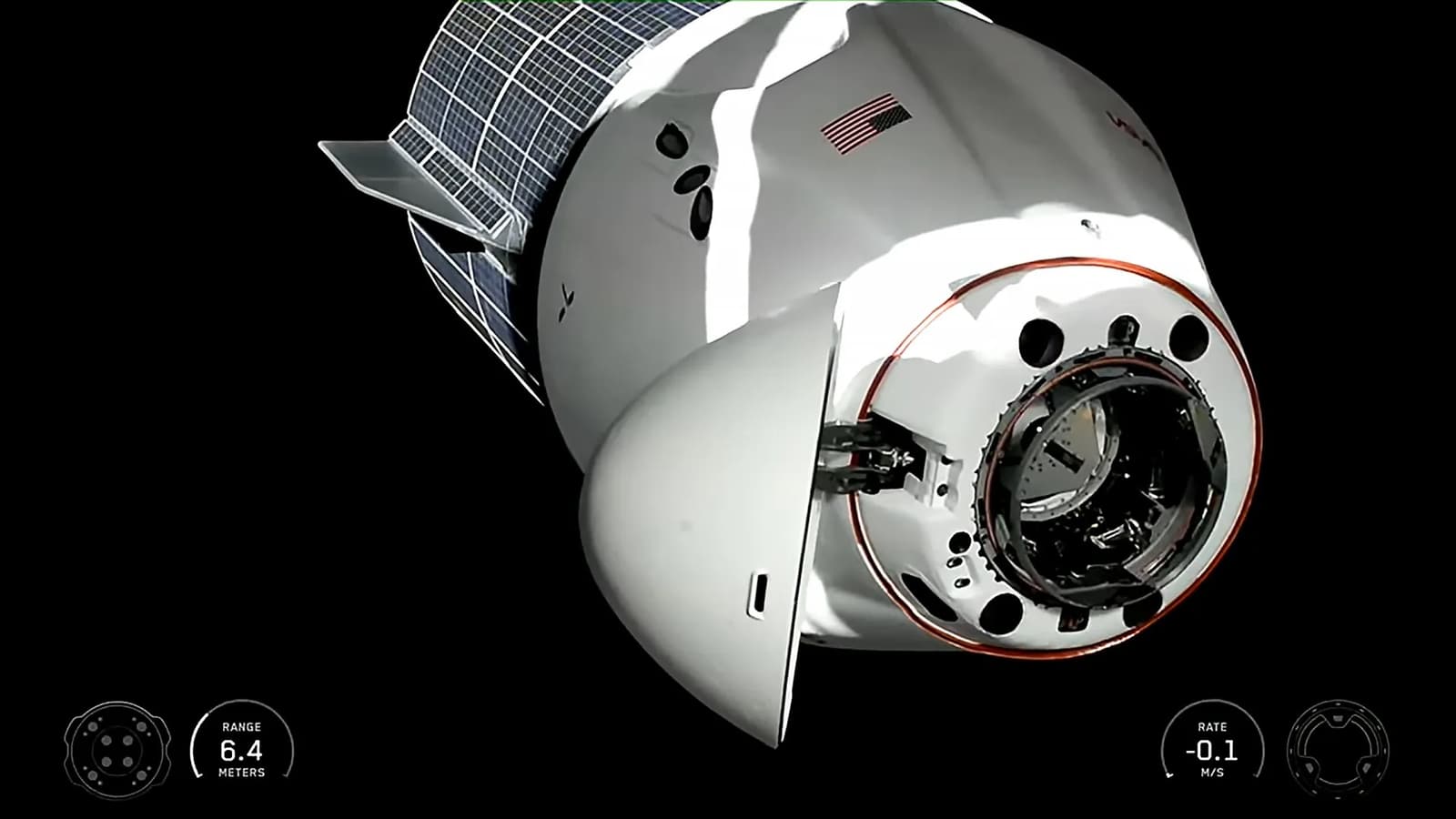
NASA's June 5 update says the issue sits in the PrK transfer tunnel connected with Russia's Zvezda service module, where cracks have produced small atmosphere leaks since 2019. During Progress 95 cargo operations the week of June 1, Roscosmos saw the previous leak rate increase to about two pounds per day and found new suspected leak areas. Roscosmos then considered a more extensive inspection and repair step that involved cutting a bracket to reach a possible leak source. NASA judged that method capable of raising local structural risk, so five astronauts were moved into the docked SpaceX Dragon in a safe-haven posture while the work was assessed.[1]
Fact File
| Item | What is known now | Confidence note |
|---|---|---|
| Immediate trigger | NASA says Roscosmos saw the leak rate rise to about two pounds per day and identified new suspected PrK leak areas during the week of June 1.[1] | Strong; direct NASA station-blog update. |
| Crew action | Five crew members entered the docked Dragon spacecraft as a precaution, then returned to normal station operations after Roscosmos paused the structural repair work.[1][2] | Strong; NASA and AP agree on the basic sequence. |
| Location | Reporting places the persistent leak in the PrK transfer tunnel leading to the Zvezda service module on the Russian segment.[1][3] | Strong; NASA and space-specialist reporting align. |
| Repair boundary | NASA says the bracket-cutting method could have elevated local structural risk; Roscosmos paused the work for more measurements and data review.[1] | Strong for the stated rationale; repair outcome remains unresolved. |
| Larger context | NASA's inspector general has separately examined risks to sustaining ISS operations through 2030 and a controlled deorbit in 2031.[5] | Strong for lifecycle context; the June 5 event is one operational datapoint inside that broader risk file. |
What Actually Changed
The change was not that the station suddenly became unsafe in a general sense. The change was that a known leak problem moved from background management into a crew-protection procedure. AP's account is intentionally spare: NASA temporarily ordered astronauts to shelter during repairs, the five moved into the SpaceX capsule docked to the station, and they came back out after repair work was paused.[2] That is not a dramatic rescue sequence. It is exactly what a cautious system is supposed to do when the risk profile changes faster than managers can fully characterize it.
The revealing detail is the repair method. NASA's public note says the revised Roscosmos approach would have involved cutting a bracket to improve access for inspection. The agency did not say the bracket cut would have caused failure. It said the method could have raised risk to structure in that area, which is a different and more precise concern.[1] In a pressurized orbital module, the distinction matters. Crews can tolerate uncertainty when it is isolated, bounded, and measured. They should not be sitting casually in the same pressure volume while an uncertain structural intervention is underway.
That is why "safe haven" should not be read as public-relations theater. It is the operational middle position between business as usual and emergency departure. Space.com's chronology adds the useful cadence: the Crew-12 astronauts and NASA astronaut Chris Williams moved into Dragon, Roscosmos paused the structural repair effort, and NASA then told the crew to end safe-haven procedures and resume planned station work.[3] The important fact is the reversal. The response was tightened, then loosened, because the underlying action changed.
Why This Is Bigger Than One Leak
The ISS is old by spacecraft standards. Zvezda launched in 2000, and the station has had continuous crews since late that year.[3] A leak in a transfer tunnel does not by itself erase the value of the orbiting laboratory, but it does expose the hardest part of late-life station operations: systems that were once treated as durable infrastructure now have to be managed as aging structure, international dependency, and crew-safety constraint at the same time.
The space-specialist coverage framed the June 5 event as part of a years-long leak problem, not as a brand-new mystery.[3][4] That framing is useful because it points away from panic and toward margin. A slow atmosphere leak can be mitigated with hatches, sealants, monitoring, consumables planning, and procedures. The operational problem gets harder when leak behavior changes, when the suspected leak geography expands, or when a repair action introduces a different structural hazard. Friday's alert bundled all three.
Ars Technica's reporting adds another boundary: the PrK area is typically kept sealed off from the rest of the station to limit the leak's effect on crew living and work areas.[4] That isolation strategy is central to why the issue has been manageable. But isolation is not the same as resolution. If the hatch has to be opened for cargo operations, inspection, or repair, then the station temporarily gives up part of its containment logic. That is when safe-haven posture becomes a rational, concrete control rather than an abstract emergency plan.
Decision Impact
Next 24 hours: the key question is not whether the crew is currently in danger. NASA says they returned to normal operations. The watch item is whether NASA and Roscosmos publish updated measurement results, leak-rate behavior, or a revised repair method after the paused work.[1]
Next 7 days: station planners should be judged on transparency about procedure, not on reassuring adjectives. A useful update would explain which inspections were completed, whether new suspected leak areas were confirmed, and whether the bracket-cutting approach has been replaced, delayed, or modified.[1][4]
Next 30 days: the broader signal is whether the PrK issue starts affecting visiting-vehicle cadence, cargo access, crew handover assumptions, or station configuration rules. The ISS can continue operating with known risks only if those risks remain bounded and operationally predictable.[3][5]
Scenarios
Base case: NASA and Roscosmos keep the leak managed through measurement, sealant work, hatches, and revised repair planning. The June 5 safe-haven order becomes a notable but contained example of conservative crew protection.[1][2]
Upside case: the additional data identifies a repair path that lowers leak rate without raising structural risk. That would restore some operating margin and reduce the chance that future Progress cargo operations or PrK access force similar shelter procedures.[1]
Downside case: the leak rate stays elevated, new leak areas are confirmed, or repair access remains structurally awkward. In that case the PrK file could become less a maintenance nuisance than a standing constraint on station logistics and the runout to ISS retirement.[4][5]
Action Checklist
- Do not overread the brief safe-haven order as proof of imminent evacuation; the crew returned to normal operations after the specific repair action was paused.[1][2]
- Do not underread it either; moving five crew members into Dragon means NASA saw enough procedural risk to remove them from the ordinary station environment.[1][3]
- Watch leak-rate language, not only "crew safe" language. The key operational variable is whether the atmosphere loss and suspected leak sites are stable, shrinking, or expanding.[1][4]
- Track ISS end-of-life decisions through risk margin. The station's value remains high, but through-2030 operation depends on keeping transportation, structure, repair access, and controlled deorbit planning aligned.[5]
Sources
- NASA, "NASA Provides Update on Space Station Leak" (June 5, 2026).
- Associated Press, "Astronauts briefly take shelter during repair to fix leak on the International Space Station" (June 5, 2026).
- Mike Wall, Space.com, "Astronauts on International Space Station take shelter in SpaceX Dragon as cosmonauts try to fix air leak" (June 5, 2026).
- Stephen Clark, Ars Technica, "The saga of the International Space Station air leak took a worrying turn Friday" (June 5, 2026).
- NASA Office of Inspector General, "NASA's Management of Risks to Sustaining ISS Operations through 2030" (IG-24-020, Sept. 26, 2024).
- NASA Image and Video Library, "View of the nadir side of the ISS taken during the first EVA of Expedition Three" (Oct. 8, 2001; image ID iss003-301-023).