As of 2026-06-08 08:32 UTC, NASA's MAVEN mission is no longer a recovery problem. It is a decommissioning and archive problem. On June 3, 2026, the agency said the Mars Atmosphere and Volatile EvolutioN spacecraft was not recoverable after a loss of signal that began when MAVEN passed behind Mars on Dec. 6, 2025.[1] A NASA anomaly review board found the spacecraft was probably in safe mode and rotating unusually fast after that occultation, draining its batteries and leaving the communications system without power.[1]
That is a hard operational ending, but it is not a clean scientific ending. MAVEN was built for a one-year primary science mission and instead spent more than 11 years in Mars orbit, producing more than 800 science publications and serving as part of the Mars Relay Network for surface missions.[1] The news is therefore not simply that an old orbiter died. The more useful reading is that Mars just lost a working upper-atmosphere sensor and relay participant, while planetary science gained a mature dataset that will keep shaping arguments about why Mars stopped being a wetter, thicker-atmosphere world.[1][3][4][5]
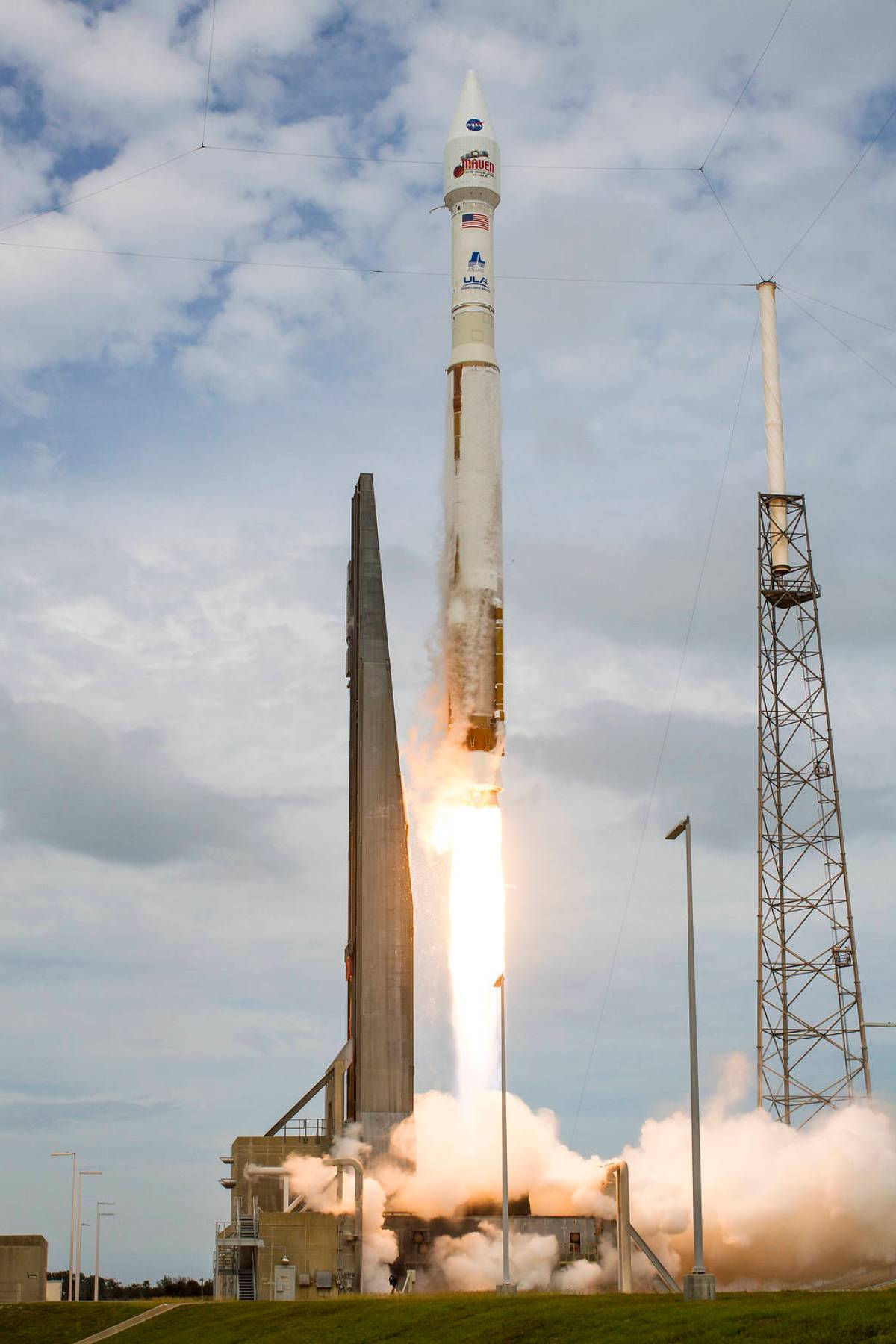
Image context: the cover uses NASA's real 2013 launch photograph of the Atlas V carrying MAVEN. The current story is an ending, but the photograph keeps the article tied to a physical mission rather than an artist rendering: a spacecraft launched from Florida, operated at Mars for over a decade, and is now being formally closed out.[7]
Fact file
| Item | What is confirmed now | Confidence note |
|---|---|---|
| Mission status | NASA has begun the official decommissioning process for MAVEN.[1] | High; direct NASA release. |
| Last contact | NASA says MAVEN was last heard from on Dec. 6, 2025, after passing behind Mars.[1] | High; direct NASA release. |
| Probable spacecraft state | A brief telemetry fragment indicated safe mode and unusually high rotation; NASA says battery drain likely left the spacecraft unrecoverable.[1] | High for current review-board conclusion; root cause remains unresolved. |
| Open uncertainty | NASA says preliminary findings do not yet identify a root cause, and a final report is expected later in 2026.[1] | Explicitly uncertain; do not treat the failure mechanism as final. |
| Science record | MAVEN completed over 11 years of observations and generated more than 800 publications.[1] | High; direct NASA release. |
| Relay impact | MAVEN helped relay rover data, while other Mars orbiters are expected to absorb relay work; AP reported NASA officials said no rover science would be lost.[2][6] | Medium-high; relay load can shift, but future scheduling effects may emerge. |
Why the mission ending matters
MAVEN's live value was unusually specific. It did not carry the public romance of a rover drilling rock or a lander touching down under parachutes. Its central job was to watch the upper atmosphere, ionosphere, solar wind, and solar storms as one coupled system.[1] That made it a mission about loss: how a planet that preserves dry riverbeds and water-shaped minerals came to have an atmosphere too thin and cold to support long-lived surface water today.[3][4]
The result is not one headline. In 2015, MAVEN data showed that the solar wind was stripping gas from Mars at about 100 grams per second, with loss increasing significantly during solar storms.[3] In 2017, MAVEN-based argon measurements supported the larger claim that most of the gas once present in the Martian atmosphere had been lost to space, with solar wind and radiation doing enough work to help transform the planet's climate over time.[4] In 2025, the mission reported the first direct observation of atmospheric sputtering at Mars, mapping argon at high altitudes where energetic particles crashed into the atmosphere and knocked material outward.[5]
That sequence is why the shutdown is not just a sentimental goodbye. MAVEN turned atmospheric escape from a broad historical suspicion into a measured process that could be tied to solar storms, ion escape, argon isotopes, and real-time sputtering.[3][4][5] The spacecraft is gone, but the empirical ladder it built remains.
The relay consequence is narrower, but practical
The more immediate operations question is not whether Curiosity and Perseverance suddenly go silent. They do not. The Mars Relay Network exists because orbiters with larger antennas, solar power, and regular Earth contact can move far more surface data than rover-to-Earth links alone.[6] NASA's relay explainer says every image from the Martian surface since 2004 has gone through the network, and that rovers otherwise face line-of-sight gaps for about 12 hours per sol because Mars rotates.[6]
MAVEN was part of that network, and NASA's own farewell release calls it an instrumental player in rover data relay.[1] AP's June 3 report adds a useful operational boundary: NASA officials said four other spacecraft around Mars would pick up the slack, with no rover science lost.[2] That is the right near-term interpretation. The loss is not a rover emergency. It is a reduction in margin inside an interplanetary communications system that already depends on orbital geometry, antenna time, spacecraft health, and ground-network scheduling.[2][6]
This distinction matters because "no science lost" is not the same as "no capacity value lost." MAVEN had become part of the background machinery that makes Mars operations look routine. When one relay participant disappears, the remaining network can compensate, but the system has less redundancy than it had before.[1][2][6]
What to watch now
The first watch item is NASA's final anomaly report. The agency has said plainly that the preliminary review does not yet explain the root cause.[1] Until that report lands, the responsible wording is narrow: MAVEN is unrecoverable; the fast-rotation and battery-drain pathway is the current state assessment; the initiating failure remains under investigation.[1]
The second watch item is archive quality. NASA says it is following standard procedures to archive the full mission dataset for the science and exploration communities.[1] That sounds administrative, but it is the next scientific handoff. MAVEN's long run matters only if future researchers can keep joining its solar-wind, ion, neutral-gas, ultraviolet, and relay-context records to other Mars datasets without losing calibration history or mission context.
The third watch item is relay performance under ordinary rover workloads. If Curiosity and Perseverance continue returning data smoothly, MAVEN's relay loss will stay a capacity-management issue rather than a visible mission constraint.[2][6] If downlink pressure or scheduling conflicts become more visible, the decommissioning will look less like a graceful retirement and more like a warning about how thin Mars infrastructure still is.
The balanced conclusion is this: MAVEN's death closes an active spacecraft file, not the Mars-atmosphere question. Its data are now part of the evidence base for why Mars changed, how solar activity shapes habitability, and what kinds of communications redundancy future Mars operations will need.[1][3][4][5][6]
Sources
- NASA, "NASA Says Farewell to MAVEN Mars Mission, Hosts Media Call Today" (June 3, 2026).
- Associated Press, "NASA's Mars Maven spacecraft is declared dead" (June 3, 2026).
- NASA, "NASA Mission Reveals Speed of Solar Wind Stripping Martian Atmosphere" (Nov. 5, 2015).
- NASA, "NASA's MAVEN Reveals Most of Mars' Atmosphere Was Lost to Space" (March 30, 2017).
- NASA Science, "NASA's MAVEN Makes First Observation of Atmospheric Sputtering at Mars" (May 28, 2025).
- NASA Science, "Mars Relay Network" (accessed June 8, 2026).
- NASA, "MAVEN Atlas V Launch" (image article, May 31, 2022).