As of November 11, 2026, 19:34 UTC.
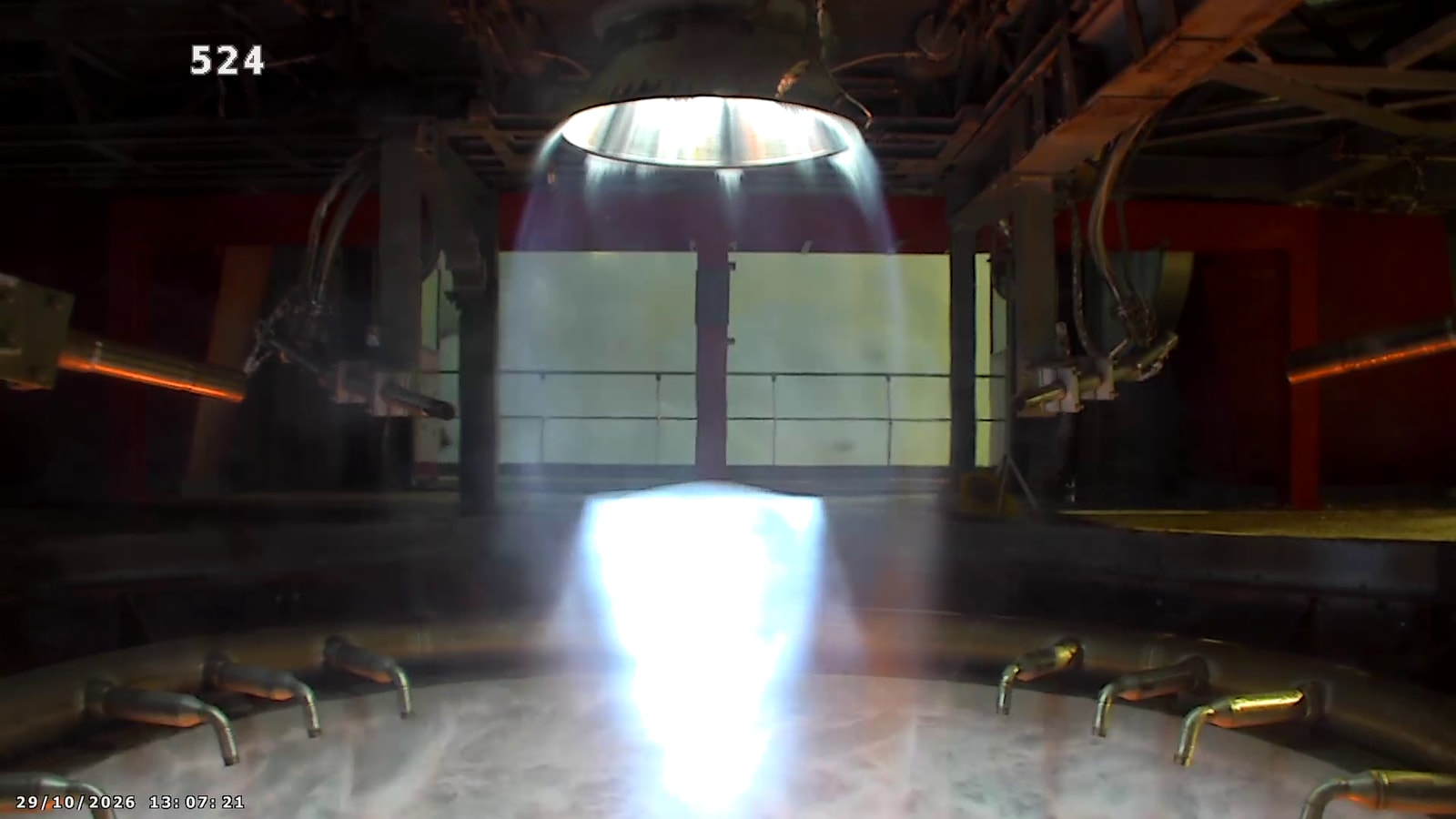
Prometheus has fired, stopped and fired again at Germany’s Lampoldshausen propulsion centre, testing both a reusable rocket engine and the infrastructure needed to put it through repeated starts. The October 29 campaign, reported by the European Space Agency on November 6, used liquid methane and oxygen at the upgraded P5 test stand. It also tested a combustion chamber made using a new additive manufacturing process.[1]
For a rocket intended to return and land, starting once is only part of the job. Engineers need to understand what happens when an engine changes thrust, shuts down and starts again. DLR, which operates the ESA-owned facility, says the campaign achieved repeated ignitions and stable operating phases within one continuous test sequence.[2]
What changed in the restart
Prometheus had already demonstrated repeated ignition. On June 20, 2025, an earlier campaign at ArianeGroup’s Vernon site in France achieved four consecutive starts. ESA’s account of those trials described work on engine hardware, different thrust profiles and the test bench’s ability to support multiple firings.[4]
That earlier result puts the latest announcement in perspective. A reusable engine develops through successive campaigns; the familiar spectacle of flame can conceal a different engineering question each time.
At Lampoldshausen, ESA says Prometheus restarted using pressure at the engine inlets, dispensing with a high-pressure starter system. ArianeGroup describes this as a European first for a gas-generator-cycle engine in the 100-tonne thrust class. That qualification matters: the claim concerns a particular starting method and engine class, rather than the invention of rocket-engine reignition.[1][3]
The public accounts establish a successful ground demonstration. They do not provide a complete performance record from which an outside reader could calculate service life or the cost of flying the engine repeatedly.
The machinery behind the flame
P5’s conversion has a substantial physical history. In August 2021, DLR documented the installation of a methane tank holding approximately 208 cubic metres. The tank stood 20 metres high beside a facility whose 65-metre test building had served propulsion development since 1990. The expansion added methane capability to infrastructure long associated with the hydrogen-burning Vulcain engines.[5]
The same 2021 announcement planned for the facility to switch between oxygen–hydrogen and oxygen–methane combinations. ESA now reports that the upgraded stand retains that flexibility.[1][5] The industrial significance is straightforward: investment in a new fuel system can extend an existing test site's usefulness across engine programmes.
Preparing for the next start involves work beyond the engine itself. DLR describes shutting down, draining and purging the supply systems, then restoring the required pressures and temperatures. Instruments record thrust, propellant flow and temperatures so engineers can examine both the engine and the facility supporting it.[2]
Those operations help explain why a test stand can be part of the news. A team studying repeated operation needs a controlled, reproducible sequence. Otherwise, a problem in the supporting equipment can complicate the interpretation of an engine’s behaviour.
A chamber built to test another manufacturing route
The campaign also brought a component made through cold gas spray into the firing sequence. ArianeGroup describes metal powder propelled at high speed onto a component, where it bonds to the surface. The combustion chamber was the programme’s first tested chamber made using this process.[3]
This is a manufacturing development with an economic ambition. ArianeGroup says additive techniques can shorten production cycles, simplify complex parts and lower production costs. Its announcement supplies no measured savings for this chamber. Successful firing therefore supports the case for further development; it does not yet give customers a verified price reduction.[3]
That distinction also applies to reuse. An engine may have the starting and thrust-control capabilities a returning stage requires while still needing further work to establish how it performs across repeated flights. DLR describes varying thrust and the transitions between operating levels as subjects for investigation at P5.[2]
What the next announcement needs to show
The next named step is an improved engine, Mark 2, with testing planned at ArianeGroup’s Vernon centre. The announcement gives no start date.[3]
The base case is continued development through that campaign. An upside would be published results showing that the revised design sustains repeated operation alongside demonstrable manufacturing gains. A downside would be component damage or unstable operation requiring redesign. These are conditional paths to watch, not outcomes reported from October’s tests.
For readers following the programme, the useful checks are:
- Over the next 24 hours: preserve the distinction between the October test date and November publication date when comparing coverage.
- Over the next week: look for disclosed burn durations and operating conditions before treating repeated headlines as additional test results.
- Over the next month: watch for a dated Mark 2 campaign update; revise the expected sequence if ArianeGroup or ESA changes the plan.
The present finding is a successful engine-and-facility test. Evidence of damage would qualify its durability implications; a revised programme announcement would change the next-step expectation. Demonstrated flight reuse and measured production savings will require their own evidence.
Sources
- European Space Agency, “Prometheus reusable rocket engine fires up at improved test bench,” November 6, 2026—October test date, inlet-pressure starting and methane-capable P5.
- German Aerospace Center (DLR), “Prometheus® test marks significant milestone for reusable rocket engines,” November 6, 2026—operating sequences, supply-system preparation, measurements and thrust control.
- ArianeGroup, “Prometheus® reusable rocket engine reaches new development milestone with hot-fire test on DLR’s P5 test bench,” November 6, 2026—scope of the starting claim, cold gas spray and the planned Mark 2 campaign.
- European Space Agency, “Prometheus fires up once again (and again),” July 2, 2025—the earlier four-ignition campaign at Vernon.
- German Aerospace Center (DLR), “DLR Lampoldshausen prepares P5 test stand for the technologies of the future,” August 31, 2021—methane-tank installation, facility history and planned fuel flexibility.
- European Space Agency, “First Prometheus hot-fire with newly-produced combustion chamber,” November 6, 2026—test-camera image, event identification and ArianeGroup/ESA/DLR credit.